
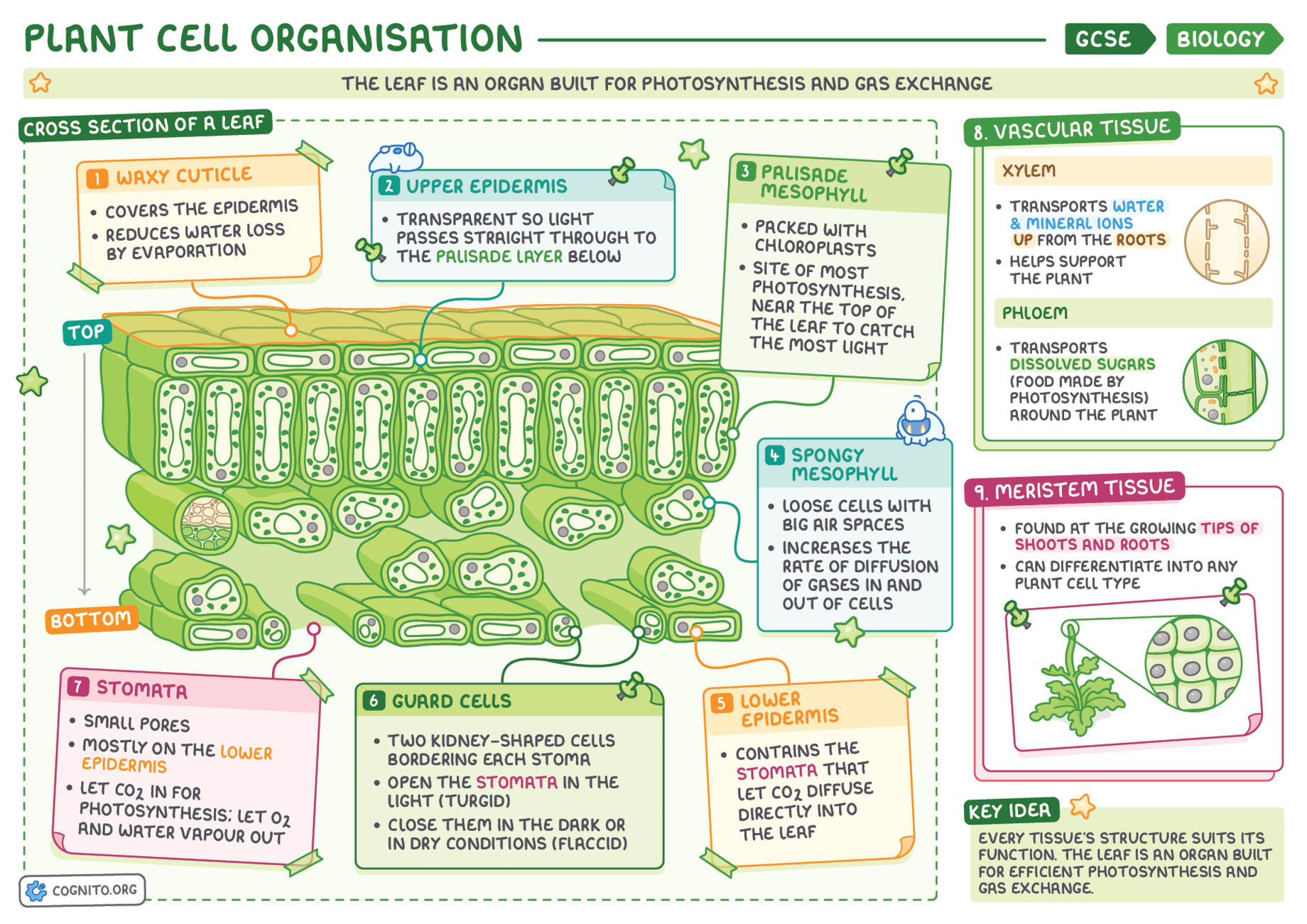
on this cheat sheet
Everything on the GCSE Biology Plant Cell Organisation poster is written out below, section by section. Use it to search the sheet, copy parts into your own notes, or check a fact quickly.
Cross section of a leaf
The leaf is an organ built for photosynthesis and gas exchange.
Waxy cuticle
- Covers the epidermis.
- Reduces water loss by evaporation.
Upper epidermis
- Transparent so light passes straight through to the palisade layer below.
Palisade mesophyll
- Packed with chloroplasts.
- Site of most photosynthesis, near the top of the leaf to catch the most light.
Spongy mesophyll
- Loose cells with big air spaces.
- Increases the rate of diffusion of gases in and out of cells.
Lower epidermis
- Contains the stomata that let CO₂ diffuse directly into the leaf.
Stomata
- Small pores, mostly on the lower epidermis.
- Let CO₂ in for photosynthesis; let O₂ and water vapour out.
Guard cells
- Two kidney-shaped cells bordering each stoma.
- Open the stoma in the light (turgid).
- Close them in the dark or in dry conditions (flaccid).
Vascular tissue
Xylem - transports water and mineral ions up from the roots; helps support the plant.
Phloem - transports dissolved sugars (food made by photosynthesis) around the plant.
Meristem tissue
- Found at the growing tips of shoots and roots.
- Can differentiate into any plant cell type.
Key idea
Every tissue's structure suits its function. The leaf is an organ built for efficient photosynthesis and gas exchange.