
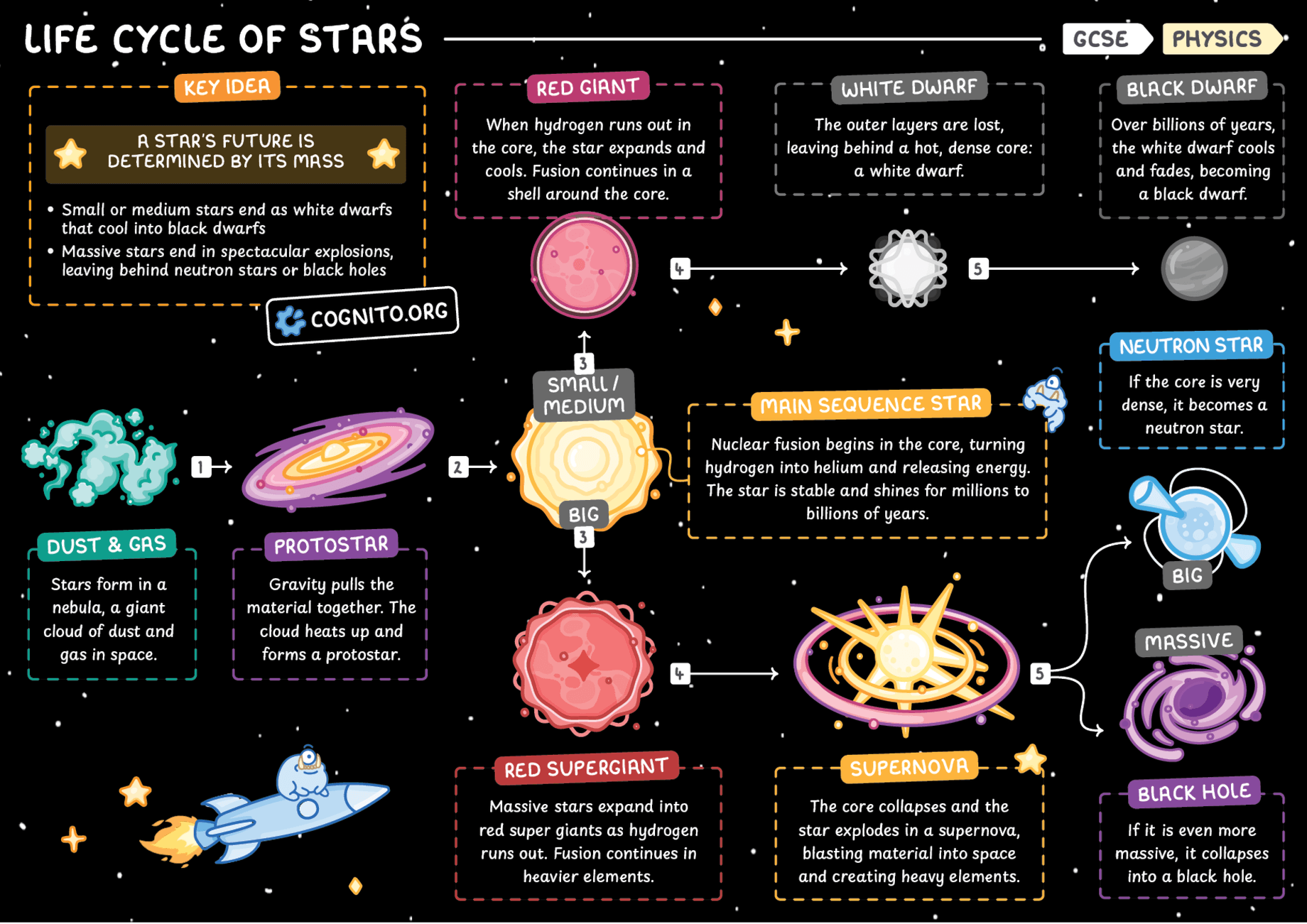
Everything on the GCSE Physics The Solar System, Stars & the Expanding Universe poster is written out below, section by section. Use it to search the sheet, copy parts into your own notes, or check a fact quickly.
Key idea
A star's future is determined by its mass.
- Small or medium stars end as white dwarfs that cool into black dwarfs.
- Massive stars end in spectacular explosions, leaving behind neutron stars or black holes.
Dust and gas
Stars form in a nebula - a giant cloud of dust and gas in space.
Protostar
Gravity pulls the material in a nebula together. The cloud heats up and forms a protostar.
Main sequence star
Nuclear fusion begins in the core, turning hydrogen into helium and releasing energy. The star is stable and shines for millions to billions of years.
Red giant (small/medium stars)
When hydrogen runs out in the core, the star expands and cools. Fusion continues in a shell around the core, forming a red giant.
White dwarf
The outer layers are lost, leaving behind a hot, dense core: a white dwarf.
Black dwarf
Over billions of years, the white dwarf cools and fades, becoming a black dwarf.
Red supergiant (massive stars)
Massive stars expand into red supergiants as hydrogen runs out. Fusion continues in heavier elements.
Supernova
The core collapses and the star explodes in a supernova, blasting material into space and creating heavy elements.
Neutron star
If the core left behind is very dense, it becomes a neutron star.
Black hole
If the core is even more massive, it collapses into a black hole.