
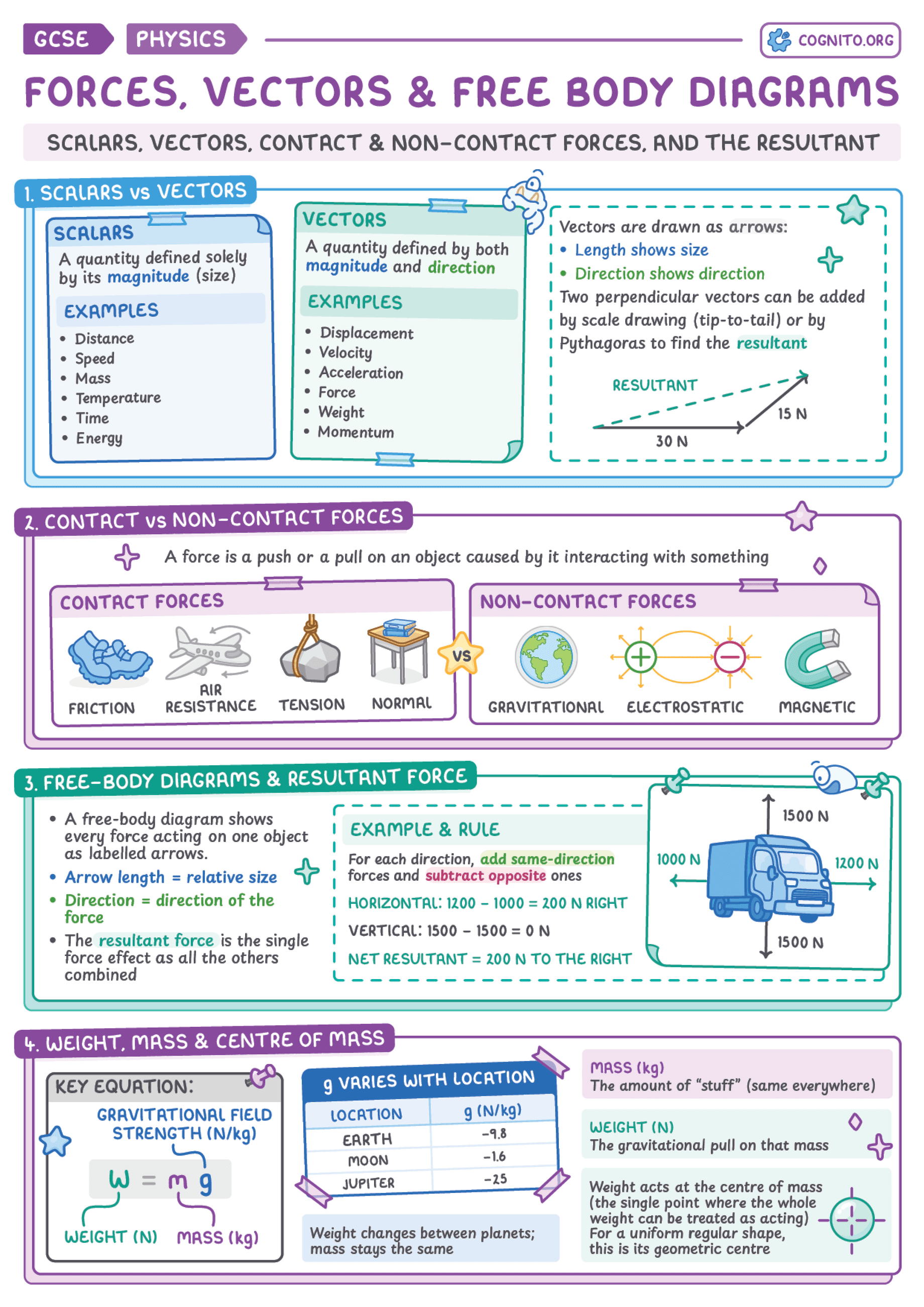
Everything on the GCSE Physics Forces, Vectors & Free-body Diagrams poster is written out below, section by section. Use it to search the sheet, copy parts into your own notes, or check a fact quickly.
Scalars vs vectors
A scalar is a quantity defined solely by its magnitude (size). Examples include distance, speed, mass, temperature, time, and energy.
A vector is a quantity defined by both its magnitude and direction. Examples include displacement, velocity, acceleration, force, weight, and momentum.
Vectors are drawn as arrows: the length shows size and the direction shows direction. Two perpendicular vectors can be added by scale drawing (tip-to-tail) or by using Pythagoras to find the resultant. For example, a 10 N force and a 15 N force at right angles combine to give a resultant of approximately 18 N.
Contact vs non-contact forces
A force is a push or a pull on an object caused by it interacting with something.
Contact forces require physical contact between objects:
- Friction
- Air resistance
- Tension
- Normal (reaction force)
Non-contact forces act at a distance:
- Gravitational
- Electrostatic
- Magnetic
Free-body diagrams and resultant force
A free-body diagram shows every force acting on one object as labelled arrows. Arrow length represents the relative size of the force and the direction of the arrow shows the direction of the force.
The resultant force is the single force that has the same effect as all the individual forces combined.
To find the resultant:
- Horizontal: add same-direction forces and subtract opposite ones. Example: 1200 - 1000 = 200 N to the right.
- Vertical: 1500 - 1500 = 0 N.
- Net resultant = 200 N to the right.
Weight, mass and centre of mass
Key equation: W = m g
- W = weight (N)
- m = mass (kg)
- g = gravitational field strength (N/kg)
Mass is the amount of "stuff" in an object - it is the same everywhere.
Weight is the gravitational pull on that mass. Weight acts at the centre of mass - the single point where the whole weight can be treated as acting. For a uniform regular shape, this is its geometric centre.
The value of g varies with location:
| Location | g (N/kg) |
|---|---|
| Earth | 9.8 |
| Moon | 1.6 |
| Jupiter | 25 |
Weight changes between planets; mass stays the same.