
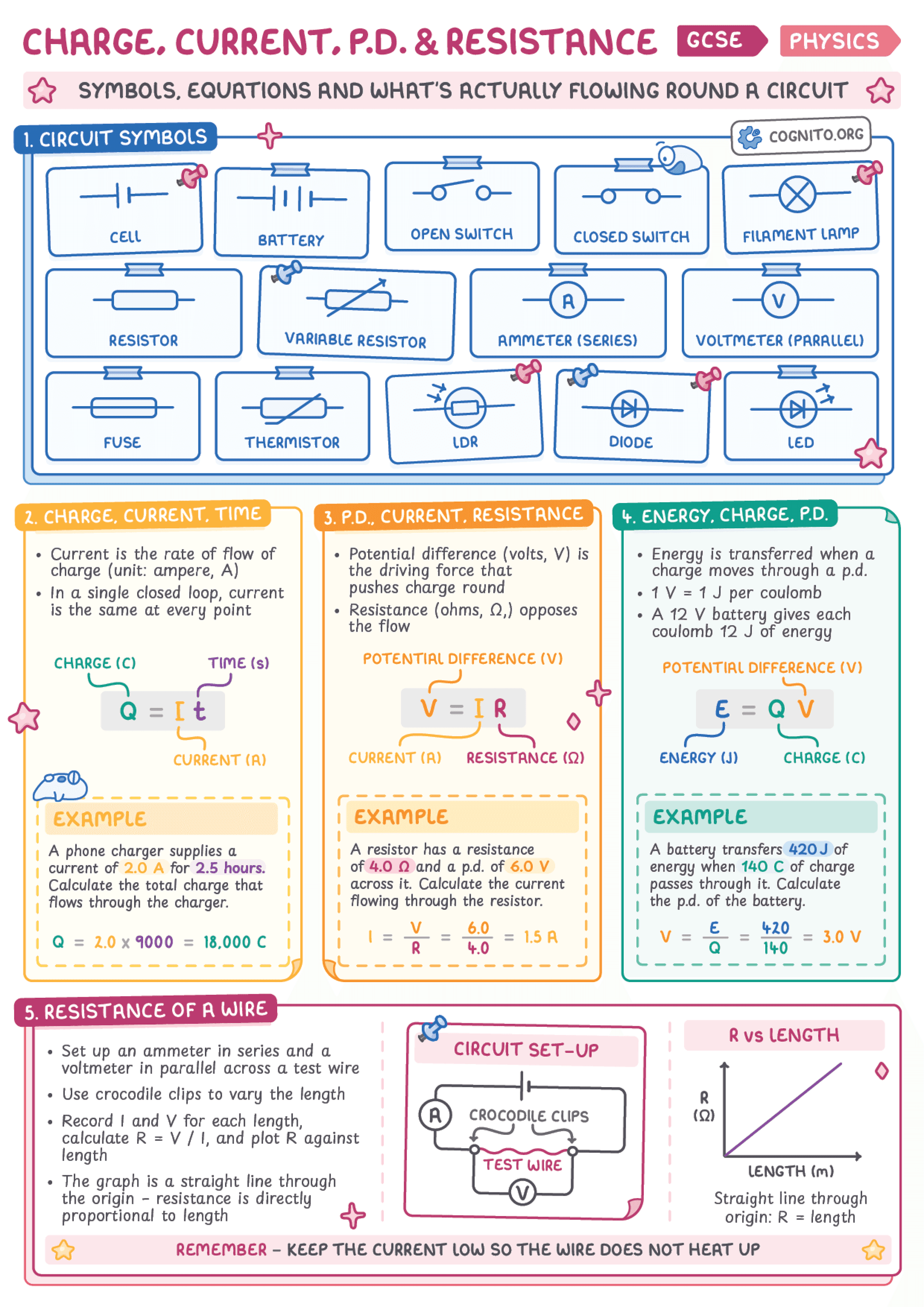
Everything on the GCSE Physics Charge, Current, p.d. & Resistance poster is written out below, section by section. Use it to search the sheet, copy parts into your own notes, or check a fact quickly.
Circuit symbols
- Cell - a single source of electrical energy (one long and one short line).
- Battery - two or more cells in series.
- Open switch - breaks the circuit; current cannot flow.
- Closed switch - completes the circuit; current can flow.
- Filament lamp - converts electrical energy to light and heat.
- Resistor - a fixed component that opposes current.
- Variable resistor - resistance can be adjusted.
- Ammeter (series) - measures current; connected in series.
- Voltmeter (parallel) - measures potential difference; connected in parallel.
- Fuse - melts and breaks the circuit if current is too high.
- Thermistor - resistance decreases as temperature increases.
- LDR (light-dependent resistor) - resistance decreases as light intensity increases.
- Diode - allows current to flow in one direction only.
- LED (light-emitting diode) - emits light when current flows through it.
Charge, current, time
Current is the rate of flow of charge (unit: ampere, A). In a single closed loop, current is the same at every point.
Q = I t - charge (C) = current (A) × time (s)
Example: A phone charger supplies a current of 2.0 A for 2.5 hours. Total charge = 2.0 × 9000 = 18,000 C.
P.D., current, resistance
Potential difference (volts, V) is the driving force that pushes charge round a circuit. Resistance (ohms, Ω) opposes the flow of current.
V = I R - potential difference (V) = current (A) × resistance (Ω)
Example: A resistor has a resistance of 4.0 Ω and a p.d. of 6.0 V across it. Current = V ÷ R = 6.0 ÷ 4.0 = 1.5 A.
Energy, charge, P.D.
Energy is transferred when a charge moves through a p.d. 1 V = 1 J per coulomb.
E = Q V - energy (J) = charge (C) × potential difference (V)
Example: A battery transfers 420 J of energy when 140 C of charge passes through it. P.d. = E ÷ Q = 420 ÷ 140 = 3.0 V.
Resistance of a wire
This experiment investigates how the resistance of a wire varies with its length.
- Set up an ammeter in series and a voltmeter in parallel across a test wire.
- Use crocodile clips to vary the length of wire being tested.
- Record current (I) and voltage (V) for each length, then calculate R = V ÷ I and plot R against length.
- The graph is a straight line through the origin, showing that resistance is directly proportional to length.
Circuit set-up: battery, ammeter (A) in series, crocodile clips onto the test wire, voltmeter (V) in parallel across the wire.
R vs length graph: straight line through the origin - R = length.
Remember - keep the current low so the wire does not heat up.