
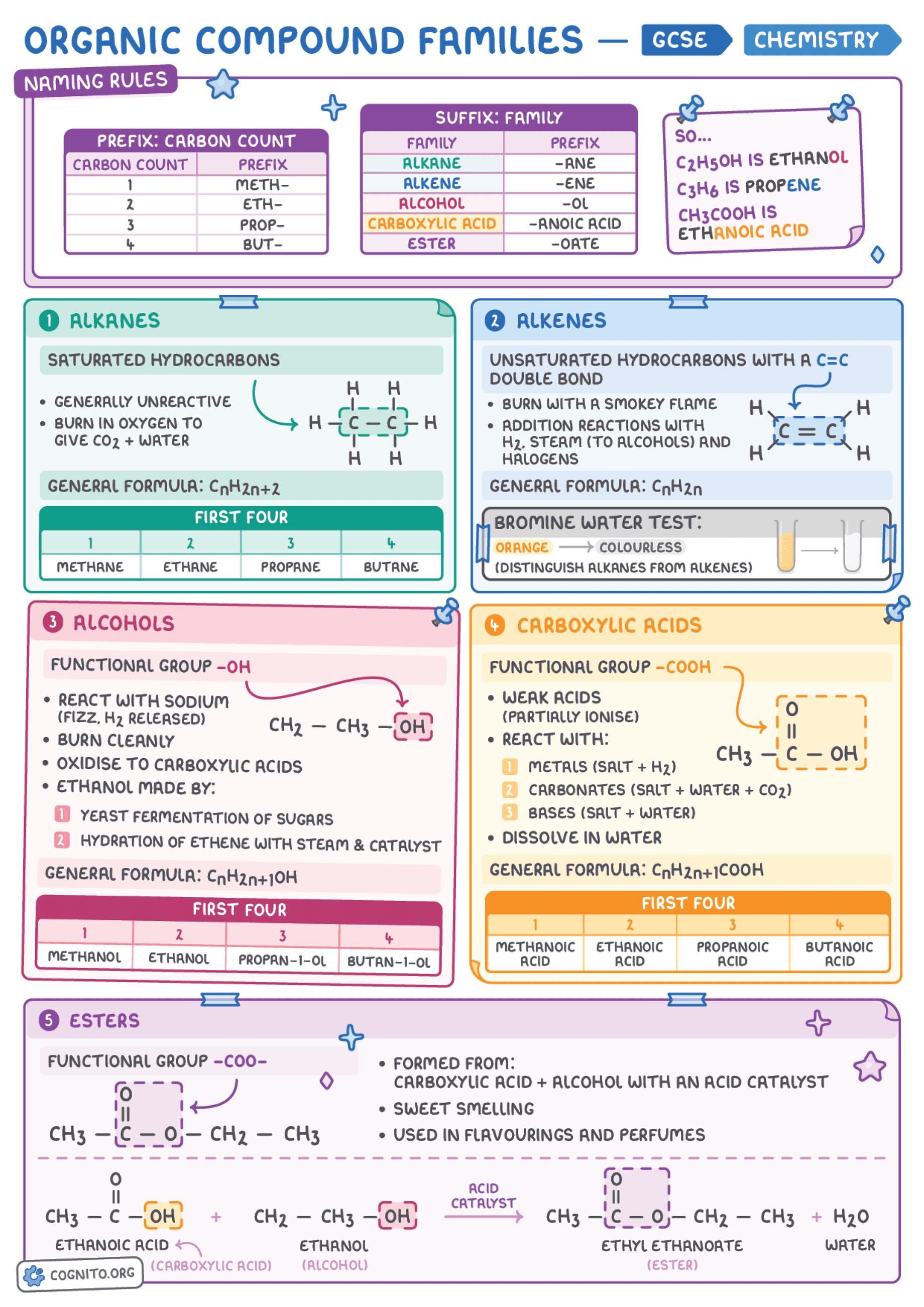
Everything on the GCSE Chemistry Organic Compound Families poster is written out below, section by section. Use it to search the sheet, copy parts into your own notes, or check a fact quickly.
Naming rules
The name of an organic compound has two parts: a prefix based on carbon count and a suffix based on the family.
| Carbon count | Prefix |
|---|---|
| 1 | meth- |
| 2 | eth- |
| 3 | prop- |
| 4 | but- |
| Family | Suffix |
|---|---|
| Alkane | -ane |
| Alkene | -ene |
| Alcohol | -ol |
| Carboxylic acid | -anoic acid |
| Ester | -oate |
Examples: C₂H₅OH is ethanol - C₃H₆ is propene - CH₃COOH is ethanoic acid.
Alkanes
Alkanes are saturated hydrocarbons - they contain only C-C single bonds.
- Generally unreactive.
- Burn in oxygen to give CO₂ and water.
General formula: CₙH₂ₙ₊₂
First four members: methane, ethane, propane, butane.
Alkenes
Alkenes are unsaturated hydrocarbons with a C=C double bond.
- Burn with a smoky flame.
- Undergo addition reactions with H₂, steam (to form alcohols), and halogens.
General formula: CₙH₂ₙ
Bromine water test: alkenes decolourise orange bromine water; alkanes do not. This distinguishes alkenes from alkanes.
Alcohols
Functional group: -OH
- React with sodium (fizzing - H₂ is released).
- Burn cleanly.
- Oxidise to carboxylic acids.
- Ethanol is made by: yeast fermentation of sugars, or hydration of ethene with steam and a catalyst.
General formula: CₙH₂ₙ₊₁OH
First four members: methanol, ethanol, propan-1-ol, butan-1-ol.
Carboxylic acids
Functional group: -COOH
- Weak acids (partially ionise).
- React with: metals (salt + H₂), carbonates (salt + water + CO₂), and bases (salt + water).
- Dissolve in water.
General formula: CₙH₂ₙ₊₁COOH
First four members: methanoic acid, ethanoic acid, propanoic acid, butanoic acid.
Esters
Functional group: -COO-
- Formed from a carboxylic acid and an alcohol with an acid catalyst.
- Sweet smelling.
- Used in flavourings and perfumes.
Formation reaction: ethanoic acid + ethanol → ethyl ethanoate + water (with acid catalyst).