
on this cheat sheet
Everything on the GCSE Biology Transport in Cells poster is written out below, section by section. Use it to search the sheet, copy parts into your own notes, or check a fact quickly.
Three ways substances move into and out of cells
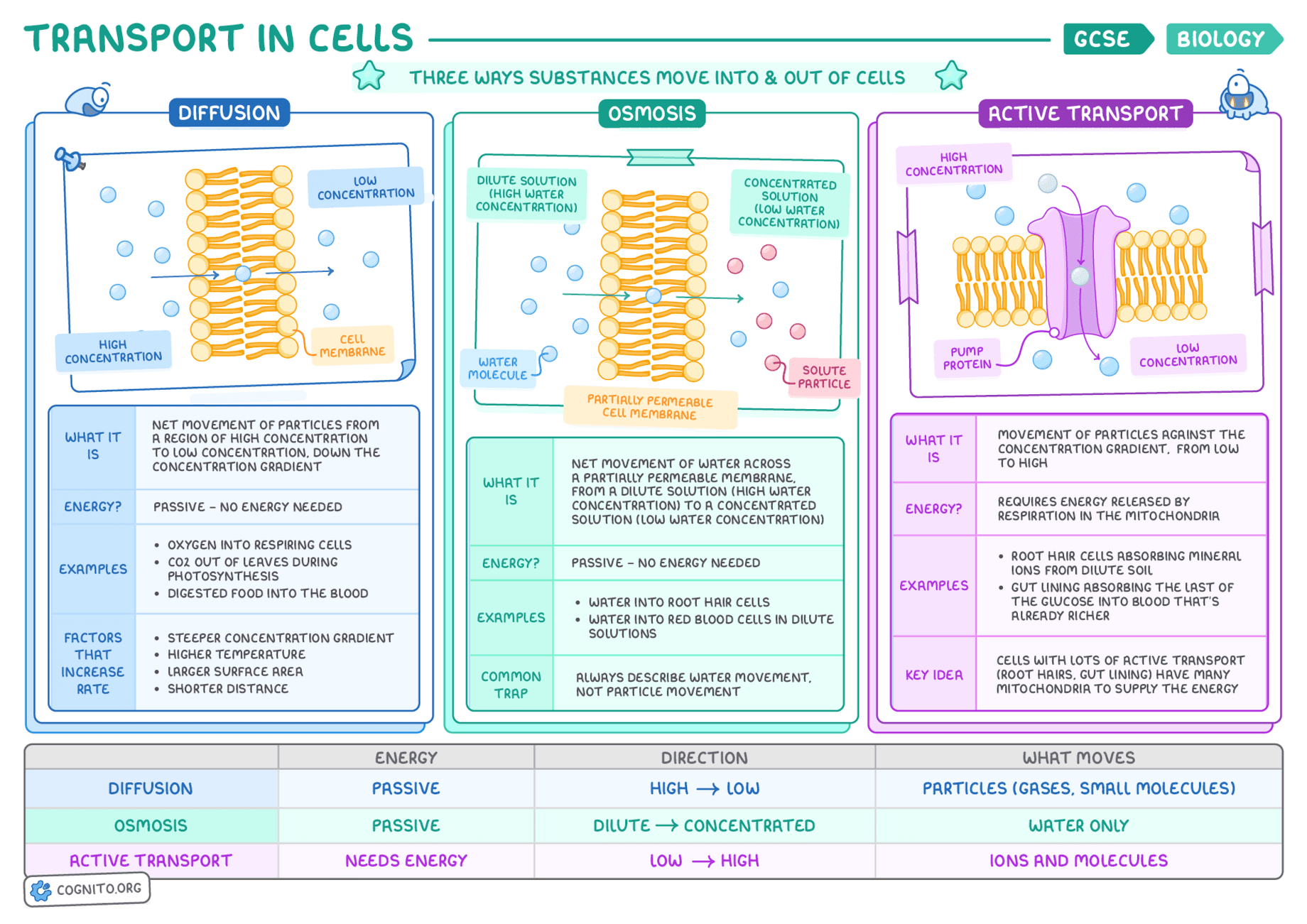
Substances cross cell membranes by three processes: diffusion, osmosis, and active transport.
Diffusion
Diffusion is the net movement of particles from a region of high concentration to a region of low concentration - down the concentration gradient.
- Energy: passive - no energy needed.
- Examples: oxygen into respiring cells; CO₂ out of leaves during photosynthesis; digested food into the blood.
- Factors that increase the rate: steeper concentration gradient, higher temperature, larger surface area, shorter distance.
Osmosis
Osmosis is the net movement of water across a partially permeable membrane, from a dilute solution (high water concentration) to a concentrated solution (low water concentration).
- Energy: passive - no energy needed.
- Examples: water into root hair cells; water into red blood cells in dilute solutions.
- Common trap: always describe osmosis as the movement of water molecules, not particle movement in general.
Active transport
Active transport is the movement of particles against the concentration gradient - from low concentration to high concentration.
- Energy: requires energy released by respiration in the mitochondria.
- Examples: root hair cells absorbing mineral ions from dilute soil; gut lining absorbing the last of the glucose into blood that already has a higher concentration.
- Key idea: cells with lots of active transport (root hairs, gut lining) have many mitochondria to supply the energy needed.
Comparison table
| Energy | Direction | What moves | |
|---|---|---|---|
| Diffusion | Passive | High → low | Particles (gases, small molecules) |
| Osmosis | Passive | Dilute → concentrated | Water only |
| Active transport | Needs energy | Low → high | Ions and molecules |