12.2 - Electromagnetic Waves
- 1
Properties of electromagnetic waves
- 2
The order of the electromagnetic spectrum
- 3
Applications of each part of the electromagnetic spectrum
Characteristics of electromagnetic waves
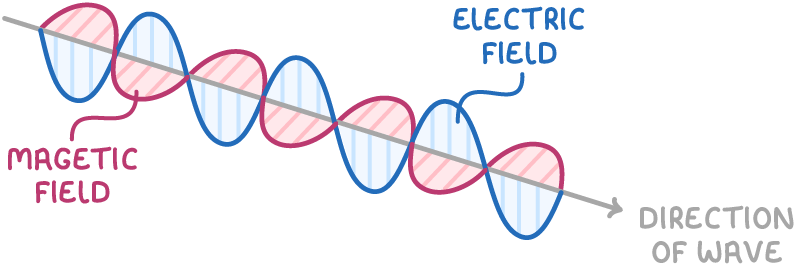
Electromagnetic waves are a type of wave that can propagate through a vacuum, unlike mechanical waves which require a medium. Despite the vast range of wavelengths in the electromagnetic spectrum, all these waves share several key properties:
- They are transverse.
- They can traverse a vacuum at a constant speed of 3.00 x 10⁸ m s-1.
- They consist of oscillating electric and magnetic fields perpendicular to each other and the direction of wave propagation.
- While the wavelength of these waves changes when entering a new medium, the frequency remains constant.
The order of the electromagnetic spectrum
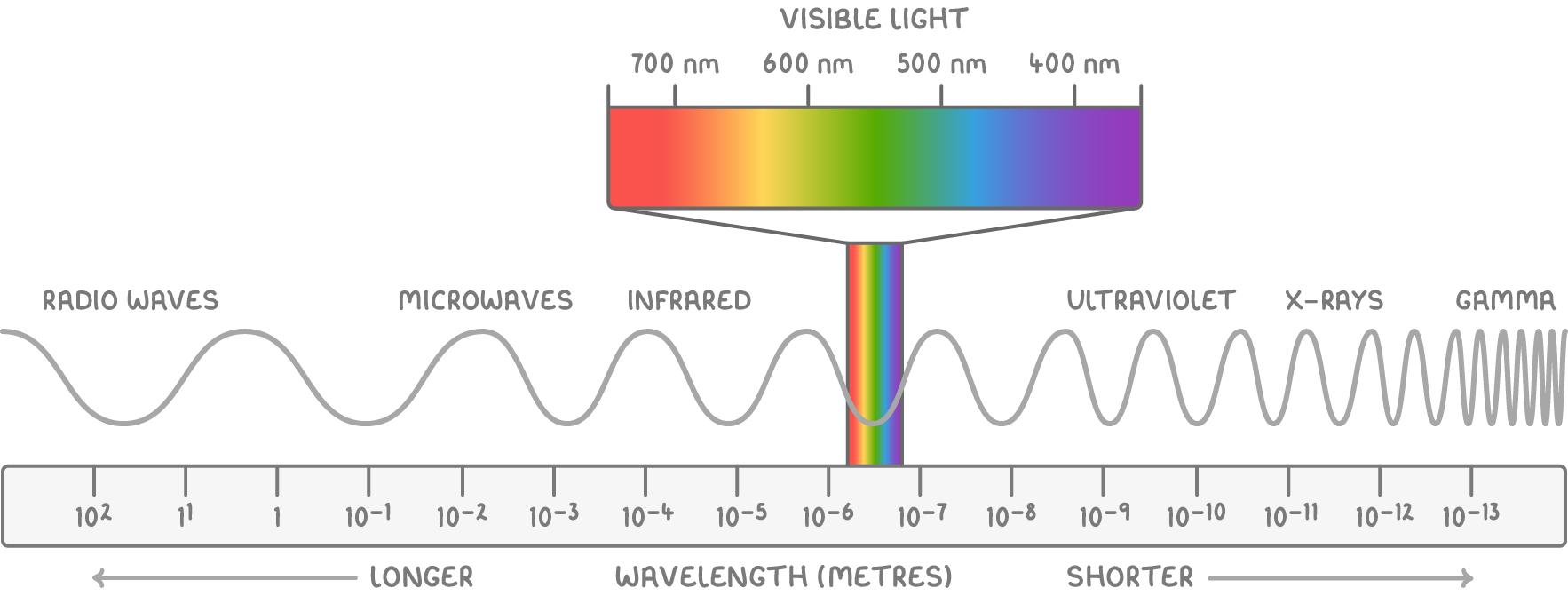
All electromagnetic waves travel at the speed of light through a vacuum but they all have different wavelengths, energy, and frequency.
Key points:
- Wavelength decreases from radio to gamma rays.
- Frequency increases from radio to gamma rays.
- Energy increases from radio to gamma rays.
Radio waves
Radio waves encompass the longest wavelengths in the electromagnetic spectrum, ranging from 1 millimeter to 100 kilometers. They possess unique properties that make them valuable for communication:
- Radio waves can reflect off certain atmospheric layers and diffract around obstacles like hills and large structures.
- These properties enable radio waves to be used extensively for communication purposes.
- Radio telescopes are employed to detect signals emitted by cosmic objects.
Microwave radiation
Microwaves, spanning wavelengths from 1 millimeter to 30 centimeters, have earned a distinct place in the electromagnetic spectrum due to their extensive applications:
- Microwaves are widely used in radar systems, radio astronomy, satellite communications, mobile phones, and cooking.
- In microwave ovens, the radiation is absorbed by water in the food, with the energy then spreading through the food via thermal conduction.
- High-power microwaves can harm living tissues through this heating mechanism.
Infrared radiation
Infrared (IR) radiation, with wavelengths ranging from 1 micrometer to 1000 micrometers, has the following properties:
- IR radiation can be detected by skin receptors as a sensation of warmth.
- Hot objects that are not visibly glowing emit significant amounts of infrared radiation, which forms the basis for night vision devices and infrared telescopes.
- Infrared radiation is employed in cooking and grilling applications. The red glow from an electric grill represents only a small fraction of the total emitted power.
Visible light spectrum
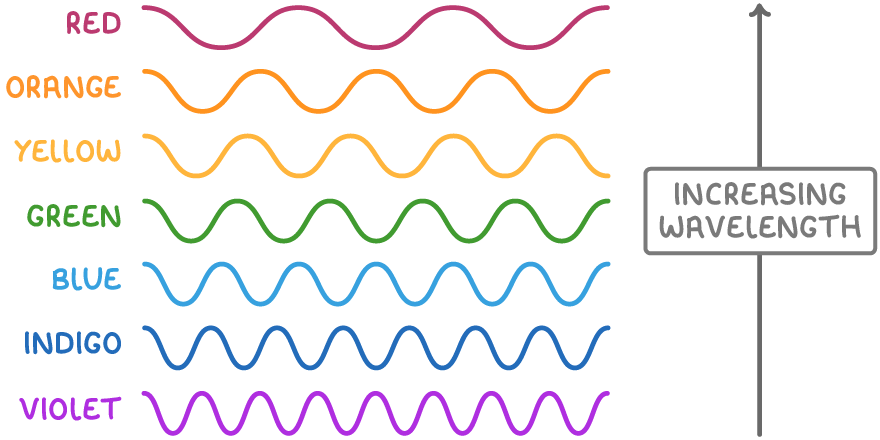
The human eye is sensitive to a narrow band of the electromagnetic spectrum known as visible light, with wavelengths ranging from about 390 nanometers (violet) to 700 nanometers (red). The eye exhibits peak sensitivity to green wavelengths within this range.
Ultraviolet radiation
Ultraviolet (UV) radiation, with wavelengths spanning approximately 100 to 400 nanometers, has both beneficial and harmful effects:
- UV exposure is crucial for certain animals as it stimulates vitamin production in the skin.
- Excessive UV exposure can cause sunburn and DNA damage.
- Mercury atoms excited by electric fields emit UV radiation, which is the operating principle of fluorescent lamps.
- Satellites positioned above Earth's atmosphere can conduct ultraviolet observations of the galaxy.
X-rays
X-rays, with wavelengths ranging from about 30 picometers to 3 nanometers, have various applications:
- They are used for internal imaging in medical diagnoses and security screenings.
- X-rays can be employed to irradiate and eliminate cancerous growths.
- Due to their high penetrating power and ability to alter DNA through ionization, X-rays pose a risk to living tissues. Proper lead shielding is essential for medical professionals working with X-rays.
- Astronomical objects like pulsars, supernovae, and black hole accretion discs emit X-rays due to their extremely high temperatures.
Gamma radiation
Gamma rays occupy the highest frequency and shortest wavelength region of the electromagnetic spectrum, with wavelengths typically less than 1 picometer. Key points about gamma radiation include:
- Most gamma rays originating outside Earth's atmosphere are absorbed by atmospheric ozone, preventing them from reaching the surface.
- Gamma rays find extensive use in medical applications, including imaging and cancer treatment.
- The ionising nature of gamma radiation is utilised to sterilise food and medical equipment by eliminating bacteria.