13.1 - Reflection, Refraction & Total Internal Reflection
- 1
Reflection of waves at a boundary or interface
- 2
Refraction of waves as they cross a boundary
- 3
Calculating refractive index using Snell's law
- 4
The conditions for total internal reflection to occur
Reflection of waves
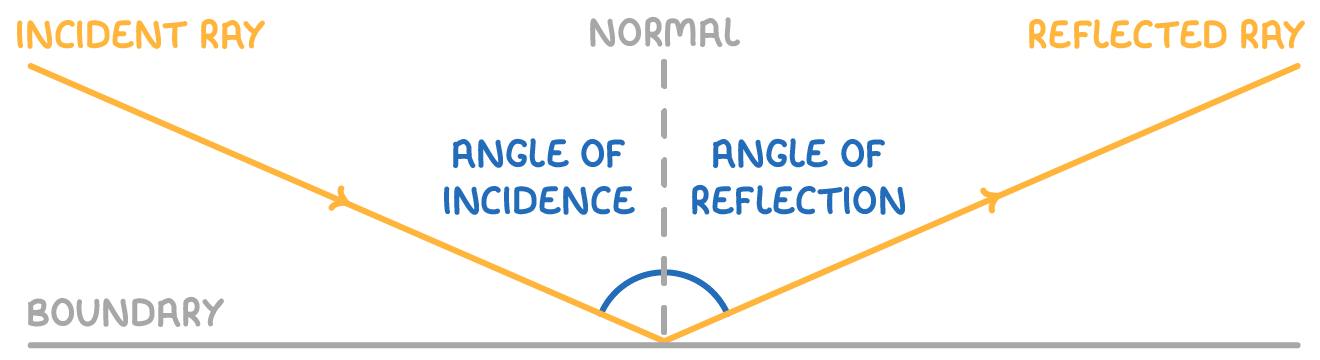
Reflection occurs when a wave hits a boundary between two materials, bouncing off the surface in a new direction. Key properties include:
- The angle of incidence (i) is the angle at which a wave strikes a surface. It is equal to the angle of reflection (r), which is the angle at which the wave bounces away.
You can observe reflection with:
- A ripple tank for water waves
- A ray box for light waves
Refraction: Waves changing direction and speed
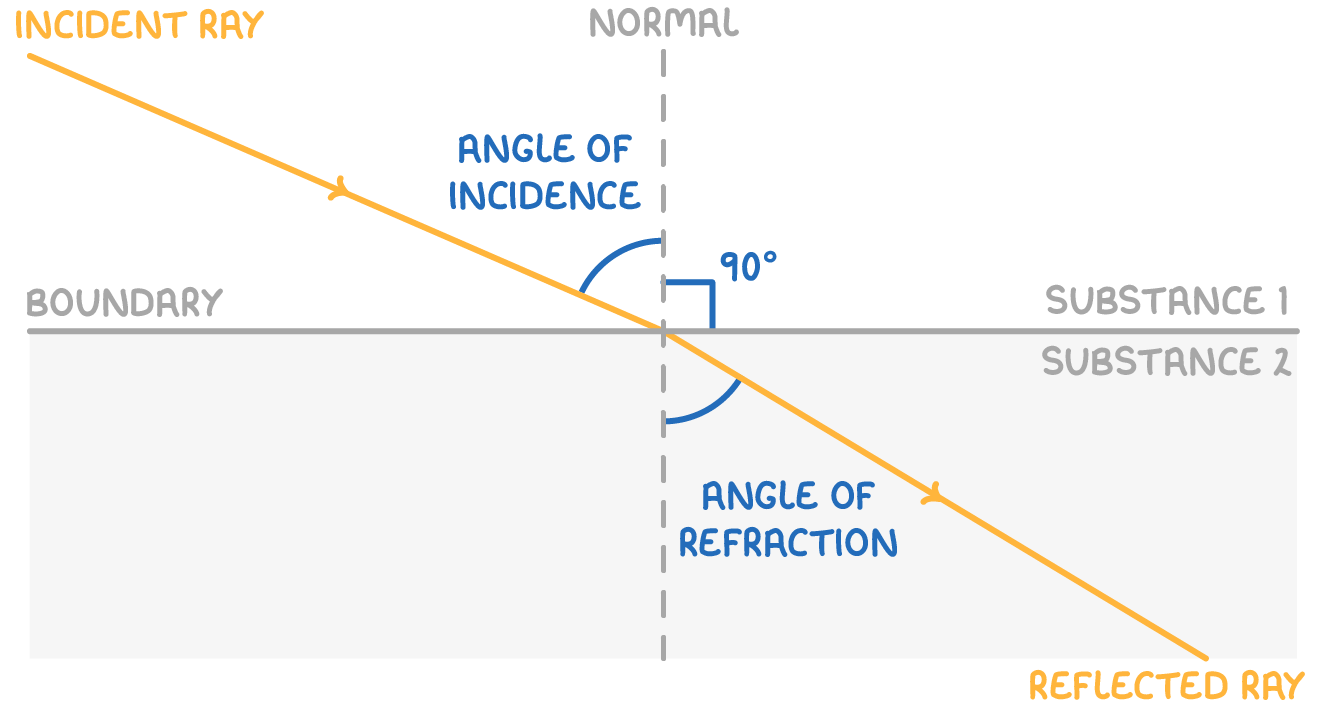
Refraction happens when waves enter a new medium, causing them to change speed and direction.
Important points:
- If a wave slows down, it refracts towards the normal line; if it speeds up, it refracts away.
- The change in speed is due to a shift in the wave's wavelength, while its frequency remains constant.
- Refraction can be seen by passing light through different materials, like glass.
Using Snell's law to calculate refractive index
The refractive index (n) is the ratio of light's speed in a vacuum (c) to its speed in a material (v):
$ \text{n = }\frac{\text{c}}{\text{v}} $
Snell's law links the angles of incidence and refraction to the refractive indices of two materials:
$ \frac{n_1}{n_2} = \frac{\sin \theta_2}{\sin \theta_1} $
Where:
- $\theta_1$ = Angle of incidence
- $\theta_2$ = Angle of refraction
- $n_1$, $n_2$ = Refractive indices of each material
By measuring these angles, you can calculate a material's refractive index.
Worked example - Calculating the refractive index using Snell's law
A light ray passes from air into glass, making an angle of 30° with the normal in air. The angle of refraction in the glass is 19°. Calculate the refractive index of the glass.
Step 1: Snell's law formula
$\frac{\text{n}_1}{\text{n}_2}\text{ = }\frac{\sin\theta_2}{\sin\theta_1}$
Step 2: Rearrangement for (n2)
$\text{n}_2\text{ = }\text{n}_1\text{ }\times\text{ }\frac{\sin\theta_1}{\sin\theta_2}$
Step 3: Substitution and correct evaluation
$\text{n}_2\text{ = 1 }\times\text{ }\frac{\sin(30)}{\sin(19)}\text{ = 1.54}$
Total internal reflection
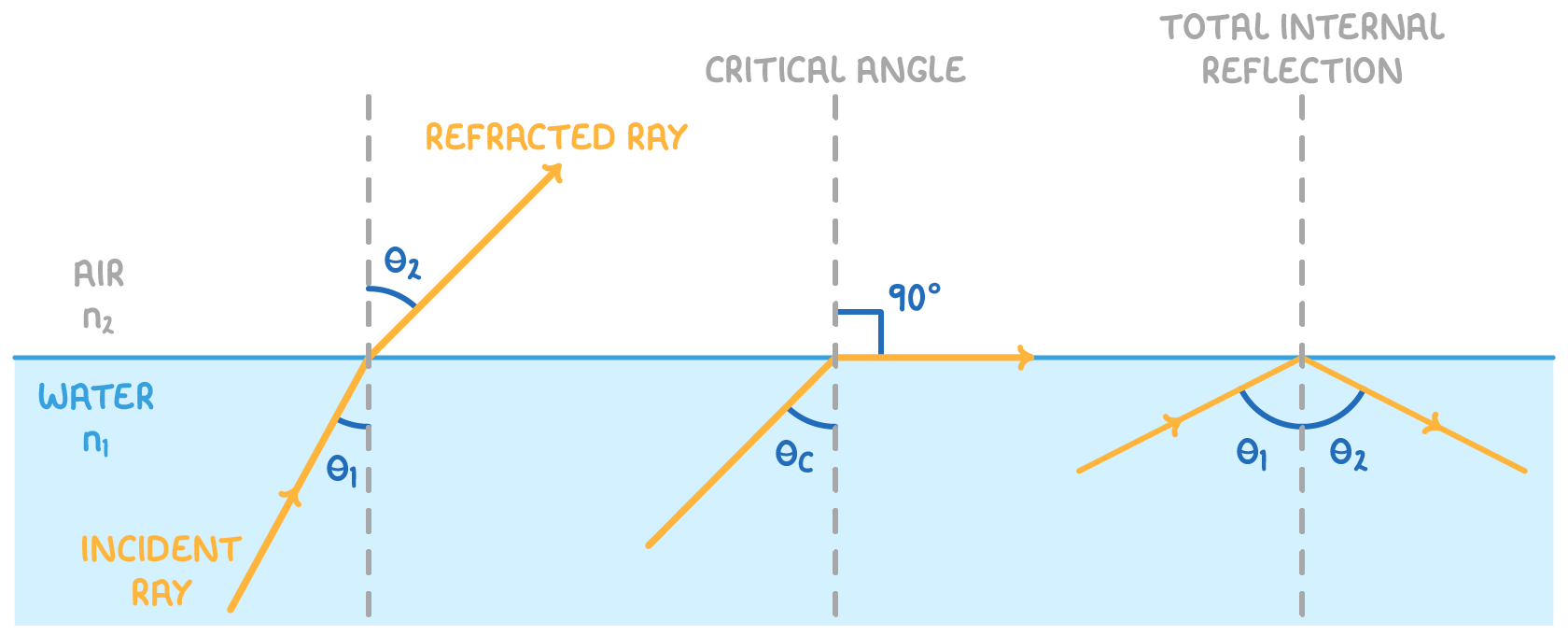
Total internal reflection occurs when light moves from a more optically dense medium to a lower optically dense medium (high to low refractive index):
- If the angle of incidence is less than the critical angle, light refracts away from the normal as it enters the material with a lower refractive index.
- If the angle of incidence is equal to the critical angle (θc), the light refracts at an angle of refraction is 90°.
- If the angle of incidence (θ) is greater than the critical angle (θc), the light totally internally reflects and all light reflects back into the original medium.
- The angle of reflection is equal to the angle of incidence.
The critical angle depends on the refractive index of the material:
$ \sin\theta_c = \frac{1}{n} $
As n increases, θc decreases. Thus, materials with higher refractive indices have lower critical angles for total internal reflection.