7.3 - Greenhouse Gases
- 1
The difference in average surface temperature between Earth and the Moon
- 2
The role of Earth's atmosphere in the greenhouse effect
- 3
The distinction between the natural and enhanced greenhouse effects
- 4
Modeling Earth's climate balance using the Stefan-Boltzmann law
- 5
The effect of atmospheric absorption on Earth's temperature
Earth, the Moon, and the greenhouse effect
Although Earth and the Moon are approximately the same distance from the Sun, their average surface temperatures differ significantly. The Moon's average surface temperature is around 255 K, while Earth's is about 288 K. This discrepancy is due to Earth's atmosphere and the greenhouse effect.
The greenhouse effect occurs when certain gases in Earth's atmosphere trap energy within the atmospheric system, leading to an increase in Earth's average temperature. The primary greenhouse gases are:
- Carbon dioxide (CO₂)
- Ozone (O₃)
- Water vapour (H₂O)
- Methane (CH₄)
- Nitrous oxide (N₂O)
It is crucial to differentiate between the natural greenhouse effect, caused by the naturally occurring levels of these gases, and the enhanced greenhouse effect, where increased concentrations lead to further temperature increases and climate change.
The role of atmospheric composition
Earth's atmosphere is primarily composed of nitrogen (N₂) and oxygen (O₂), which make up approximately 80% and 20% by weight, respectively. These tightly bound molecules do not absorb energy from sunlight and contribute minimally to the natural greenhouse effect.
In contrast, the 0.04% of the atmosphere consisting of greenhouse gases has a much more significant impact. The graphs below show the radiation intensity levels at varying wavelengths and their relative absorption by the main greenhouse gases in the atmosphere.
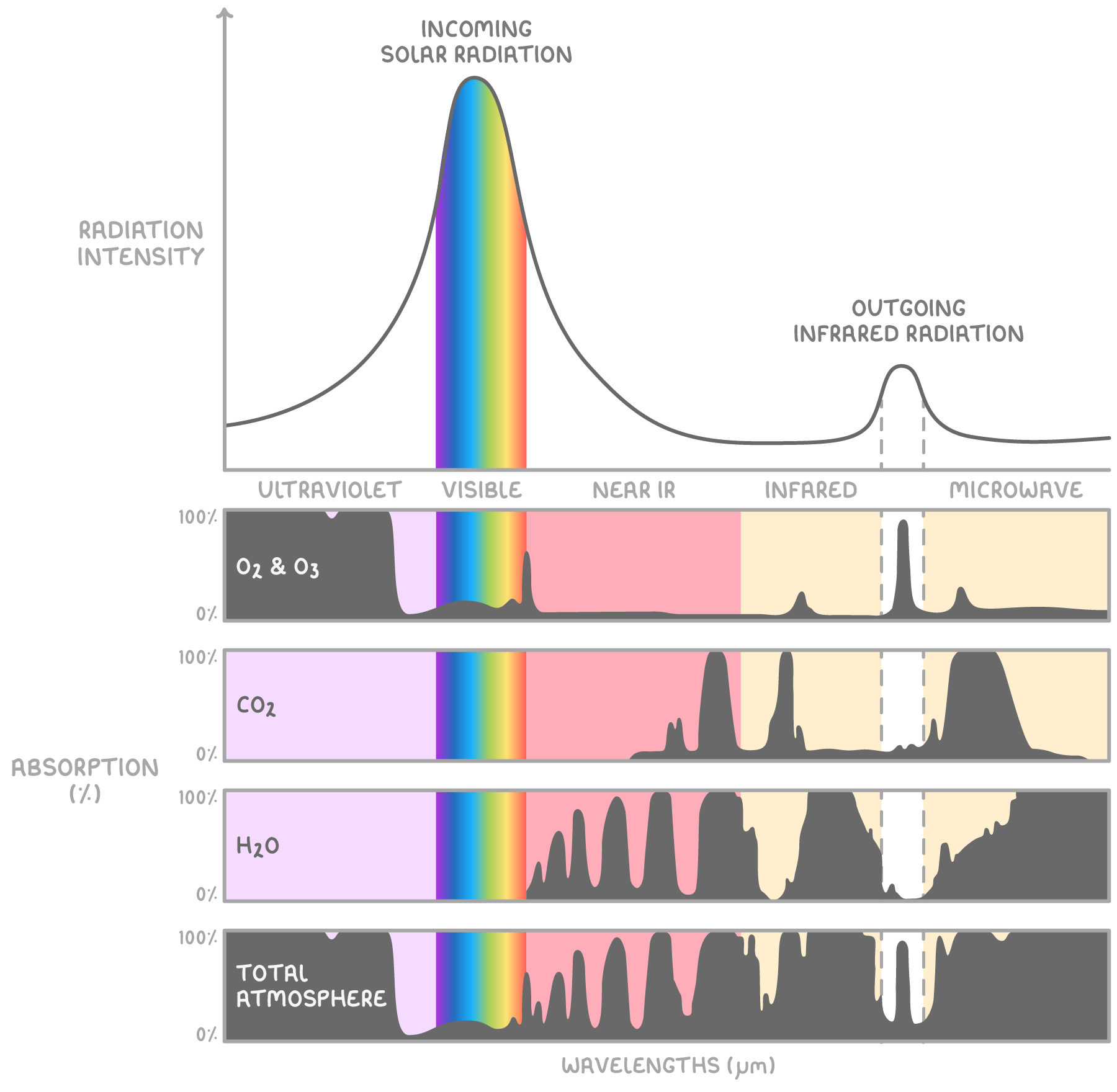
Key points:
- Ozone (O_2_ and O_3_) is responsible for almost 100% radiation absorption in the ultraviolet region.
- Carbon dioxide (CO_2_) is a good absorber of radiation between 1.5 - 20 $\mu$m.
- Water vapour (H_2_O) is a good absorber of radiation in the 0.8 - 35 $\mu$m range.
- Visible light is not absorbed in large amounts by the gases in the atmosphere.