7.4 - The Greenhouse Effect
- 1
Why greenhouse gases absorb energy
- 2
The vibrational modes and resonance in carbon dioxide
- 3
Evidence and causes of global warming
Absorption of energy by greenhouse gases
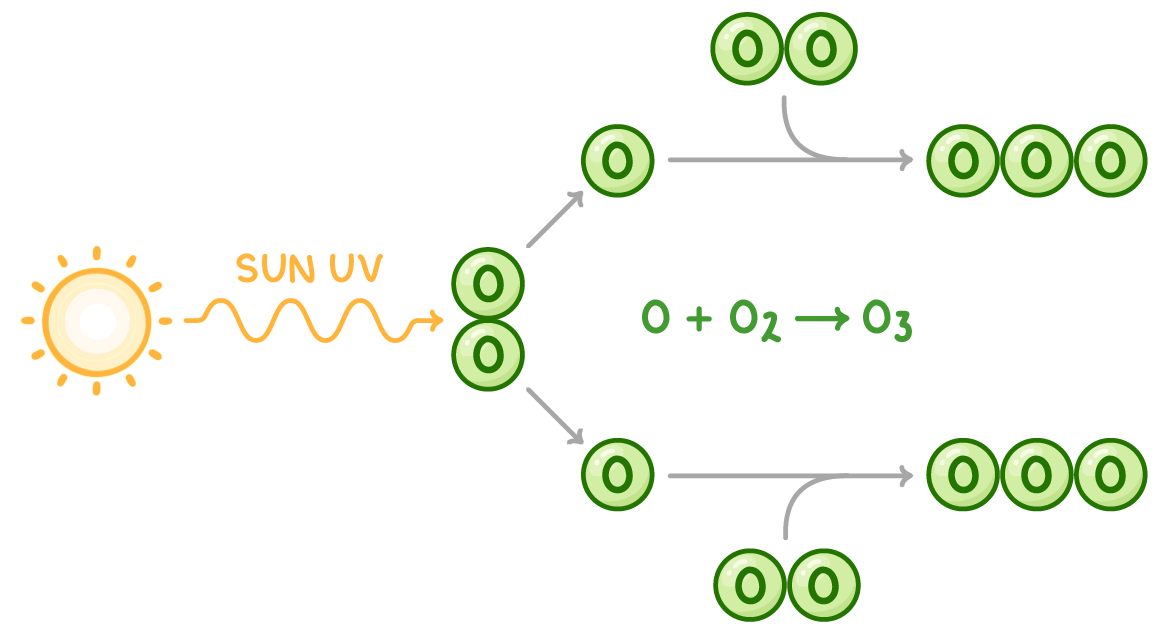
Earth's atmosphere absorbs both ultraviolet and long-wavelength infrared radiation. Photons in the ultraviolet region are highly energetic and can break the bonds within gas molecules, leading to the production of ionised materials in the atmosphere. For example, ultraviolet photons can split oxygen molecules (O_2_) apart, forming oxygen atoms (O) that react to produce ozone (O_3_).
In contrast, infrared photons have lower energies and cannot break molecules apart. Instead, they cause resonance when their frequency matches the vibrational state of a greenhouse-gas molecule. This effect is particularly evident in carbon dioxide.
Vibrational modes and resonance in carbon dioxide
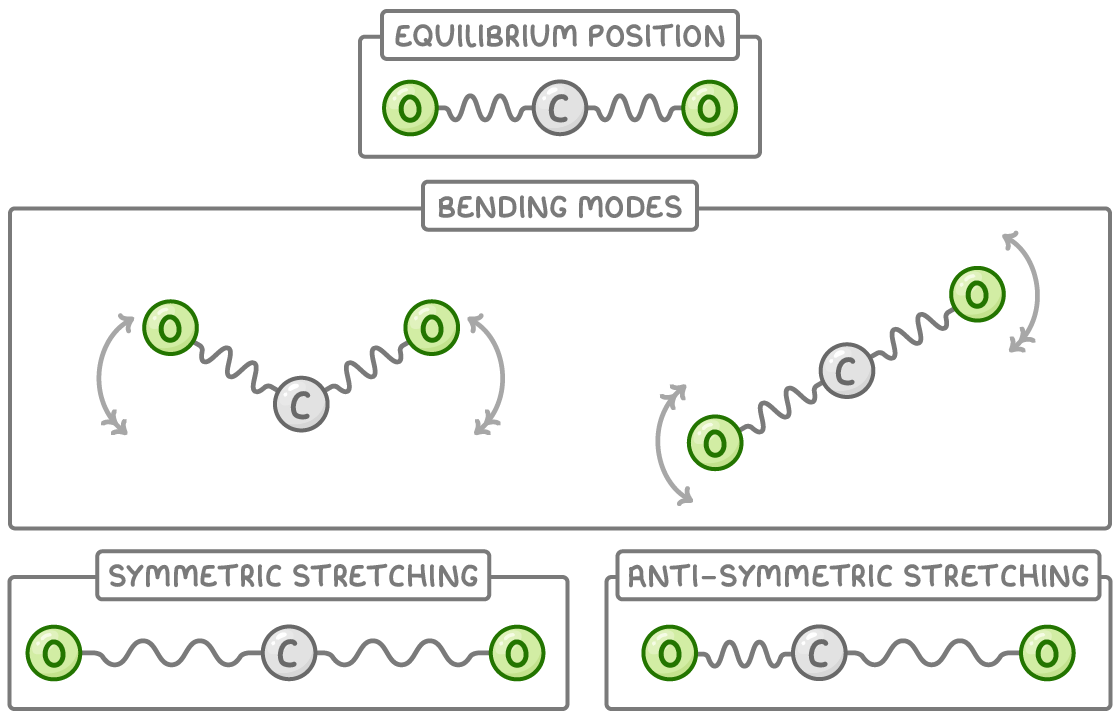
A carbon dioxide molecule consists of a carbon atom double-bonded to an oxygen atom at each end in a linear arrangement. The bonds behave like springs, allowing different vibrational modes:
- Bending mode (causes infrared absorption at 15 µm)
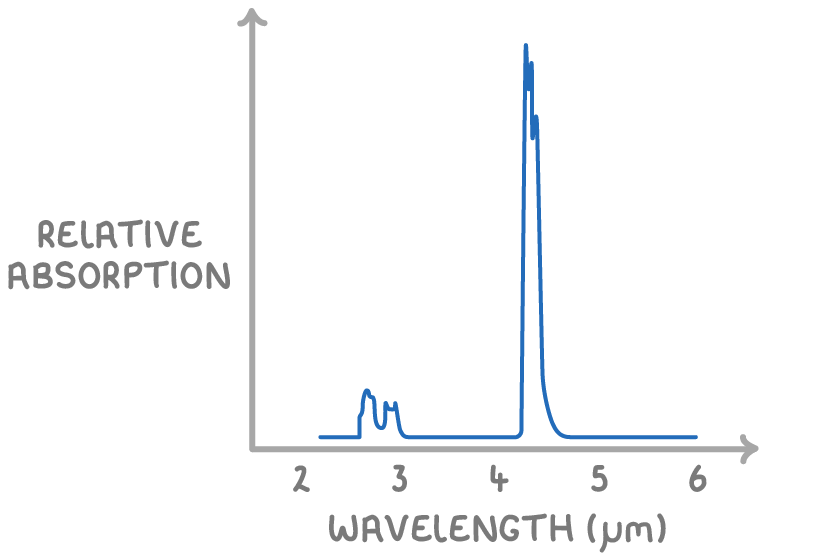
- Asymmetric stretching mode (causes infrared absorption at 4.3 µm)
- Symmetric stretching mode (causes infrared absorption at 2.7 µm)
When the frequency of incident radiation matches the frequency of a vibrational mode, the molecule vibrates at that mode, converting the incident infrared radiation into vibrational energy. This leads to absorption at specific infrared wavelengths, as shown in the absorption spectrum of carbon dioxide.
Variation in greenhouse gases over time
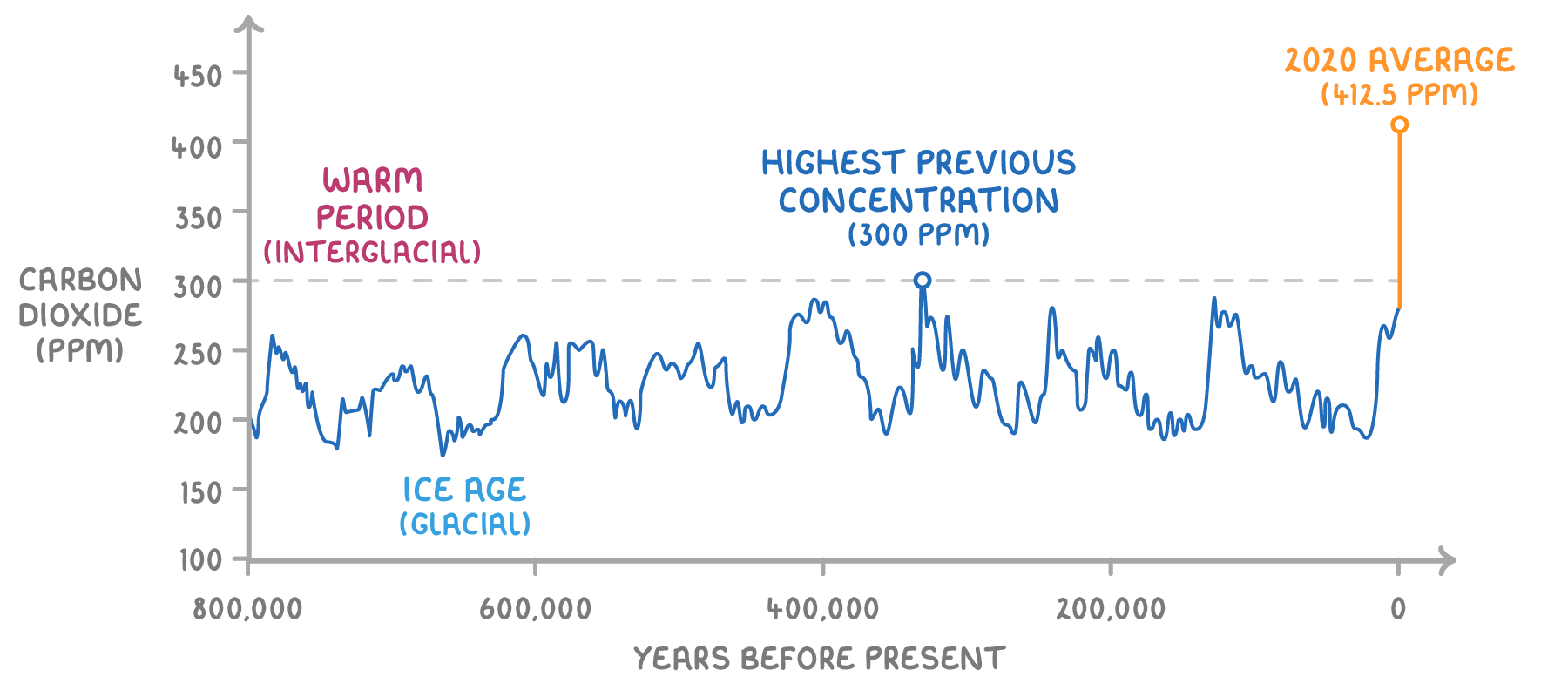
Climate change is undoubtedly occurring on our planet, with significant warming leading to changes in sea levels and weather patterns worldwide. While Earth has experienced natural climate fluctuations in the past, the current global warming is primarily attributed to human activities, particularly the burning of fossil fuels since the Industrial Revolution. The graph above shows how atmospheric carbon dioxide in parts per million has dramatically increased since the Industrial Revolution.
Scientists have proposed several models to explain global warming, including:
- Changes in atmospheric composition (particularly greenhouse gases) leading to an enhanced greenhouse effect
- Increased solar flare activity
- Cyclic changes in Earth's orbit
- Volcanic activity
The table below summarises the changes in the concentrations of principal greenhouse gases over the past 250 years.
| Greenhouse Gas | Pre-industrial level (ppm) | Current level (ppm) | Percentage increase |
|---|---|---|---|
| Carbon dioxide | 280 | 415 | 48% |
| Methane | 0.7 | 1.8 | 157% |
| Nitrous oxide | 0.27 | 0.33 | 22% |
The enhanced greenhouse effect
The enhanced greenhouse effect refers to the process by which the increased concentration of greenhouse gases in Earth's atmosphere, primarily due to human activities, leads to greater absorption and re-radiation of infrared radiaiton. This results in a rise in Earth's temperature and overall warming of the planet. As more greenhouse gases accumulate, they trap more heat, enhancing the natural greenhouse effect and contribute to global warming.
Global warming is likely to trigger additional mechanisms that will accelerate the warming process, such as:
- Melting of ice and snow cover at the poles, decreasing Earth's average albedo and increasing the rate of energy absorption by the surface.
- Increased ocean water temperatures, reducing the amount of CO2 dissolved in seawater and further increasing its atmospheric concentration of CO_2_.
Human activities which contribute to an increase in greenhouse gases:
Carbon dioxide:
- Produced when fossil fuels are burned in power stations and vehicles
- Burning of wood
- Deforestation
Methane:
- Decay of organic matter - landfill, crops, manure
Nitrous Oxides:
- Artificial fertilisers
- Burning fossil fuels