5.3 - Special Relativity
- 1
The role of postulates as starting points for proofs
- 2
Postulates of special relativity
- 3
The concept of simultaneity
Newton's postulates
In mathematics and science, a postulate is an assumption or assertion that is not proven but acts as the foundation for further proofs. Newton used this concept to develop Galileo's ideas in his groundbreaking work, Principia Mathematica.
Newton's postulates of relativity:
- Space and time are fixed and absolute.
- Galilean relativity means that Newton's laws of motion are the same in all inertial reference frames.
Postulates of special relativity
Einstein recognised that Maxwell's four electromagnetic equations held true in all inertial frames. This realisation led him to propose modifications to Newton's postulates.
Einstein's first postulate:
The laws of physics are the same in all inertial frames of reference. This generalises Newton's second postulate to include all scientific laws, such as optics and electromagnetism.
Einstein's second postulate:
The speed of light is constant for all observers in inertial frames, regardless of the motion of the light source.
Comparing Galilean and special relativity
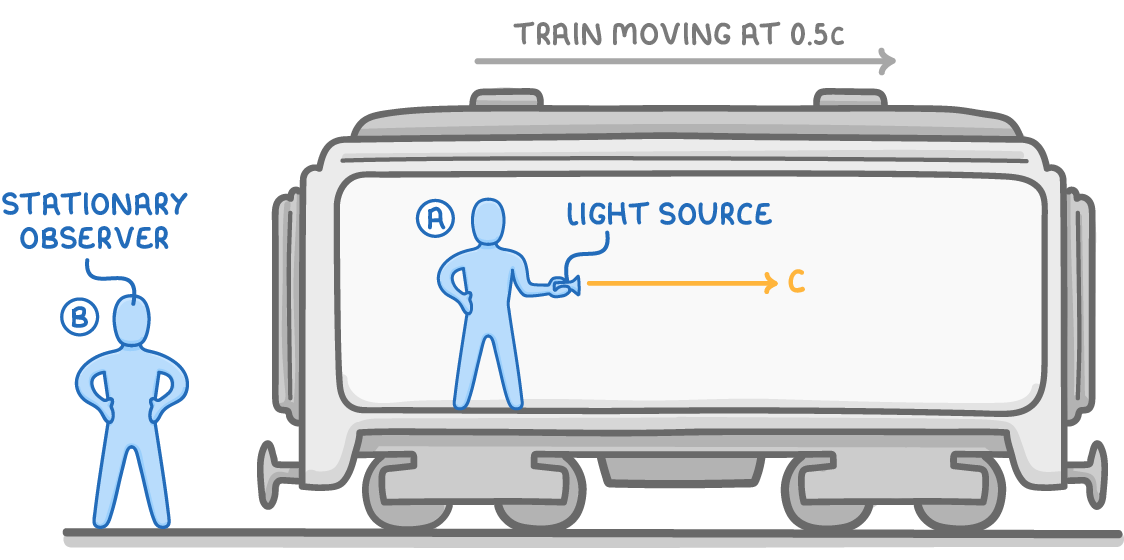
Consider a train moving from left to right at half the speed of light (0.5 c). Observer A is standing on the train, holding a light source. Observer B is stationary on the platform. Consider the observations of each person.
Observations of observer A:
- Galilean relativity - The light moves away from observer A at 0.5c = c - 0.5c
- Einsteinian relativity - The light moves away from observer A at the speed of light.
Observations of observer B:
- Galilean relativity - Observer B would observe the light travelling away from them at 1.5c = 0.5c + c.
- Einsteinian relativity - Observer B would also observe the light travel away from them at the speed of light, c, because the speed of light is constant in all inertial frames of reference.
Understanding simultaneity
Simultaneity refers to whether two events at different locations occur at the same time. The concept differs between Galilean and Einsteinian relativity:
Galilean relativity (Newton):
- Time is independent of the observer.
- Simultaneity is absolute.
- Synchronised clocks in different frames will measure the same time intervals for an event.
Einsteinian relativity:
- Clocks in different frames will not measure identical time intervals for the same event.
- Simultaneity is relative to the observer's frame of reference.
Simultaneity example
Consider a moving train with an observer positioned at the centre of the carriage. A stationary observer is on the platform. The train is struck by two bolts of lightning at the front and the back of the train. What would each observer see?
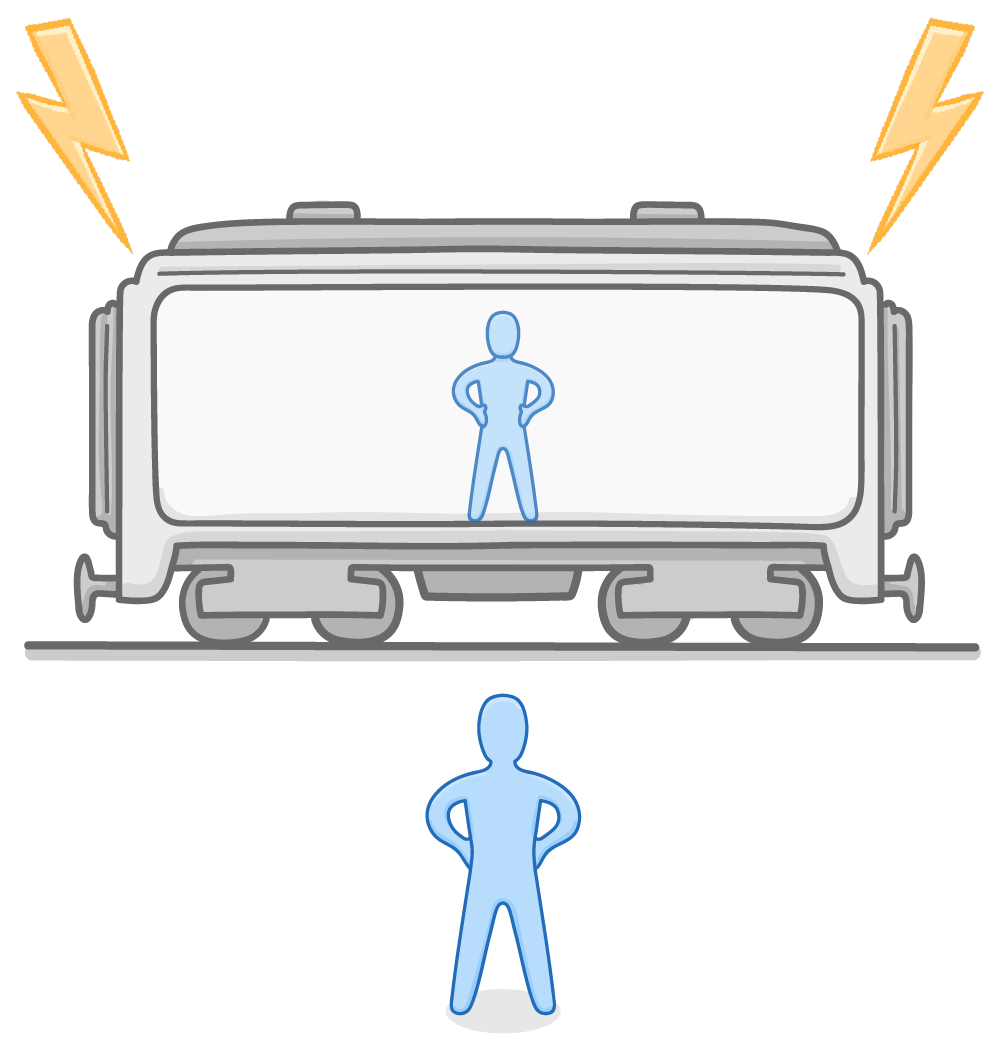
Observer on train:
The train is travelling towards the bolt of lightning at the front and away from the lightning at the back of the train. The observer would therefore see the front lightning bolt first.
Key points for observer on the train:
- The distance travelled by both lightning bolts is identical.
- Speed of light is fixed.
- The bolt of lightning at the rear of the train happened after the one at the front.
Observer on the platform:
The lightning strikes when the train carriage passes the observer on the platform. The observer on the platform observes both lightning bolts at exactly the same time.
Key points for observer on the platform:
- The distance travelled by each lightning bolt is identical.
- Speed of light is fixed.
- Both lightning bolts occur at the same time.
The observer on the train observes a different set of events compared to the observer on the platform. The time between flashes of light is different for each observer and therefore the simultaneity of events is dependent on the inertial frame of reference.