5.4 - Lorentz Transformation
- 1
Defining the Lorentz factor and its relationship with velocity
- 2
Introducing the Lorentz transformation equations
- 3
Comparing Lorentz transformations with Galilean transformations
The Lorentz factor
The Lorentz factor ($\gamma$) appears in the time dilation equation and is a key component of the Lorentz transformations. Its value depends on the ratio of the relative velocity ($v$) to the speed of light ($c$).
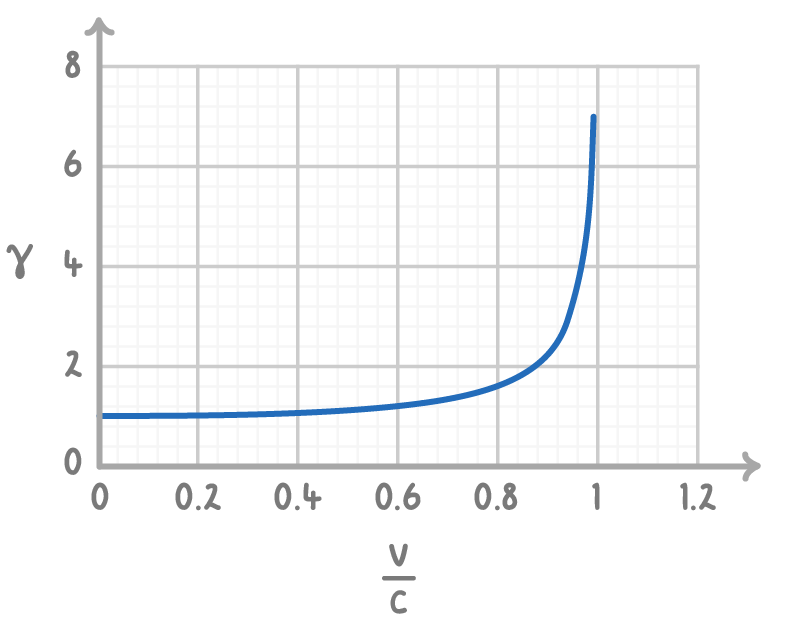
When the value of $\frac{v}{c}$ is less than 0.5, the lorentz factor is approximately 1. As the value of $\frac{v}{c}$ approaches 1, the Lorentz factor tends to infinity.
What is the Lorentz factor?
The Lorentz factor, often denoted by the gamma ($\gamma$), is a fundamental concept in Einstein's special theory of relativity. It describes how measurements of time, length, and other physical properties change for objects moving at speeds close to the speed of light relative to an observer.
The Lorentz factor is given by:
$\gamma = \frac{1}{\sqrt{1-\frac{v^2}{c^2}}}$
Where:
- $\gamma$ = Lorentz factor
- v = velocity of the object relative to the observer (m s^-1^)
- c = speed of light in a vacuum (3 x 10^8^ m s^-1^)
Key points:
- The Lorentz factor is always greater than or equal to 1
- As v approaches c, $\gamma$ increases rapidly
- When v = 0, $\gamma$ = 1
Lorentz transformations
The Lorentz factor can be applied to the Galilean transformation equations to give the Lorentz trnasformation equations. The table below compares the Lorentz and Galilean transformation equations.
| Lorentz | Galilean |
|---|---|
| x' = | x' = x - vt |
| y' = y | y' = y |
| z' = z | z' = z |
| t' = | t' = t |
Worked example 2 - Applying Lorentz transformation for position
A particle is at position $x = 2 \text{ m}$ and time $t = 3 \text{ s}$ in the stationary frame. Calculate its position in the moving frame moving at 0.5c.
Step 1: Formula
$x' = \gamma (x - vt)$
Step 2: Calculate Lorentz factor (γ)
$\gamma = \frac{1}{\sqrt{1 - \left(\frac{0.5c}{c}\right)^2}} = \frac{1}{\sqrt{1 - 0.25}} = \frac{1}{\sqrt{0.75}} \approx 1.1547$
Step 3: Substitution and correct evaluation
$x' = 1.1547 \times (2 - 0.5 \times 3 \times 10^8 \times 3) = 1.1547 \times (2 - 4.5 \times 10^8) \approx -5.192 \times 10^8 \text{ m}$
Worked example 3 - Applying Lorentz transformation for time
A particle is at a position $x = 4 \text{ m}$ and time $t = 2 \text{ s}$ in the stationary frame. Calculate its time in the moving frame moving at 0.8c.
Step 1: Formula
$t' = \gamma \left(t - \frac{vx}{c^2}\right)$
Step 2: Calculate Lorentz factor (γ)
$\gamma = \frac{1}{\sqrt{1 - \left(\frac{0.8c}{c}\right)^2}} = \frac{1}{\sqrt{1 - 0.64}} = \frac{1}{\sqrt{0.36}} \approx 1.6667$
Step 3: Substitution and correct evaluation
$t' = 1.6667 \times \left(2 - \frac{0.8 \times 3 \times 10^8 \times 4}{(3 \times 10^8)^2}\right)\text{ = 3.33 s}$
Worked example 1 - Calculating the Lorentz factor
Calculate the Lorentz factor for an object moving at 40% of the speed of light.
Step 1: Formula
$\gamma = \frac{1}{\sqrt{1-\frac{v^2}{c^2}}}$
Step 2: Substitution and correct evaluation
$\gamma = \frac{1}{\sqrt{1-\frac{(0.4c)^2}{c^2}}}= 1.09$