9.3 - Addition Polymers
- 1
Polymers as macromolecules made from monomers
- 2
Types of polymer
- 3
Properties of plastics based on their structure
- 4
Addition polymerisation of alkenes
- 5
Representing repeating units of addition polymers
Polymers are macromolecules made from monomers
Polymers are very large molecules, also known as macromolecules. They are made from many smaller repeating subunits called monomers.
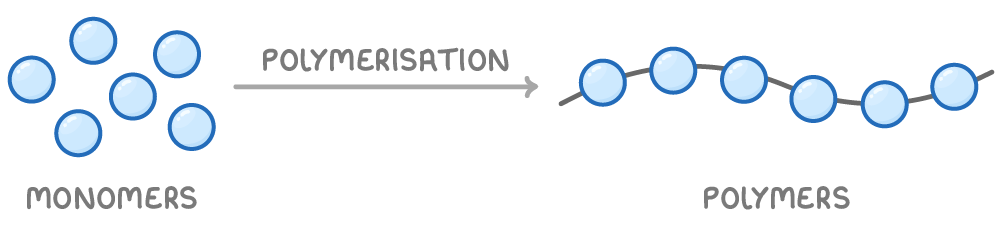
The monomers are joined together by covalent bonds, usually forming long chain structures. The process of monomer molecules linking together to form polymers is called polymerisation.
Types of polymer
Polymers can be classified in different ways:
- By source:
Natural polymers - Produced by living organisms (e.g. cellulose, starch, proteins).
Synthetic polymers - Made by humans, usually from crude oil (e.g. polyethene, nylon).
- By type of polymerisation reaction:
Addition polymers - Formed by addition polymerisation of monomers containing carbon-carbon double bonds.
Condensation polymers - Formed by condensation polymerisation with elimination of a small molecule like water.
The table below shows some examples of natural and synthetic polymers, their monomers, and typical uses.
| Polymer | Monomer | Natural or synthetic? | Example uses | Type of polymer |
|---|---|---|---|---|
| Cellulose | Glucose | Natural | Paper, textiles, cellophane | Condensation |
| Starch | Glucose | Natural | Energy storage in plants | Condensation |
| Proteins | Amino acids | Natural | Enzymes, structural roles | Condensation |
| Polyethene | Ethene | Synthetic | Plastic bags, bottles, insulation | Addition |
| Polystyrene | Phenylethene | Synthetic | Packaging, disposable cutlery | Addition |
| Nylon | Diamine and dicarboxylic acid | Synthetic | Textiles, ropes, parachutes | Condensation |
Common properties of plastics
Plastics are an important class of synthetic polymers. They have some characteristic properties that result from their structure of covalently-bonded chains:
- Low density - Plastics are lightweight compared to many other materials. This is because their long hydrocarbon chains have a relatively low mass for their volume.
- Electrical insulators - The covalent bonding in plastics means they lack delocalised electrons or mobile ions to carry charge. As a result, plastics are poor conductors of electricity.
- Thermal insulators - Plastics are also poor conductors of heat as they lack mobile particles to efficiently transfer thermal energy.
- Chemically inert - Plastics are unreactive because their strong, non-polar covalent bonds require large amounts of energy to break, making them resistant to corrosion and degradation.
- Easily molded - When heated, the intermolecular forces between polymer chains weaken, allowing the chains to slide past each other so the plastic can be shaped. The chains then lock into the new shape on cooling.
The specific properties of a plastic also depend on factors like:
- Chain length.
- Types of intermolecular forces between chains.
- Chemical structure of the monomers.
- Arrangement of monomers in the chain.
For example, the bulky phenyl side groups in polystyrene prevent the chains packing closely together. This makes polystyrene more rigid and brittle than polyethene, which has smaller side groups.
Addition polymerisation of alkenes
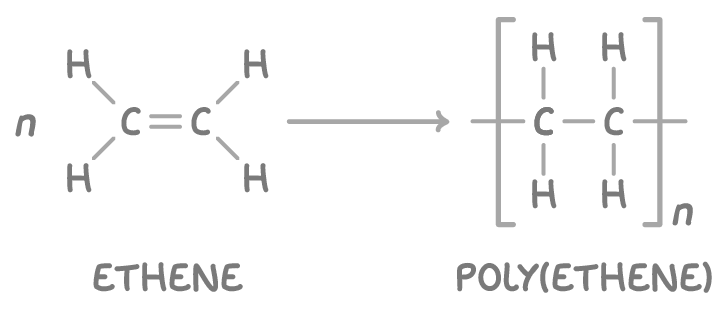
Many synthetic polymers are made by addition polymerisation of alkene monomers. Alkenes contain a carbon-carbon double bond (C=C).
During addition polymerisation:
- The double bond in each alkene monomer breaks.
- The electrons from the broken bond form new single bonds between alkene monomers.
- This links the alkene monomers together into a long polymer chain.
For example, ethene monomers polymerise to form the addition polymer poly(ethene):
Drawing the repeating units of addition polymers
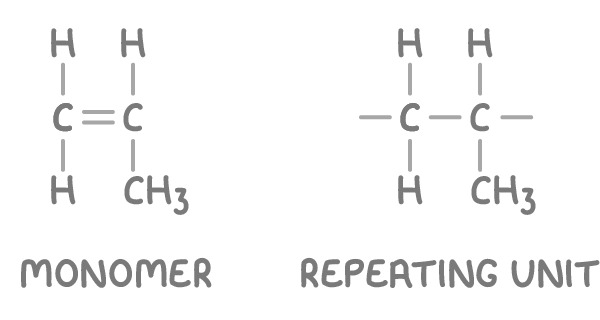
Polymers are made up of smaller repeating units. A repeating unit is the smallest section of a polymer chain that repeats over and over.
To draw the repeating unit from given monomer:
- Replace the carbon-carbon double bond with a single bond.
- Extend single bonds from each carbon atom to represent attachment sites within the polymer chain.
For example, the repeating unit of poly(propene) can be deduced from the propene monomer.
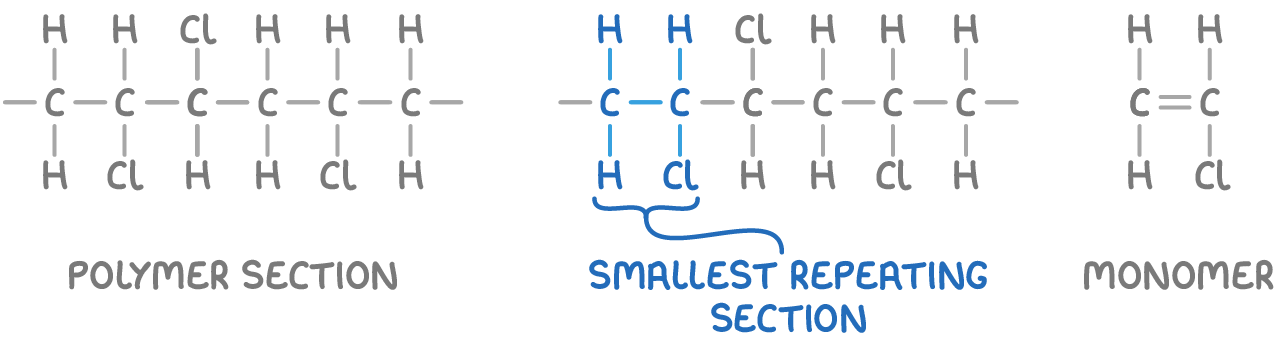
To deduce the monomer from a given polymer section:
- Identify the smallest section that repeats in the full polymer chain.
- Replace the carbon-carbon single bond with a double bond.
For example, the monomer of poly(chloroethene) can be deduced from a section of the polymer chain.
Naming addition polymers
Addition polymers made from alkenes follow systematic naming rules:
- Take the name of the alkene monomer.
- Enclose the monomer name in brackets.
- Add the prefix "poly".
For example, the addition polymer made from butene is poly(butene).
Addition polymers made from alkenes are called polyalkenes.