9.4 - Condensation Polymers
- 1
How condensation polymers form
- 2
Representing the repeating units of polyesters and polyamides
- 3
The formation of biological macromolecules by condensation reactions
- 4
Working out monomer and repeat unit structures
- 5
Comparing addition and condensation polymerisation
Condensation polymerisation involves elimination reactions
Condensation polymerisation reactions lead to the formation of long polymer chains through the joining of monomers, accompanied by the elimination of small molecules such as water (H2O).
Key features of condensation polymers:
- They are formed from reactions between monomers that contain a functional group at both ends
- These functional groups react with each other to form a covalent bond called a linkage.
- A small molecule, such as water, is eliminated each time a linkage forms between monomers.
Some common examples of condensation polymers include:
- Polyesters such as Terylene.
- Polyamides such as Nylon.
- Biological macromolecules such as proteins, carbohydrates, and DNA.
Polyesters
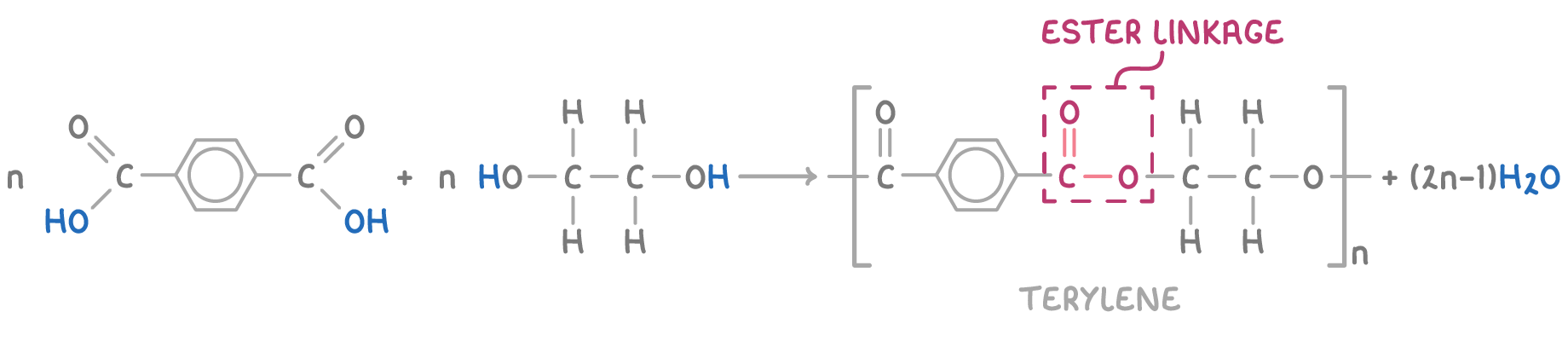
Polyesters are a type of condensation polymer formed from the reaction between dicarboxylic acids (or derivatives such as acyl chlorides) and diols. The carboxyl (-COOH) and hydroxyl (-OH) groups react, forming ester links in the polymer chain.
An example of a polyester is Terylene, which is synthesised from benzene-1,4-dicarboxylic acid and ethane-1,2-diol:
Polyamides
Polyamides are another type of condensation polymer, formed from dicarboxylic acids (or derivatives such as acyl chlorides) and diamines. The carboxyl and amine groups react, forming amide links within the polymer chain.
Examples of polyamides include:
- Nylon - Formed from hexanedioic acid and 1,6-diaminohexane.

- Kevlar - Formed from benzene-1,4-dicarboxylic acid and 1,4-diaminobenzene.

Biological macromolecules form by condensation reactions
In living organisms, many important biological macromolecules are condensation polymers formed from smaller monomers. For example:
- Proteins are polypeptides, which are polymers of amino acid monomers.
- Carbohydrates like starch and cellulose are polysaccharides, which are polymers of monosaccharide monomers such as glucose.
- DNA (deoxyribonucleic acid) is a polynucleotide, which is a polymer of nucleotide monomers.
In each case, the monomers join together by condensation reactions, releasing a water molecule each time a new bond forms between them. As more and more monomers link up, the biological polymer grows longer.
The formation of a dipeptide provides a simple illustration of this process. A dipeptide consists of two amino acids joined by a condensation reaction.
The general structure is shown below, where R represents the side chain that is unique to each amino acid:
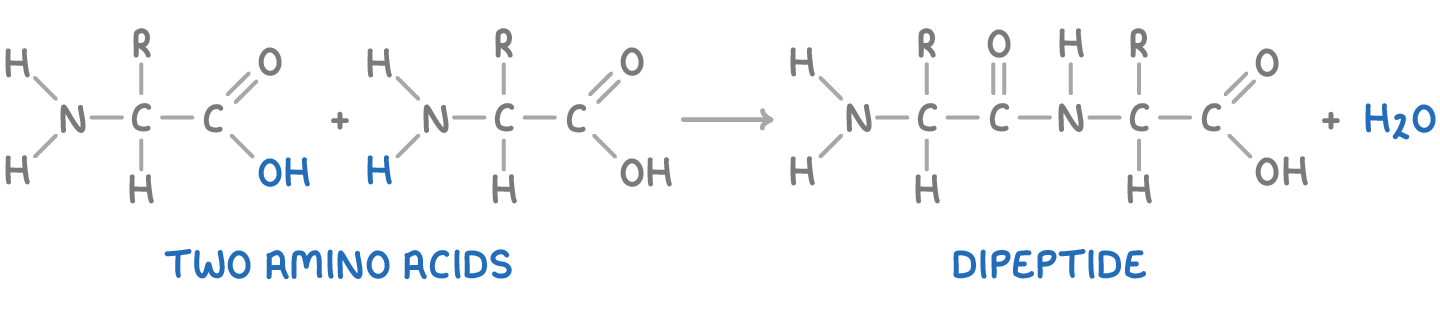
This same basic reaction occurs repeatedly to link many amino acids into a polypeptide chain. Similar condensation reactions form polysaccharides from monosaccharides and polynucleotides from nucleotides.
Organisms can also break these biological polymers back down into their constituent monomers through hydrolysis reactions:
- In hydrolysis, a water molecule is used to break the bond between each monomer unit.
- Hydrolysis is essentially the reverse of the condensation reaction that initially formed the polymer.
- Biological polymers are hydrolysed when the organism needs the monomers again, either as an energy source or as building blocks to make other molecules.
Working out monomer and repeat unit structures
Drawing monomers from a polymer
To deduce the monomers that form a condensation polymer, follow these steps:
- Identify the amide (HN-CO) or ester (CO-O) linkage between repeat units.
- Cut the link in the middle to separate the polymer chain.
- Add an H atom or -OH group to both ends of the molecules. H atoms are added to N or O atoms, and -OH groups to C atoms.
For example, the monomers that form a particular polyamide can be identified from its polymer structure:

Drawing repeat units from monomers
To draw the repeat unit from condensation monomers, follow these steps:
- Place the structures of the two monomers side by side.
- Remove an H atom from one monomer (e.g., diol or diamine) and an OH group from the other (e.g., dicarboxylic acid), forming a H2O molecule as a by-product.
- Connect the monomers through either an amide or ester linkage, depending on their functional groups.
- To indicate continuity in the polymer chain, remove another H atom and OH group from the opposite ends.
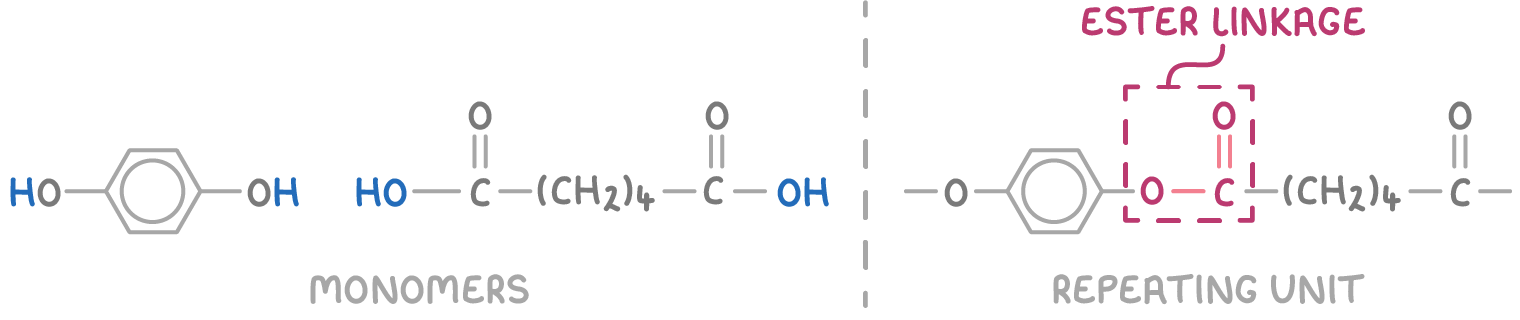
The repeating unit of a polyester, for instance, can be deduced from its monomers' structures:
Comparing addition and condensation polymerisation
The mechanisms of addition and condensation polymerisation differ significantly:
| Polymerisation type | Addition | Condensation |
|---|---|---|
| Monomers used | Alkenes | Carboxylic acids, amines, alcohols |
| Polymer chain | Continuous chain of carbon atoms | Contains ester or amide bonds |
| Products formed | Polymer only | Polymer and small molecule (e.g. H2O) |
Addition polymers are synthesised from alkene monomers, which contain C=C double bonds, forming chains composed solely of carbon atoms.
Condensation polymers, on the other hand, are synthesised from monomers containing functional groups such as -COOH, -NH2, and -OH, leading to chains that incorporate ester and/or amide bonds.