22.4 - Coordination Bonds & Complex Ions
- 1
What coordination bonds and complex ions are
- 2
The relationship between ligands and transition element cations
- 3
Calculating the charge on complex ions and transition element cations
Coordination bonds and complex ions
Transition elements are metals that can form ions with a partially filled d-subshell. For instance, the chromium(III) ion has an electron configuration of [Ar]3d3.
Transition metal cations are Lewis acids, which means they can form several coordination bonds by accepting electron pairs from Lewis bases. A complex ion is a transition metal ion bonded to several Lewis bases.
In complex ions, the surrounding Lewis bases are called ligands. Ligands can be:
- Neutral molecules - Such as H2O and NH3.
- Anions - Such as CN-, Cl-, and OH-.
Ligands are electron-rich species with at least one lone pair of electrons, making them nucleophiles. The positively charged transition element cation acts as an electrophile, accepting electron pairs from the ligands.
An example of a complex ion is [Cr(H2O)6]3+; the oxygen atom of each water molecule donates a lone pair of electrons to the central Cr3+ ion:
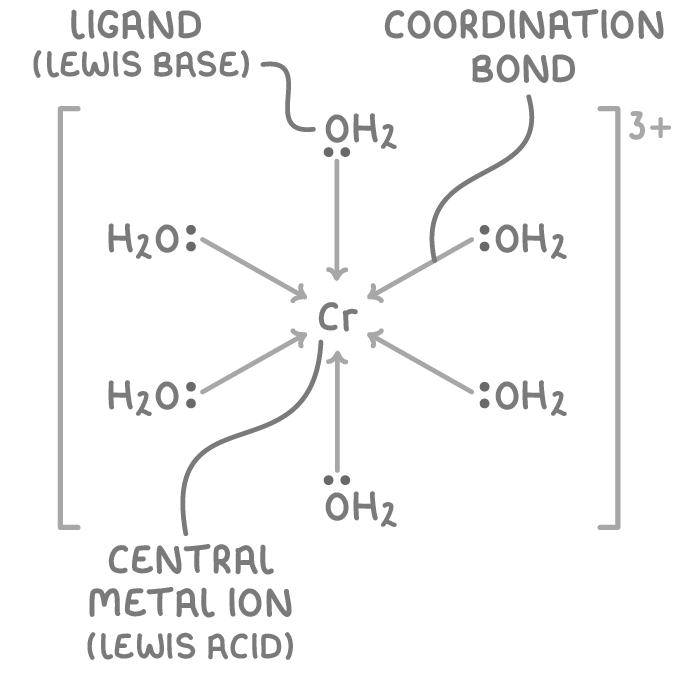
The number of coordinate bonds formed between the ligands and metal ion is called the coordination number.
For example, [Cr(H2O)6]3+ has a coordination number of 6, with six water ligands bonded to the chromium(III) ion.
Calculating the overall charge of a complex ion
You can calculate the overall charge on a complex ion if you know:
- The charge of the central metal cation.
- The charges on the ligands.
- The number of charged ligands.
The equation to calculate the overall charge on a complex ion is:
$\text{Overall charge on complex ion }=\text{ Charge of metal cation}+\text{ Sum of charges of all ligands}$
Worked example 1 - Calculating the charge of complex ion
Determine the overall charge on the complex ion [Cu(NH3)4 which contains a central Cu2+ ion.
Step 1: Calculate sum of charges of all ligands
Each ammonia (NH3) ligand is neutral.
There are 4 ammonia ligands, so the sum of the charges of all ligands is $0 \times 4 = 0$
Step 2: Equation
$\text{Overall charge on complex ion }=\text{ Charge of metal cation}+\text{ Sum of charges of all ligands}$
Step 3: Substitution and correct evaluation
$\text{Overall charge on complex }= +2 - 0 = +2$
So, the overall charge of complex ion [Cu(NH3)4 is 2+.
Worked example 2 - Calculating the charge of complex ion
Determine the overall charge on the complex ion [Cr(H2O)4Cl2] which contains a central Cr3+ ion.
Step 1: Calculate sum of charges of all ligands
Each water (H2O) ligand is neutral.
Each chloride (Cl) ligand has a charge of $-1$.
There are 4 water ligands and 2 chloride ligands, so the sum of the charges of all ligands is $(0 \times 4) + (-1 \times 2) = -2$
Step 2: Equation
$\text{Overall charge on complex ion }=\text{ Charge of metal cation}+\text{ Sum of charges of all ligands}$
Step 3: Substitution and correct evaluation
$\text{Overall charge on complex }= +3 - 2 = +1$
So, the overall charge of complex ion [Cr(H2O)4Cl2] is 1+.