22.5 - Electrophilic Substitution in Benzene
- 1
The preference for substitution over addition in benzene
- 2
The mechanism of benzene nitration
- 3
Drawing the mechanism for electrophilic substitution reactions
Benzene's preference for substitution over addition
Benzene, with its stable six-electron aromatic ring, does not readily undergo addition reactions. Instead, it favours substitution reactions, where one of the hydrogen atoms is replaced by another atom or group.
The mechanism of electrophilic substitution in benzene can be effectively demonstrated using the nitration reaction as an example.
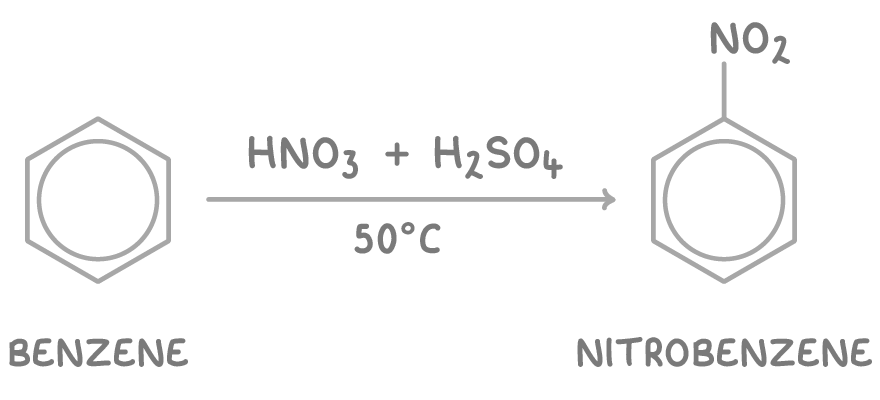
The mechanism of benzene nitration
The nitration of benzene is an example of an electrophilic substitution reaction. It involves the following steps:
Step 1: Formation of the electrophile
The nitronium ion (NO2+) is formed from a mixture of concentrated sulfuric acid and concentrated nitric acid at 50°C:
HNO3 + H2SO4 ➔ NO2+ + HSO4- + H2O
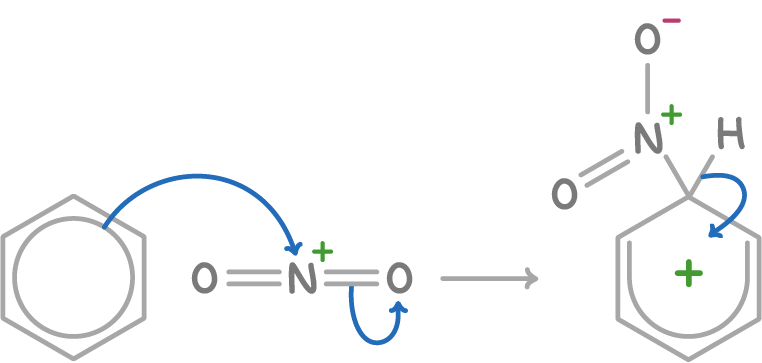
Step 2: Electrophilic attack
- The NO2+ electrophile is attracted to the delocalised π-electrons of the benzene ring.
- Two electrons from the benzene ring are donated to the NO2+ ion, forming a new C–N bond.
- A π-electron from one N-O bond in the NO2+ ion moves onto the oxygen atom.
Breaking the aromatic ring in benzene requires energy, making this the rate-determining step.
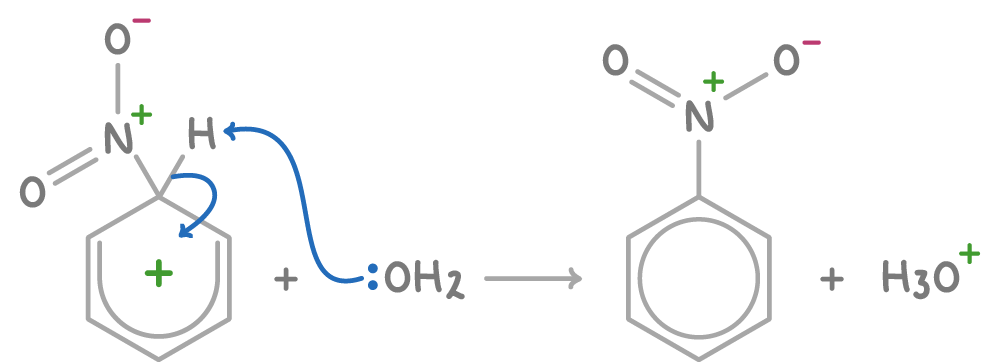
Step 3: Deprotonation
- Water acts as a base, removing a proton from the carbocation intermediate.
- This restores the aromaticity of the benzene ring, yielding the final product, nitrobenzene.
Drawing the mechanism for electrophilic substitution reactions
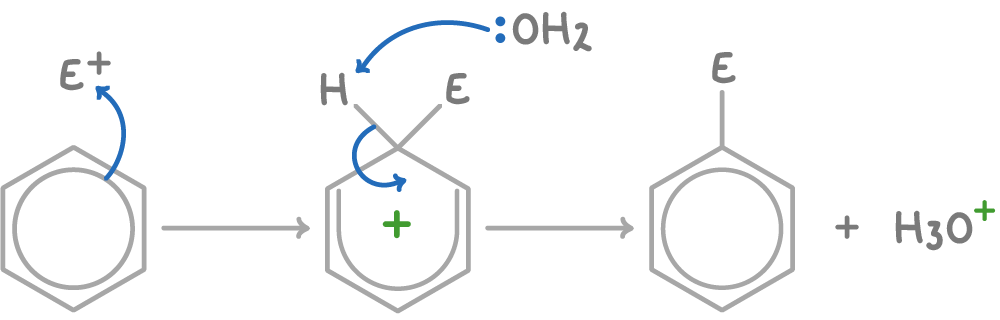
When drawing the mechanism for an electrophilic substitution reaction involving benzene:
- Use a curly arrow from the delocalised electrons in benzene to the positive charge on the electrophile.
- Show the carbocation with an incomplete circle and a positive charge on the ring.
- Draw a curly arrow from the C-H bond to the benzene ring cation for the leaving hydrogen ion.
- Use a curly arrow from a lone pair on water to the leaving hydrogen ion.
- Show the final substituted benzene product along with the released H3O+.