10.6 - Properties of the Transition Elements
- 1
What transition elements are
- 2
The characteristic properties of transition elements
Transition elements are found in the d-block
Most of the elements found in the middle section of the periodic table are classified as transition elements or transition metals. This section is known as the d-block. The highest energy electrons in transition elements are found in the d sub-shell.
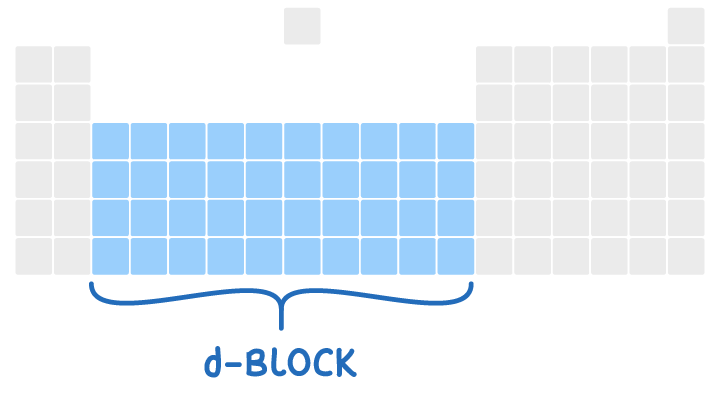
The main transition elements we will focus on are the metals in the first row of the d-block, from scandium (Sc) to copper (Cu).
Transition elements have a partially filled d sub-shell
Transition elements are defined as d-block elements that form one or more stable ions with partially filled d orbitals. This means transition elements have electron configurations with between 1 and 9 electrons in their d sub-shell.
Zinc is found in the d-block but does not meet the definition of a transition element because it only forms Zn2+ ions with an electron configuration of [Ar]3d10, meaning a full d sub-shell.
Characteristic properties of transition elements
The incomplete d sub-shells of transition elements give rise to several characteristic properties:
- Variable oxidation states - Transition elements can exhibit multiple stable oxidation states due to the similar energies of their 4s and 3d sub-shells.
- High melting points - Transition elements have strong metallic bonding, resulting in high melting points.
- Magnetic properties - Many transition elements and their compounds exhibit magnetic behavior due to the presence of unpaired electrons in their d orbitals.
- Catalytic properties - Transition elements and their compounds often act as catalysts in chemical reactions.
- Formation of coloured compounds - The incomplete d sub-shells of transition elements allow for electronic transitions that absorb visible light, resulting in the formation of coloured compounds.
- Formation of complex ions with ligands - Transition elements can form complex ions by bonding with ligands (atoms, ions, or molecules that donate electron pairs) due to the availability of empty orbitals and the relatively small size of the ions.