10.7 - Variable Oxidation States in Transition Elements
- 1
How to deduce electron configurations of transition elements
- 2
The tendency of transition elements to form ions with variable oxidation states
- 3
How successive ionisation energies explain variable oxidation states
Deducing electron configurations of transition elements
The electron configuration of a transition element can be determined from its position on the periodic table.
The process involves these steps:
- Identify the previous noble gas and write its symbol in square brackets. This represents the core electrons.
For example, the previous noble gas for iron (Fe) is argon, so the electron configuration begins with [Ar].
- Determine the valence sublevels from the period number. For transition elements, these are always the $n$s and $(n-1)$d sublevels.
Iron is in period 4, so its valence sublevels are 4s and 3d.
- Deduce the number of valence electrons from the group number.
Iron is in group 8, so it has 8 valence electrons.
- Distribute the valence electrons into the sublevels according to the following rule: Add electrons to the $n$s sublevel until it is full (2 electrons), then add the remaining electrons to the $(n-1)$d sublevel.
For iron, the 8 valence electrons are distributed as follows: 4s2 3d6.
- Write the complete electron configuration by combining the core electrons (step 1) and the valence electrons (step 4).
Therefore, the condensed electron configuration of Fe is [Ar] 4s2 3d6.
Two exceptions to this rule are:
- Chromium: [Ar] 4s1 3d5
- Copper: [Ar] 4s1 3d10
In these cases, an electron is promoted from the 4s to 3d sublevel to achieve a half-filled (Cr) or completely filled (Cu) 3d sublevel, which is more stable. This exceptional configuration minimises electron-electron repulsion and results in a lower overall energy for the atom.
The electronic configurations of all period 4 transition elements are summarised in the following table:
| Element | Symbol | Condensed electronic configuration |
|---|---|---|
| Scandium | Sc | [Ar] 4s^2^ 3d^1^ |
| Titanium | Ti | [Ar] 4s^2^ 3d^2^ |
| Vanadium | V | [Ar] 4s^2^ 3d^3^ |
| Chromium | Cr | [Ar] 4s^1^ 3d^5^ |
| Manganese | Mn | [Ar] 4s^2^ 3d^5^ |
| Iron | Fe | [Ar] 4s^2^ 3d^6^ |
| Cobalt | Co | [Ar] 4s^2^ 3d^7^ |
| Nickel | Ni | [Ar] 4s^2^ 3d^8^ |
| Copper | Cu | [Ar] 4s^1^ 3d^10^ |
Variable oxidation states
A distinctive property of transition elements is their ability to form stable ions in different oxidation states. This means that a single transition element can form multiple ions, each with a different charge, depending on the number of electrons lost.
When a transition element atom loses electrons to form an ion, the 4s electrons are always lost before the 3d electrons.
For example, when an iron atom forms an Fe2+ ion, it loses the two 4s electrons first:
Fe: [Ar] 4s23d6
Fe2+: [Ar] 3d6
If the iron atom loses one more electron to form an Fe3+ ion, it will come from the 3d subshell:
Fe3+: [Ar] 3d5
The ability to lose varying numbers of electrons allows transition elements to form ions with different charges, leading to the formation of compounds in different oxidation states.
For example, manganese commonly forms ions in the +2, +4, and +7 oxidation states. As a result, it can form stable oxides with the following formulas:
- Manganese(II) oxide: MnO
- Manganese(IV) oxide: MnO2
- Manganese(VII) oxide: Mn2O7
This table summarises the common oxidation states for each period 4 transition element. The most common oxidation states are bolded.
| Element | Oxidation states |
|---|---|
| Sc | +3, +2 |
| Ti | +4, +3, +2, +1 |
| V | +5, +4, +3, +2, +1 |
| Cr | +6, +5, +4, +3, +2, +1 |
| Mn | +7, +6, +5, +4, +3, +2, +1 |
| Fe | +6, +5, +4, +3, +2, +1 |
| Co | +5, +4, +3, +2, +1 |
| Ni | +4, +3, +2, +1 |
| Co | +3, +2, +1 |
Explaining variable oxidation states
The ability of transition elements to form ions with variable oxidation states can be explained by their successive ionisation energies. In general, transition elements have successive ionisation energies that are relatively close in value, especially for the first few ionisations. This allows them to lose multiple electrons and form stable ions in different oxidation states.
Let's consider the examples of chromium and copper. The graph below shows the first six ionisation energies for both elements:
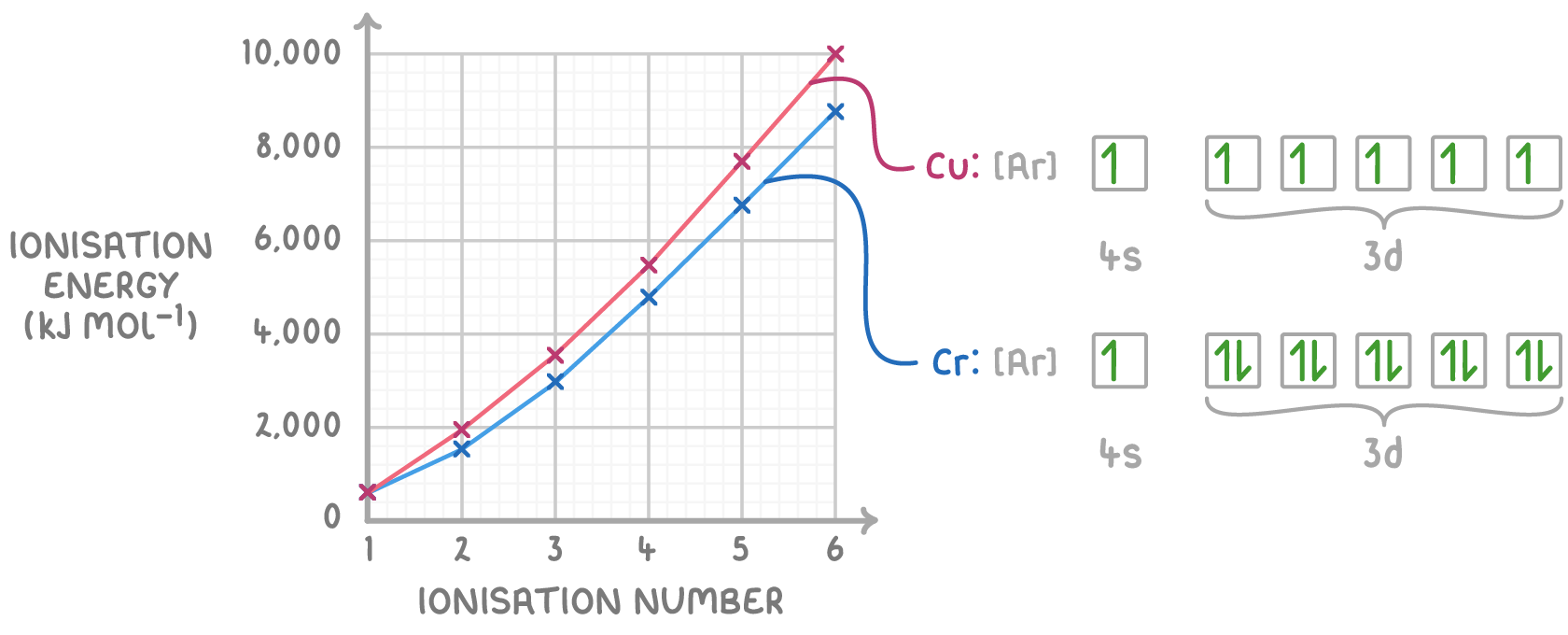
For chromium, the small, steady increase in energy from the 1st to the 6th ionisation means that it can form stable ions with oxidation states from +1 to +6 by losing up to six electrons. The most common ions of chromium are Cr3+ and CrO42-/Cr2O72-.
In contrast, copper shows larger increments between successive ionisation energies. The larger jumps in ionisation energy mean that it becomes increasingly difficult for copper to lose more electrons after the first two. As a result, copper forms fewer stable ions compared to chromium. The common ions of copper are Cu+ and Cu2+.
While Cu(III) and Cu(IV) are known in some compounds, they are far less stable due to the high ionisation energies required to remove additional electrons.