7.6 - Chromatography
- 1
What chromatography is and how it works
- 2
Paper chromatography
- 3
Thin-layer chromatography (TLC)
Chromatography separates mixtures
Chromatography is a technique used to separate the components of a mixture based on their relative attractions involving intermolecular forces to mobile and stationary phases.
- The mobile phase - A liquid or gas that carries the mixture through a system.
- The stationary phase - A solid or solid-supported liquid that does not move with the mobile phase.
The separation in chromatography occurs due to the differences in the relative attractions between the mixture components and the mobile and stationary phases, which are governed by intermolecular forces such as hydrogen bonding, dipole-dipole forces, and London (dispersion) forces.
Two main factors influence the separation process:
- Mobile phase interactions - Components with stronger intermolecular forces of attraction to the mobile phase are more soluble and, therefore, move faster through the system.
- Stationary phase interactions - Components with stronger intermolecular forces of attraction to the stationary phase are retained longer and move slower through the system.
The interplay between these two factors determines the rate at which each component travels through the chromatographic system, resulting in the separation of the mixture into its individual components, which can be individually analysed.
You'll learn about two types of chromatography in this lesson:
- Paper chromatography
- Thin-layer chromatography (TLC)
Paper chromatography of mixtures
Paper chromatography is a simple and cost-effective chromatography technique used to separate and analyse mixtures. In this method, the stationary phase is chromatography paper and the mobile phase is a liquid solvent or a mixture of solvents.
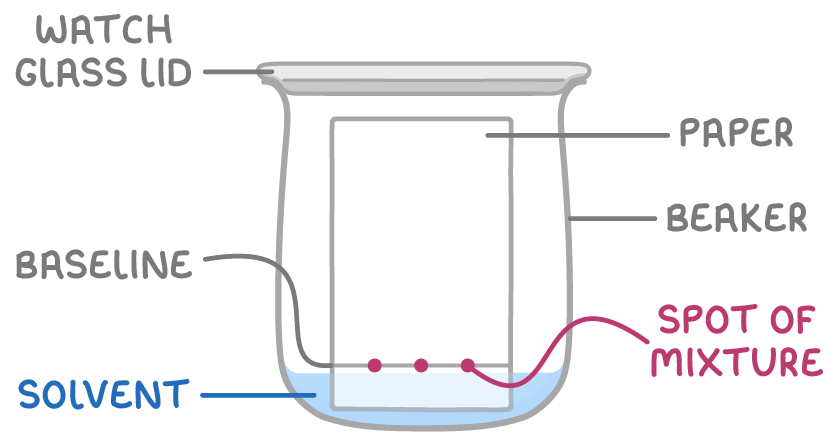
How paper chromatography works:
- A small spot of the mixture to be analysed is placed near the bottom edge of the chromatography paper.
- The paper is then placed vertically in a sealed container with a small amount of the mobile phase (solvent) at the bottom, ensuring that the mixture spot is above the solvent level.
- As the solvent moves up the paper by capillary action, it carries the mixture components along with it. The components with stronger intermolecular forces with the mobile phase and weaker interactions with the stationary phase move faster, while those with weaker attractions to the mobile phase and stronger attractions with the stationary phase move slower.
- Once the solvent front has nearly reached the top of the paper, the chromatogram is removed from the container and allowed to dry.
- The separated components appear as distinct spots or bands on the chromatography paper.
Using Rf values to identify substances
The retardation factor (Rf) value is the ratio of the distance travelled by a component (spot) from the baseline to the distance travelled by the solvent. Rf values range from 0 to 1.
The Rf value can be calculated for each component using the formula:
$ \text{R}_\text{f }=\frac{\text{distance travelled by spot }}{\text{distance travelled by solvent}} $
These distances are represented on the chromatogram below.
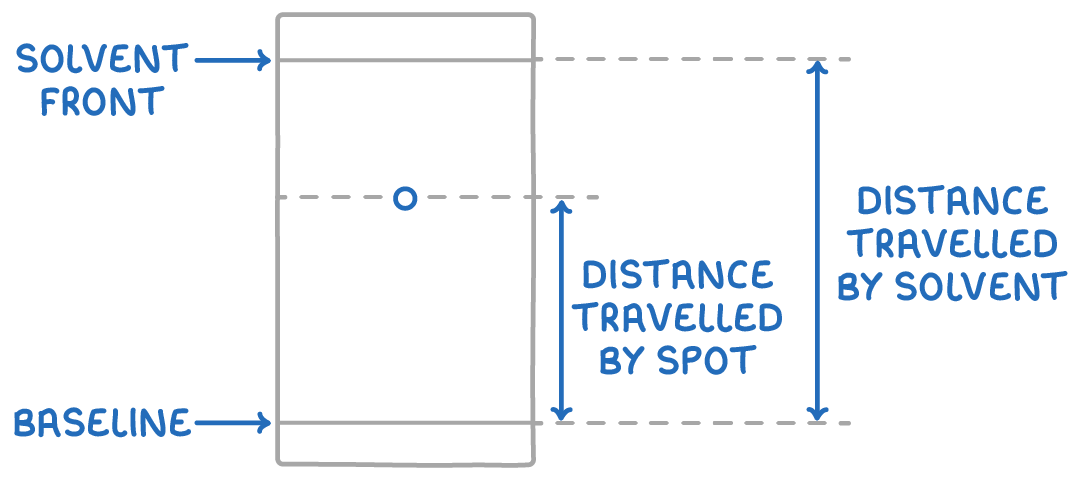
The Rf values can be used to identify the components of the mixture by comparing them with the Rf values of known substances under the same chromatographic conditions.
Thin-layer chromatography of mixtures
Thin-layer chromatography (TLC) is another simple and inexpensive form of chromatography used to analyse mixtures. In TLC, the stationary phase is typically silica gel or alumina, which is spread thinly on a support material like glass or metal. The mobile phase is a liquid solvent or a mixture of solvents.
How TLC works:
TLC works in exactly the same way as paper chromatography, with the separation process governed by the strength of intermolecular forces between the mixture components and the mobile and stationary phases.
Calculating Rf values in TLC:
The retardation factor (Rf) value is calculated in the same way as in paper chromatography.