7.7 - Benzene & Resonance
- 1
The concept of resonance structures and how they are represented
- 2
Delocalisation of electrons in molecules and ions
- 3
Benzene as a prime example of resonance and delocalisation
- 4
Physical and chemical evidence supporting the delocalised model of benzene
Resonance occurs when multiple Lewis structures are possible
In some molecules, a single Lewis structure fails to fully describe the bonding. Instead, the molecule is better described by two or more resonance structures.
Resonance arises when there are multiple potential positions for a double or triple bond within a molecule.
A classic example is ozone (O3), which can be represented by two Lewis structures:
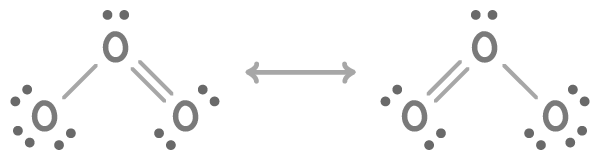
These resonance structures might suggest that ozone's two oxygen-oxygen bonds are different, with one being a single bond and the other a double bond. However, experimental evidence reveals that the actual ozone molecule is a hybrid of these two resonance forms.
Both O-O bonds in ozone are:
- Identical to each other.
- Intermediate in length and strength between a single O-O bond and a double O=O bond.
| Bond | Length (10^-12^ m) | Average bond enthalpy (kJ mol^-1^) |
|---|---|---|
| O-O single bond | 148 | 144 |
| O-O bond in ozone | 128 | 362 |
| O=O double bond | 121 | 498 |
Delocalisation involves electron sharing between three or more atoms
Resonance structures can be represented as a single structure using the concept of delocalisation.
In typical covalent bonds, a pair of electrons is shared (localised) between two atoms. Delocalisation, on the other hand, involves the sharing of electrons by more than two atoms in a molecule or ion.
Consider the sulfur dioxide molecule (SO2). It can be represented by two resonance structures:
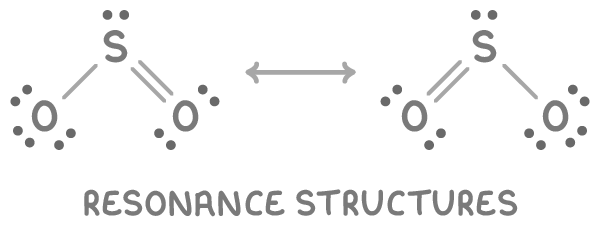
In this molecule, the sulfur-oxygen bonds have lengths and strengths intermediate between those of a single S-O bond and a double S=O bond. Here, one electron pair is delocalised across the two S-O bonding domains.
To represent this delocalisation, the molecule can be depicted using a single structure with a dashed line:
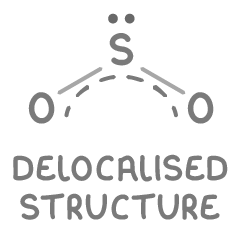
Note that this delocalised structure is not a true Lewis formula, as it does not specify the exact locations of bonding and non-bonding electron pairs.
Benzene is a prime example of resonance and delocalisation
Benzene (C6H6) is a key example of a molecule exhibiting resonance and delocalisation.
The Lewis structure for benzene features a six-membered ring of carbon atoms connected by alternating single and double bonds, known as the Kekulé structure.
Two resonance structures are possible:
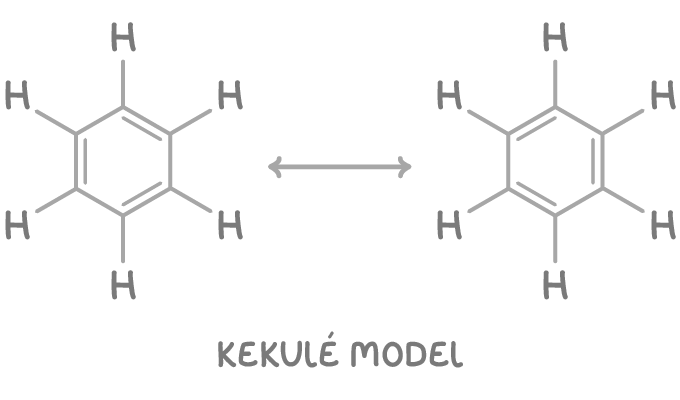
Some of the electrons in the carbon-carbon bonds of benzene are delocalised around the ring. These delocalised electrons are often represented by a circle inside the hexagonal structure:

Benzene is an aromatic hydrocarbon. The term "aromatic" describes planar, cyclic molecules that are stabilised by delocalised electrons. Benzene is the simplest aromatic hydrocarbon, and similar structures are found in a wide range of compounds.
How the delocalised model is formed
The delocalised model arises from overlap of the unhybridised p-orbitals on the six carbon atoms in benzene:
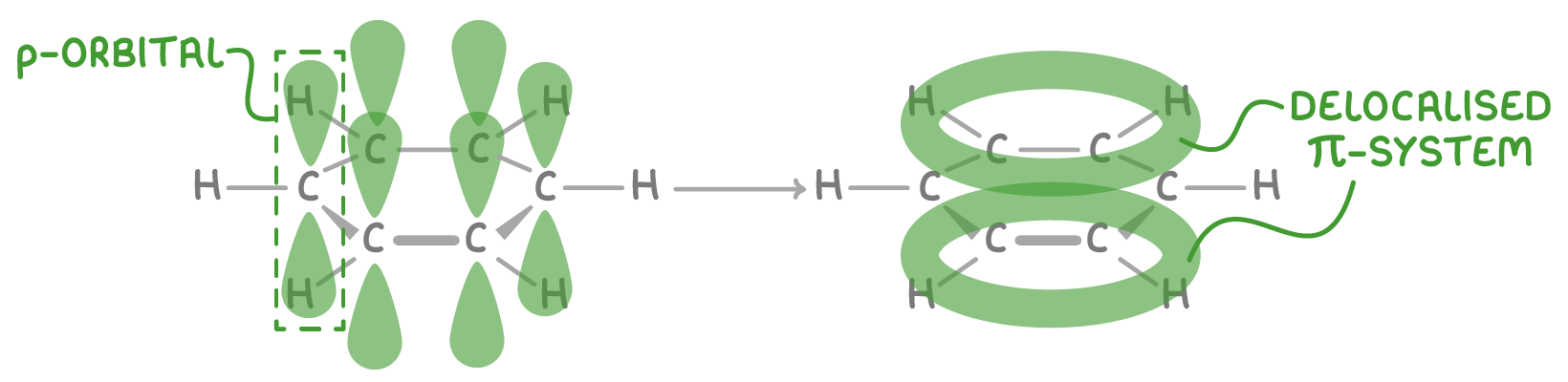
- Each carbon contributes one electron from its unhybridised 2p orbital to a π-bonding system.
- The p-orbitals overlap side-by-side around the ring, forming a delocalised system of 6 π-electrons.
- This creates an electron density above and below the plane of carbon atoms.
- The electrons are not fixed between specific atom pairs, but rather delocalised over the whole ring.
- The carbon atoms in benzene are sp2 hybridised.
Evidence supports the delocalised model
The delocalised model of benzene is strongly supported by scientific evidence.
- Equivalent carbon-carbon bond lengths
- X-ray diffraction techniques have revealed that all carbon-carbon (C-C) bonds in benzene measure 140 pm in length.
- This measurement sits between the length of a typical C-C single bond (134 pm) and that of a C=C double bond (154 pm).
- Such findings contradict the Kekulé model, which would suggest alternating lengths for single and double bonds.
- Enthalpy of hydrogenation
- Hydrogenation of cyclohexene, which has one C=C bond, results in a change in enthalpy (ΔH) of $-$120 kJ mol-1.
- If benzene had three double bonds, as suggested by the Kekulé model, it would have a ΔH of $-$360 kJ mol-1 following the same logic.
- However, the actual ΔH for benzene's hydrogenation is only $-$208 kJ mol-1.
- This indicates that breaking the bonds in benzene requires more energy, suggesting a stability greater than what the Kekulé model predicts.
- Resistance to electrophilic addition reactions
- Unlike alkenes, which readily undergo electrophilic addition reactions (e.g., decolourising bromine water at room temperature), benzene is resistant to such reactions.
- This resistance is due to the delocalised π-electron system, which stabilises the benzene ring and makes it less reactive towards electrophiles.
- The Kekulé model, with its alternating double bonds, would predict benzene to be more reactive, similar to alkenes.
This remarkable stability seen in benzene is attributed to the delocalisation of electrons above and below the hexagonal ring.