17.4 - Catalysts
- 1
What catalysts are and how they work
- 2
The difference between intermediates and transition states
- 3
The effect of catalysts on Maxwell-Boltzmann distribution curves
- 4
Enzymes as biological catalysts
Catalysts increase reaction rates without being consumed
A catalyst is a substance that speeds up the rate of a chemical reaction without being permanently altered or consumed in the process.
Key features of catalysts:
- They provide an alternative reaction pathway with a lower activation energy.
- They are regenerated at the end of the reaction, so only small amounts are needed.
- The overall enthalpy change for the reaction remains the same with or without the catalyst.
Catalysts work by reacting with the starting materials to form an unstable species called an intermediate. This intermediate then undergoes further changes to form the final products, regenerating the original catalyst.
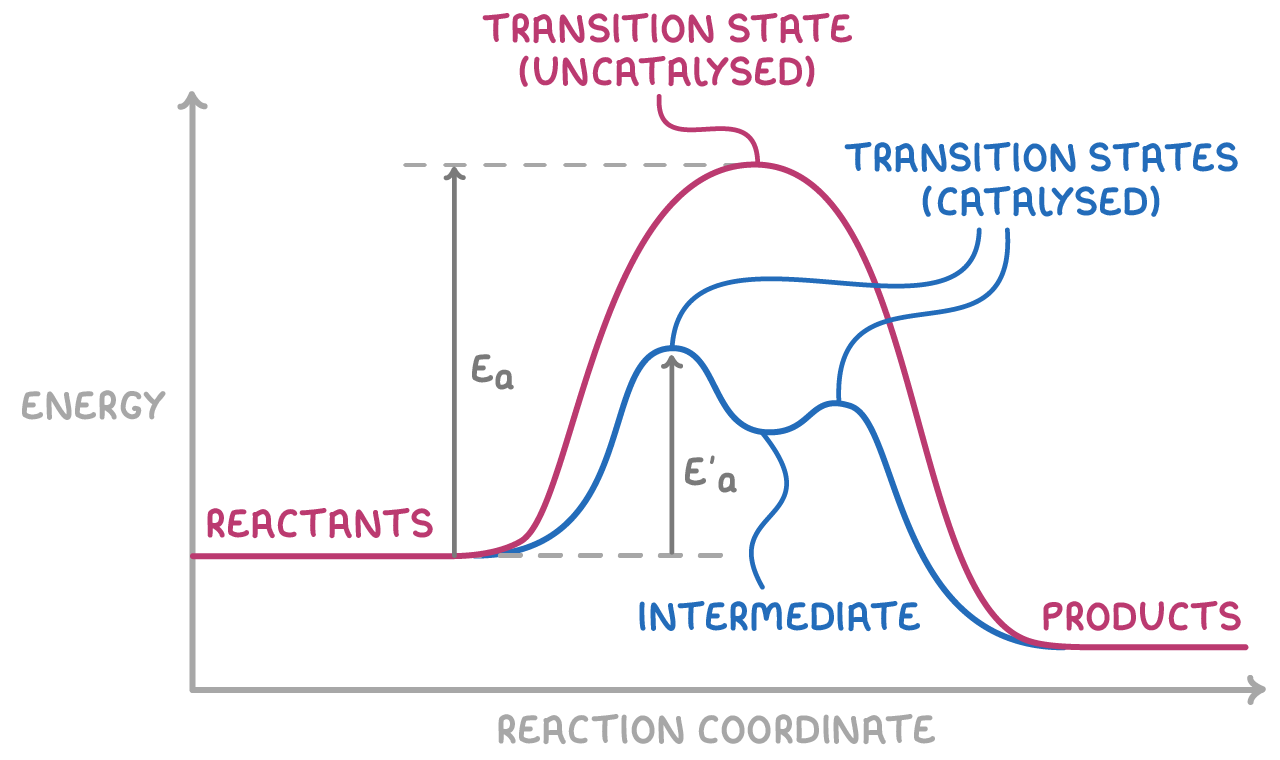
Intermediates vs. transition states
Intermediates and transition states are two important concepts in catalysed reactions:
- An intermediate is a relatively stable species that forms during the reaction and has a finite lifetime. It will eventually react further - But only after some time or if disturbed.
- A transition state is a particular configuration of atoms along the reaction pathway that is extremely unstable and cannot exist for any measurable time period. It immediately converts into products or reverts to reactants.
Catalysts reduce activation energy
By providing an alternative reaction pathway, a catalyst lowers the activation energy barrier that reactants must overcome to form products.
- The catalysed reaction usually involves multiple steps, each with its own lower activation energy.
- These steps typically involve the formation and consumption of reaction intermediates.
- Each step is faster than the uncatalysed reaction as it requires less energy.
- This allows a greater proportion of collisions to be successful, increasing the reaction rate.
This effect can be visualised using a Maxwell-Boltzmann distribution curve:
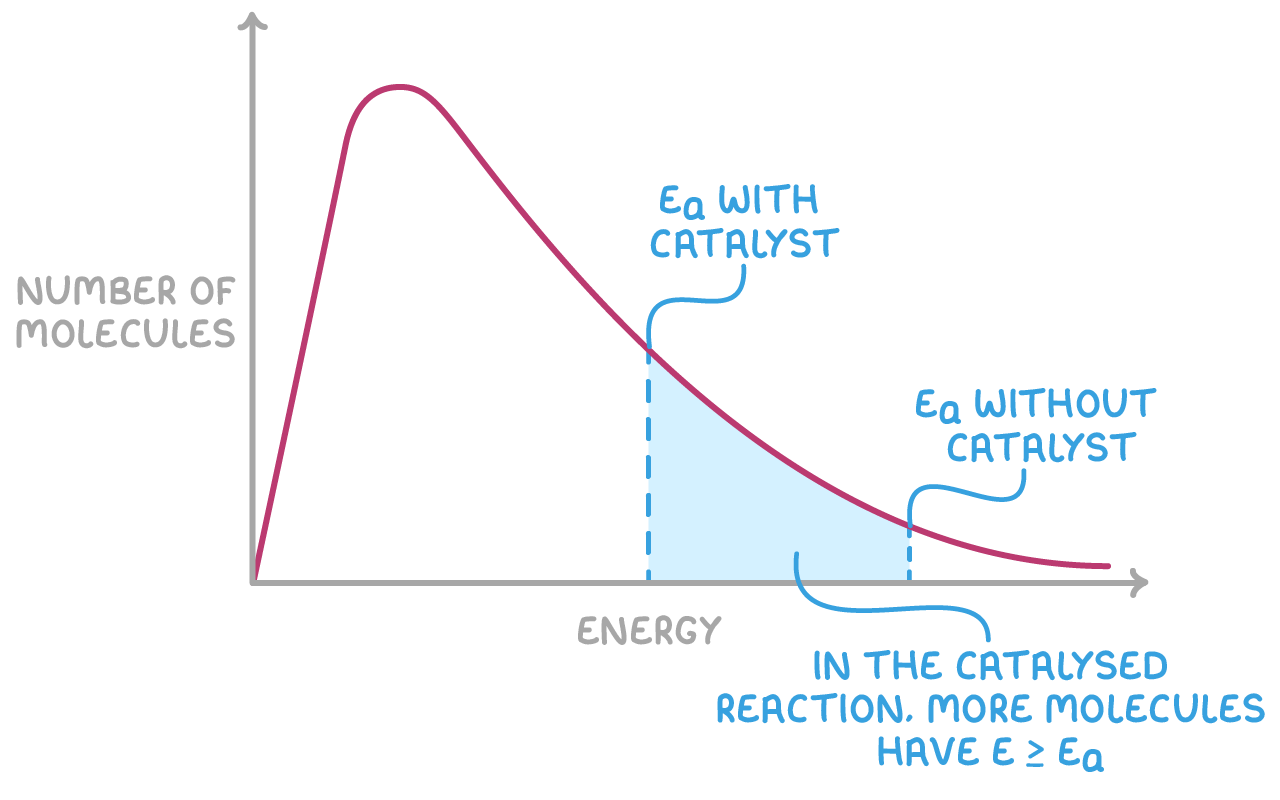
Adding a catalyst:
- Lowers the activation energy barrier.
- Shifts the activation energy threshold to the left on the Maxwell-Boltzmann distribution curve.
- Increases the proportion of particles with enough kinetic energy to react (area under the curve to the right of Ea).
- Does not change the average kinetic energy of the particles.
Enzymes are biological catalysts
Enzymes are protein catalysts that speed up biochemical reactions in living organisms.
Key features of enzyme catalysis:
- Highly efficient - Enzymes can accelerate reactions up to 106 times compared to uncatalysed rates.
- Highly specific - Each enzyme usually catalyses only one specific reaction or a small group of related reactions.
Without enzymes, most biochemical reactions would be too slow to sustain life as we know it.