17.5 - Multistep Reactions
- 1
What reaction mechanisms are
- 2
The difference between intermediates and transition states
- 3
Elementary steps and molecularity
- 4
The rate-determining step
- 5
Drawing energy profile diagrams for multistep reactions
Reaction mechanisms involve multiple chemical changes
A reaction mechanism is the step-by-step sequence of chemical changes that reactants undergo to form products. It shows the order in which bonds are broken and formed, and the changes in relative energy along the way.
Reaction mechanisms involve two types of chemical species:
- Intermediates - Unstable molecules or ions that form in one step and are consumed in a subsequent step. They exist for a measurable time period.
- Transition states - Highly unstable arrangements of atoms that occur at the peak of the activation barrier. They can't be isolated.
Intermediates appear as chemical formulae in a reaction mechanism, whereas transition states are represented by the symbol ‡.
Elementary steps have defined molecularity
A reaction mechanism consists of one or more elementary steps. These are single-stage processes involving one (unimolecular), two (bimolecular), or very rarely three (termolecular) chemical species.
The number of species involved in an elementary step defines its molecularity:
- Unimolecular - One reactant or intermediate undergoes bond-breaking and/or bond-forming in a single step. For example:
A ➔ Products
- Bimolecular - Two reactants or intermediates collide and react in a single step. For example:
A + B ➔ Products
- Termolecular - Three reactants or intermediates collide and react in a single step. For example:
A + B + C ➔ Products
Termolecular steps are very rare because the probability of three particles colliding at the same time and in the right orientation is extremely low. Most elementary steps are unimolecular or bimolecular.
Rate-determining steps have the highest activation energy
Each elementary step has its own activation energy (Ea). The step with the highest Ea is the slowest and determines the overall reaction rate - this is known as the rate-determining step (RDS).
- Changing the concentration of species in the RDS will affect the reaction rate.
- Changing the concentration of species not in the RDS will not affect the reaction rate.
Sketching energy profile diagrams
Energy profile diagrams visually represent reaction mechanisms by showing the relative energies of reactants, products, intermediates, and transition states.
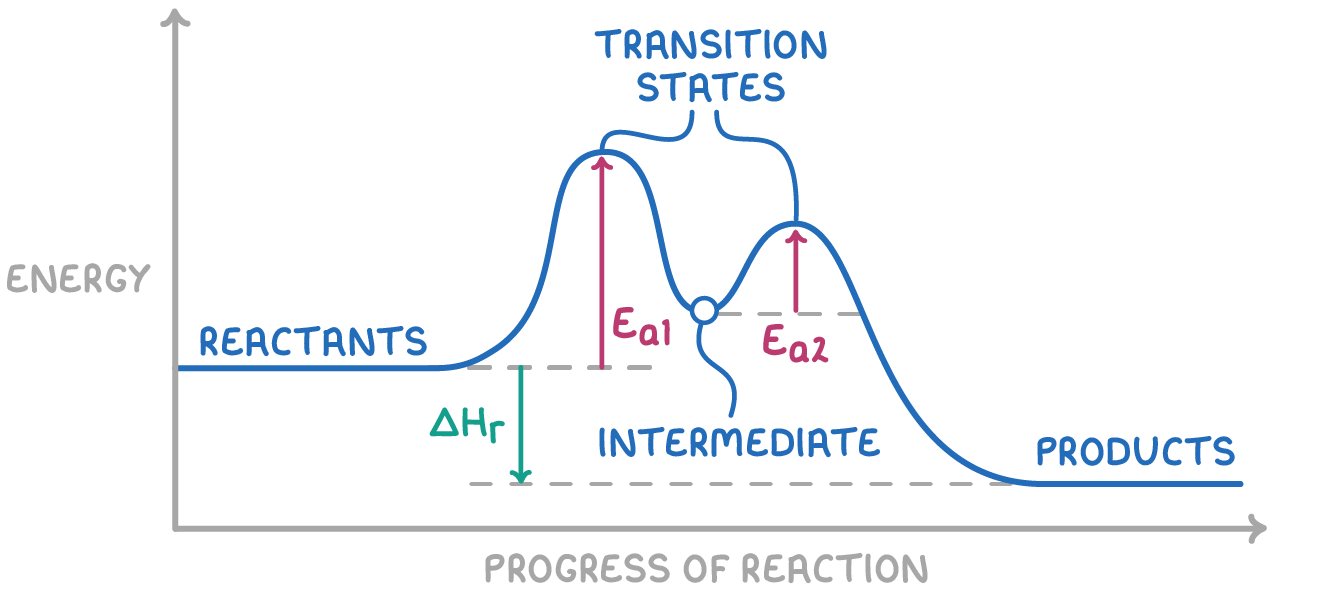
The following guidelines apply when sketching energy profiles for multistep reactions:
- The reactants and products are labelled on the left and right of the diagram respectively.
- Transition states are local maxima on the curve. The number of transition states equals the number of elementary steps.
- Intermediates are local minima in the middle of the diagram. The number of intermediates is always one less than the number of elementary steps.
- The activation energy (Ea) for each step is the difference in energy between the transition state and the species immediately before it. The rate-determining step usually has the largest Ea.
- Intermediates are higher in energy than both reactants and products.
- For an exothermic reaction, the products are lower in energy than the reactants. For an endothermic reaction, the products are higher in energy.
Worked example 1 - Multistep reaction mechanism
Consider the gas phase reaction:
H2(g) + I2(g) ➔ 2HI(g) ΔHr = +51.9 kJ mol-1
At high temperatures, the reaction proceeds in a single step.
At low temperatures, the reaction proceeds via a two-step mechanism:
Step 1: I2(g) ➔ 2I(g)
Step 2: 2I(g) + H2(g) ➔ 2HI(g)
Experimental data shows that the reaction rate is independent of H2 concentration.
Determine the rate-determining step, identify the reaction intermediate, and sketch energy profiles for the reaction at low and high temperatures.
Step 1: Determine the rate-determining step (RDS)
- H2(g) only participates in the second elementary step.
- If this were the RDS, changing [H2] would alter the overall rate.
- Since [H2] has no effect on rate, step 2 must be fast while step 1 is the slow RDS.
Step 2: Identify the reaction intermediate
- Intermediates are species formed in one step and consumed in another, not present in the overall balanced equation.
- The intermediate here is I(g), formed in step 1 and consumed in step 2.
Step 3: Sketch energy profiles for the reaction at low temperature
At low temperatures, the two-step mechanism has one intermediate and two transition states.
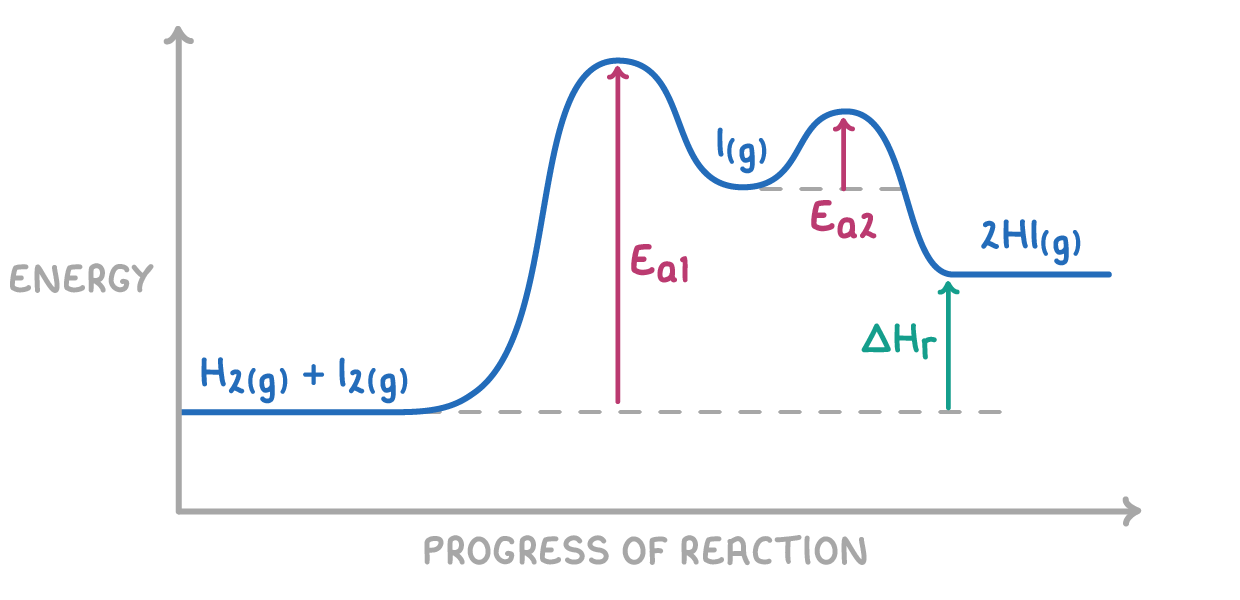
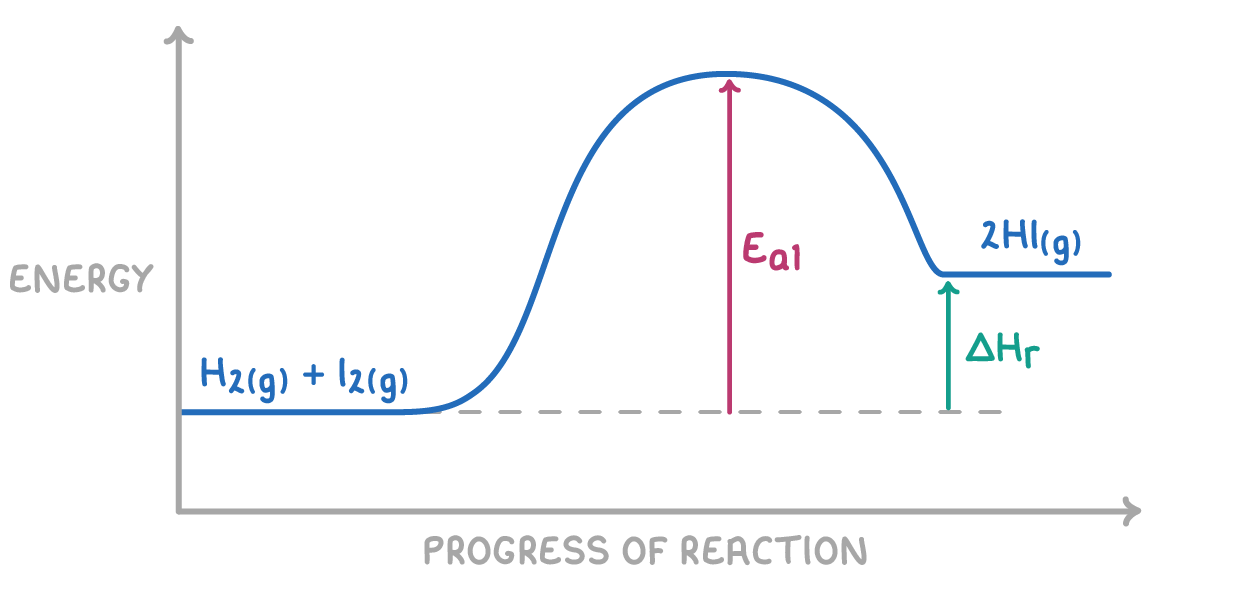
Step 4: Sketch energy profiles for the reaction at high temperature
At high temperatures, the single-step mechanism has one transition state and no intermediates. The reactant and product energy levels are unchanged.