10.1 - Periods, Groups & Blocks in the Periodic Table
- 1
The structure of the periodic table in terms of periods, groups and blocks
- 2
The classification of elements as metals, non-metals and metalloids
- 3
The relationship between an element's position and its electron configuration
Periods and groups in the periodic table
The periodic table is organised into periods (rows) and groups (columns):
- Periods are numbered from 1 to 7 - The period number corresponds to the principal quantum number (n) of the outermost electron sublevels for elements in that period.
For example, elements in period 2 have their valence electrons in sublevels with n=2 (2s or 2p).
- Groups are numbered from 1 to 18 - Elements in the same group have the same number of valence electrons.
For groups 1 and 2, the group number equals the number of valence electrons.
For groups 13 to 18, the last digit of the group number equals the number of valence electrons.
For example, all elements in group 14 have four valence electrons.
For groups 3-12, the number of valence electrons varies.
Some groups have specific collective names, as shown in the table below:
| Group number(s) | Group name |
|---|---|
| 1 | Alkali metals |
| 3-11 | Transition elements |
| 17 | Halogens |
| 18 | Noble gases |
Blocks in the periodic table
The periodic table is further divided into four blocks based on how the valence electrons are arranged:
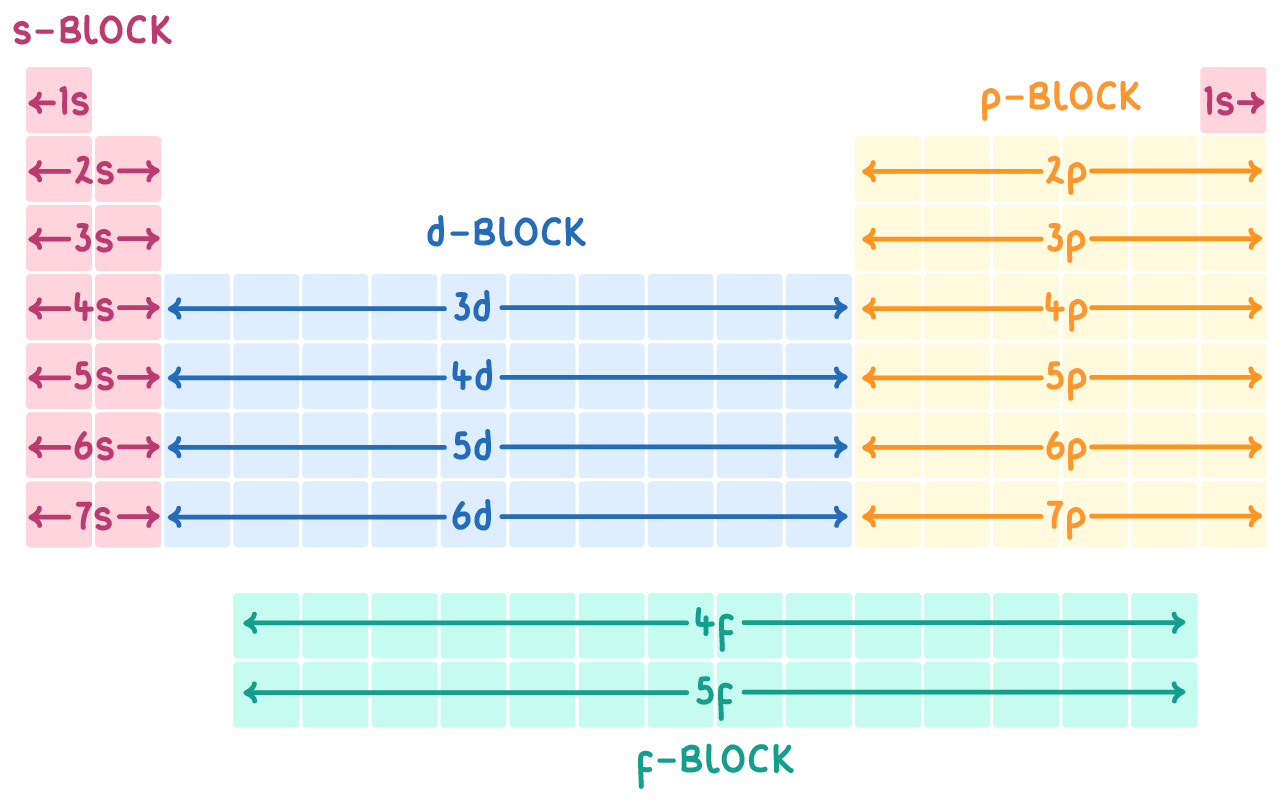
- s-block: Elements in the s-block have their valence electrons in an s sublevel.
For example, the electronic configuration of lithium (Li) is 1s2 2s1.
- p-block: Elements in the p-block have their valence electrons in a p sublevel.
For example, the electronic configuration of oxygen (O) is 1s2 2s2 2p4.
- d-block: Elements in the d-block have their valence electron in a d sublevel.
For example, the electronic configuration of iron (Fe) is 1s2 2s2 2p6 3s2 3p6 4s2 3d6.
- f-block: Elements in the f-block have their valence electron in an f sublevel. The f-block elements are located below the main body of the periodic table.
For example, the abbreviated electronic configuration of neodymium (Nd) is [Xe] 6s2 4f4.
Classifying elements as metals, non-metals and metalloids
Elements can be broadly classified into three categories based on their properties and position in the periodic table: metals, non-metals and metalloids.
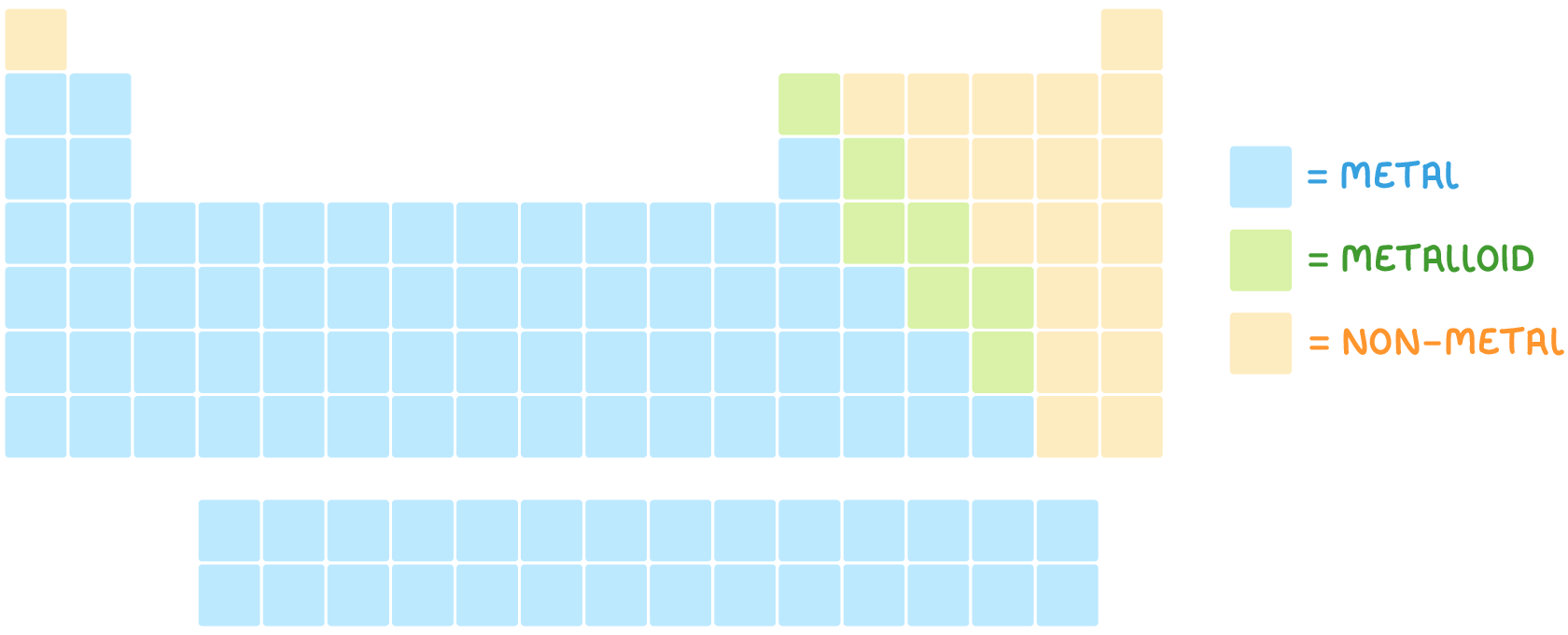
- Metals generally have three or fewer valence electrons - these electrons are delocalised and contribute to metallic bonding. Metals are found to the left of the metalloids in the periodic table.
- Non-metals usually have four or more valence electrons - these electrons are not delocalised. Non-metals are located to the right of the metalloids.
- Metalloids exhibit properties of both metals and non-metals - they can form ionic and covalent bonds. Metalloids are found along the zig-zag line that separates metals from non-metals in the p-block.
Using the periodic table to deduce electron configurations
An element's position in the periodic table provides information that can be used to determine its electron configuration. This process is straightforward for elements in periods 2 and 3.
For example, consider sulfur:
- Being in period 3 means the valence sublevels have a principal quantum number (n) of 3.
- Being in group 16 means it has six valence electrons.
So the condensed electron configuration of sulfur is: [Ne] 3s2 3p4.
For elements in period 4 and beyond, the d sublevels need to be considered - they fill after the s sublevel of the same period, but before the p sublevel.
For example, consider bromine:
- Being in group 17 means it has 17 electrons in its valence sublevels.
- Two electrons occupy the 4s sublevel, ten fill the 3d sublevel, and five are in the 4p.
Therefore, the electron configuration of bromine is: [Ar] 4s2 3d10 4p5.