4.6 - Pressure & Volume
Pressure and volume are inversely proportional
For a fixed mass of gas kept at a constant temperature, pressure and volume are inversely proportional:
- When volume goes up, pressure goes down.
- When volume goes down, pressure goes up.
Why pressure and volume change together
- Gas pressure comes from gas particles colliding with the walls of their container.
- Reducing the volume squeezes the same particles into a smaller space. They hit the walls more frequently, so pressure increases.
- Increasing the volume spreads the particles out. They hit the walls less frequently, so pressure decreases.
- At constant temperature, the particles keep the same average speed, so only the frequency of collisions changes.
The pressure-volume formula (pV = constant)
For a fixed mass of gas at a constant temperature:
This can be written to compare starting and final states:
Where:
- = Pressure, in pascals (Pa)
- = Volume, in cubic metres (m3)
Pressure-volume graph
- A graph of pressure against volume is a curve that falls steeply at first and levels off ().
- This formula only holds for a fixed mass of gas at a constant temperature.
Boyle's Law and the combined gas relationship
For a fixed mass of gas:
Where:
- = Pressure, in pascals (Pa)
- = Volume, in cubic metres (m3)
- = Temperature, in kelvin (K)
Temperature must be in kelvin (K). To convert from degrees Celsius to kelvin, add 273. At constant temperature, (Boyle's Law), so pressure and volume are inversely proportional.
Worked example - New pressure with pV = constant
A fixed mass of gas has a volume of 0.50 m3 at a pressure of 200,000 Pa. It's slowly compressed to a volume of 0.20 m3 at constant temperature. Calculate its new pressure.
Step 1 - Find the constant from the starting values
Step 2 - Rearrange for the new pressure
Step 3 - Calculate
Worked example - Using pV/T = constant
A fixed mass of gas has a volume of 0.0030 m3 at a pressure of 100,000 Pa and a temperature of 300 K. It's compressed to a volume of 0.0020 m3 and heated to 400 K. Calculate its new pressure.
Step 1 - Write the relationship as a before-and-after comparison
Step 2 - Rearrange for the new pressure
Step 3 - Substitute the values and calculate
Required practical - Investigating Boyle's Law
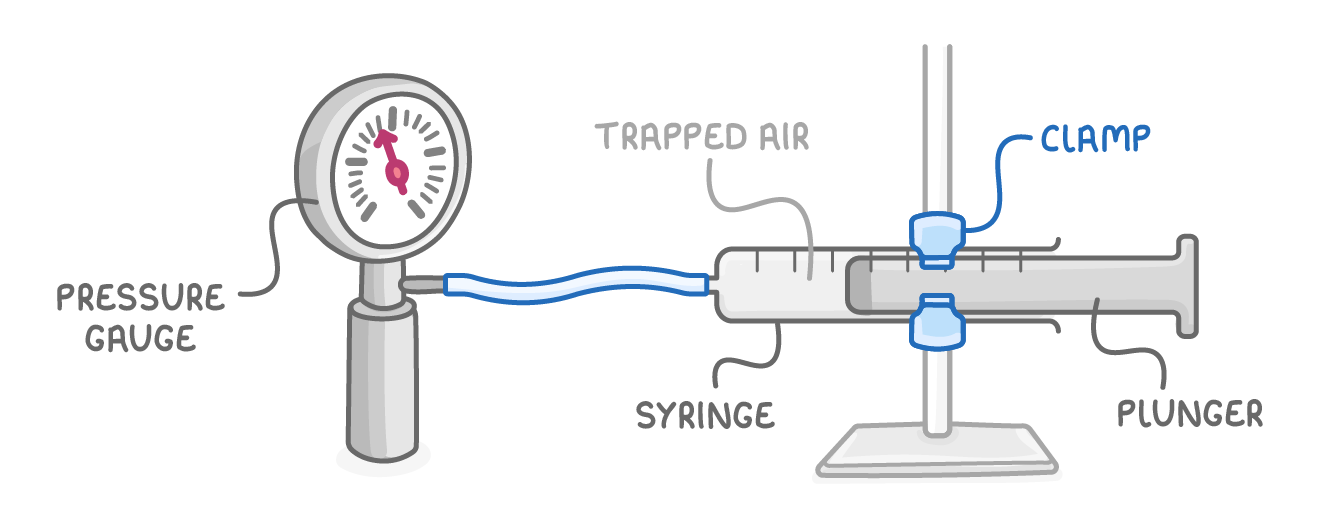
The pressure-volume relationship for a fixed mass of gas can be investigated with a sealed syringe connected to a pressure gauge.
Method
- Seal a fixed mass of air in the syringe and connect it to the pressure gauge. Keep the connecting tube short to minimise unmeasured air volume.
- Clamp the syringe rather than holding it, so body heat doesn't warm the trapped air.
- Read the volume from the syringe and the pressure from the gauge.
- Slowly push the plunger in to reduce the volume in steps. Doing this slowly keeps the temperature constant.
- Record the pressure and volume at several intervals.
Analysing the results
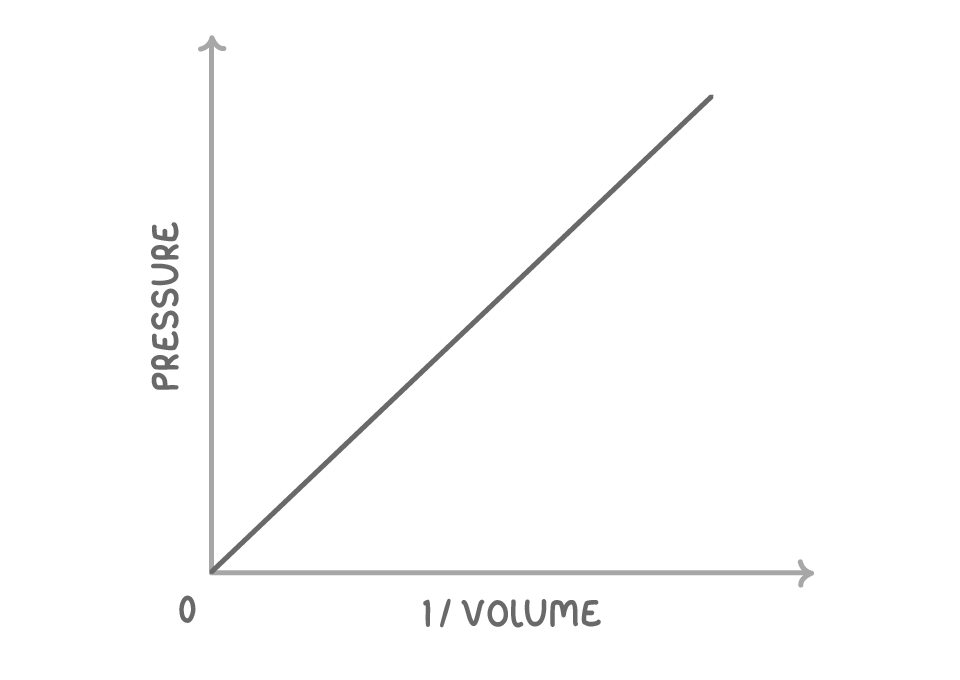
- Plot a graph of pressure against .
- If pressure is inversely proportional to volume, the points lie on a straight line through the origin, confirming Boyle's Law.