4.7 - Gas Laws
Pressure and temperature at constant volume
- For a fixed mass of gas at constant volume, the pressure is directly proportional to the temperature in kelvin (Gay-Lussac's law).
- Heating the gas makes its particles move faster, so they strike the walls more often and with greater force, increasing the pressure.
- A graph of pressure against temperature in kelvin is a straight line through the origin.
Formula for pressure and temperature at constant volume
Where:
- = Starting and final pressures
- = Starting and final temperatures, in kelvin (K)
Temperatures must be in kelvin, not degrees Celsius. Convert from Celsius to kelvin by adding 273.
Worked example - Pressure of a heated gas at constant volume
A sealed, rigid canister holds a fixed mass of gas at a pressure of 120 kPa and a temperature of 280 K. It is heated until the temperature reaches 350 K. Its volume does not change. Calculate the new pressure.
Step 1 - Formula
Step 2 - Check the temperatures are in kelvin
Both temperatures are already in kelvin (280 K and 350 K), so no conversion is needed.
Step 3 - Rearrange, substitute and calculate
Investigating Gay-Lussac's law
Method
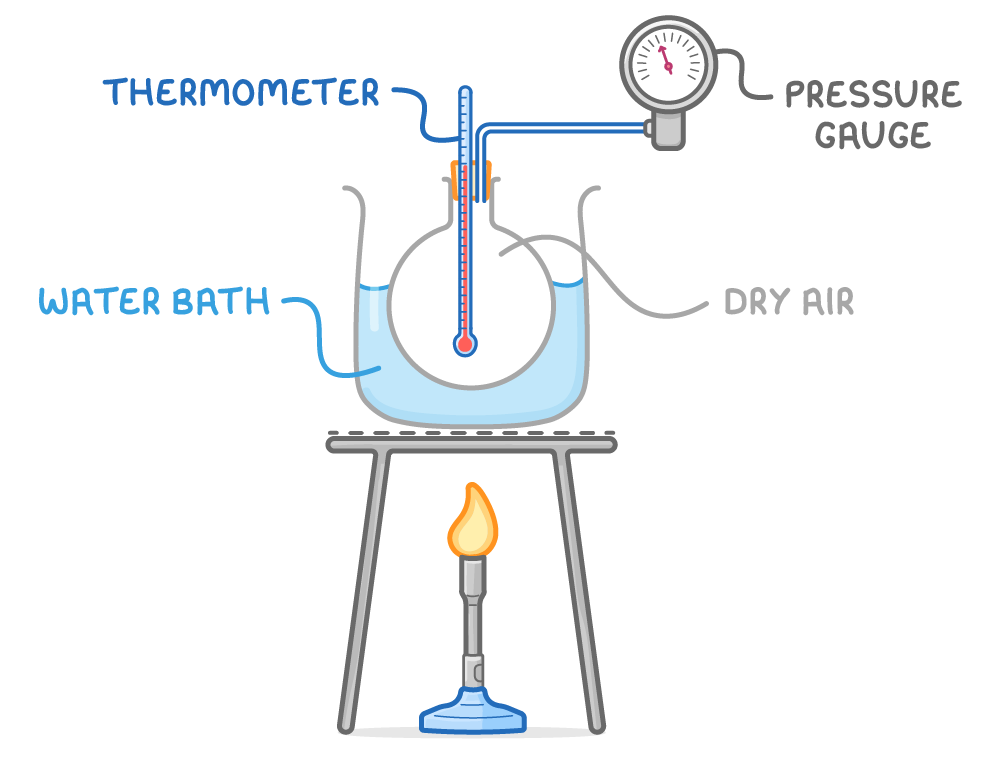
- Seal a flask of air with a stopper carrying a thermometer, and connect the stopper to a pressure gauge with a short tube. The tube's volume must be much smaller than the flask's so that unheated air in the tube does not significantly affect the results.
- Stand the flask in a beaker of water, submerging as much of it as possible, and heat gently until near boiling.
- Record the temperature of the air in the flask and the pressure on the gauge.
- Let the water cool, regularly recording matching pairs of temperature and pressure.
- Convert each temperature from °C to kelvin by adding 273.
Analysing the results
- Plot a graph of pressure against temperature in kelvin.
- The line of best fit is a straight line through the origin, showing pressure is directly proportional to kelvin temperature.
Explaining the results
- As the gas cools, particles lose kinetic energy and move more slowly.
- At constant volume, they collide with the walls less often and with less force.
- This reduces the total force per unit area, lowering the pressure ().
Volume and temperature at constant pressure
- For a fixed mass of gas at constant pressure, the volume is directly proportional to the temperature in kelvin (Charles' law).
- Heating the gas makes its particles move faster, striking the walls harder and more often. For pressure to stay constant, the gas must expand, spreading the particles out so they strike each unit of wall area less often.
- A graph of volume against temperature in kelvin is a straight line through the origin.
Formula for volume and temperature at constant pressure
Where:
- = Starting and final volumes
- = Starting and final temperatures, in kelvin (K)
Investigating Charles' law
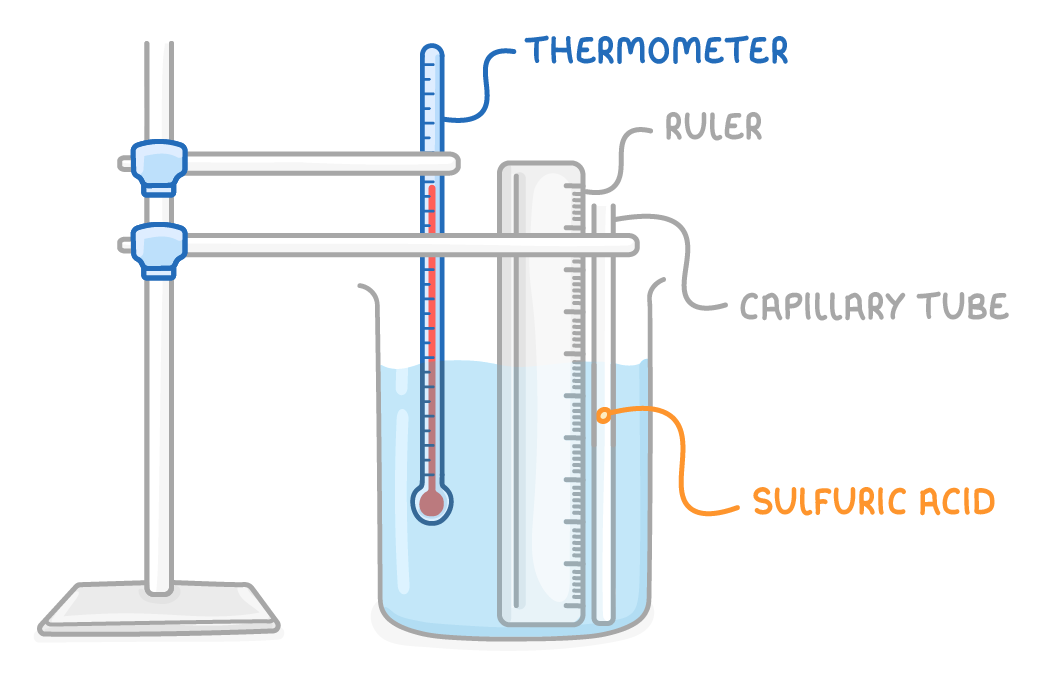
Use a thin capillary tube with a sealed bottom end, and a small drop of concentrated sulfuric acid part-way up the tube trapping a column of air below it. Because the tube has a uniform bore, the volume of trapped air is proportional to the length of the column.
- Clamp the tube alongside a ruler in a beaker of water, with a thermometer in the water.
- Heat the water until near boiling, then let it cool.
- As it cools, regularly record matching pairs of water temperature and column length.
- Convert each temperature from °C to kelvin by adding 273.
- Plot a graph of column length against temperature in kelvin. The line of best fit is a straight line through the origin, confirming that volume is directly proportional to kelvin temperature.
Worked example - Volume of a heated gas at constant pressure
A fixed mass of gas has a volume of 0.40 m3 at a temperature of 300 K. It is heated at constant pressure until the temperature reaches 450 K. Calculate the new volume.
Step 1 - Formula
Step 2 - Check the temperatures are in kelvin
Both temperatures are already in kelvin (300 K and 450 K), so no conversion is needed.