2.2 - Orbits
Gravity provides the force that creates orbits
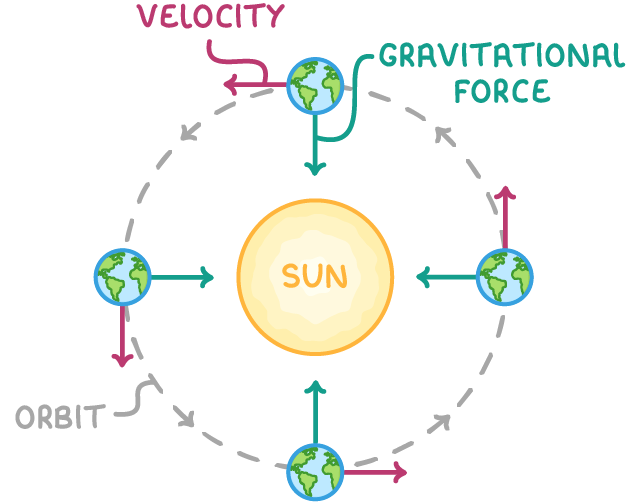
- Planets orbit the Sun, and moons and artificial satellites orbit planets, in almost circular orbits.
- An object moving in a circle is constantly changing direction, so even at a constant speed its velocity is constantly changing.
- A changing velocity means the object is accelerating, which requires a resultant force.
- This force acts towards the centre of the circle.
Gravity provides the inward force
- For an orbiting object, this inward force is provided by gravity:
- The Sun's gravitational pull keeps planets and comets in orbit.
- A planet's gravitational pull keeps moons and artificial satellites in orbit.
- Because the object is already moving, the gravitational pull doesn't pull it straight in - it constantly bends its path into a circle.
Orbital speed and the size of the orbit
- For a circular orbit, the gravitational force acts at right angles to the object's motion.
- This changes the object's direction without changing its speed.
Orbital speed depends on the radius
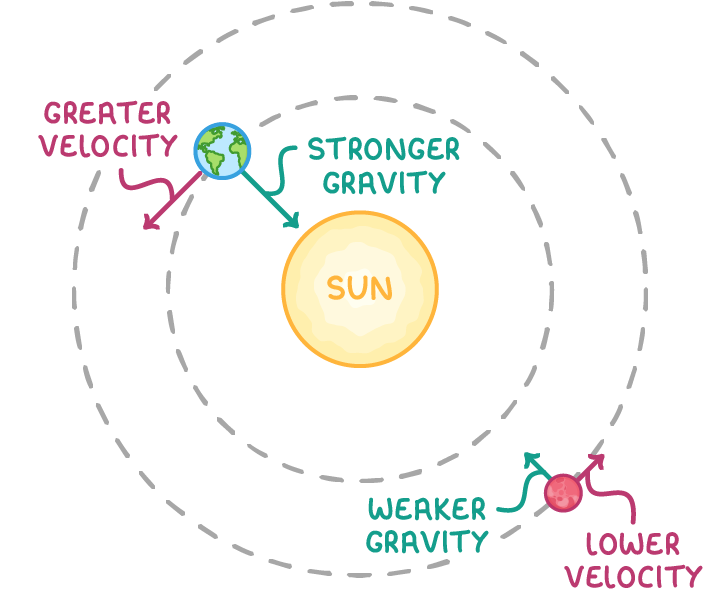
- Gravitational pull is stronger the closer an object is to the body it orbits.
- The stronger the pull, the faster the object must travel to maintain a stable orbit.
- If the speed of an orbiting object changes, its radius must change too:
- A faster object orbits with a smaller radius.
- A slower object orbits with a larger radius.
- This is why planets closer to the Sun travel faster and have shorter orbital periods than planets further out.
Satellite orbits, uses and geostationary satellites
- A satellite is an object that orbits a larger object in space.
- The Moon is a natural satellite; satellites launched from Earth are artificial satellites.
A satellite is a projectile in free fall
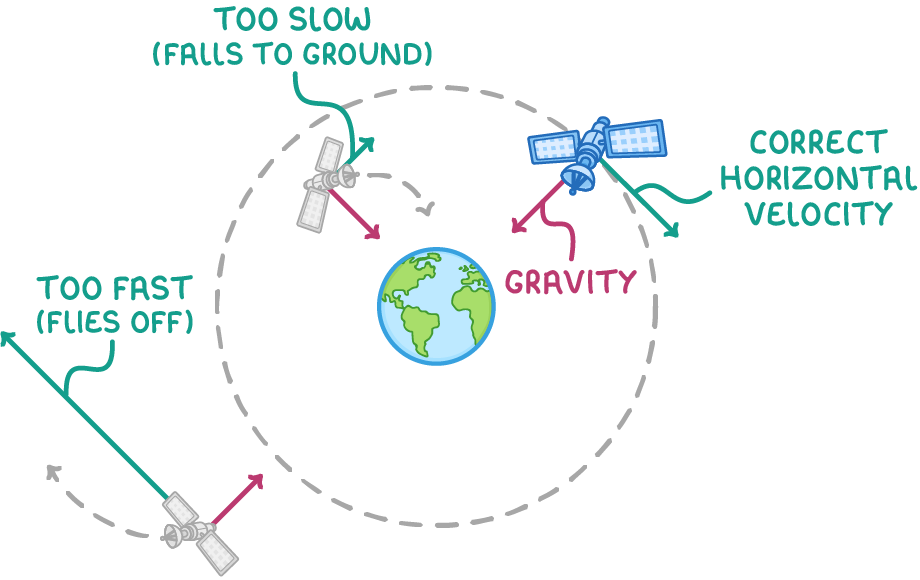
- A satellite is launched with a high horizontal velocity, with gravity (weight) as the only force acting on it in space.
- The satellite is in constant free fall towards the Earth.
- Its horizontal velocity curves its path to match the curvature of the Earth, so it keeps falling around the Earth without getting closer to the surface.
- If it travels too slowly it falls back to the ground, and if it travels too quickly it flies off into space, so only the correct horizontal velocity gives a stable orbit.
Orbital period and altitude
- The orbital period is the time taken for one full orbit.
- A satellite in a higher orbit has a longer orbital period.
Geostationary satellites
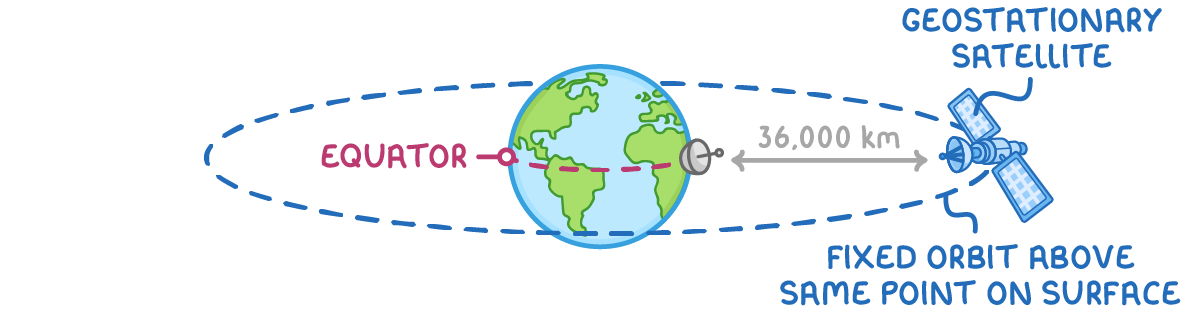
- A geostationary satellite orbits above the equator at an altitude of about 36,000 km with an orbital period of 24 hours.
- Because its period matches the Earth's rotation, it stays above the same point on the surface.
- This is ideal for communications, as a ground receiver dish can stay fixed in one position.
Uses of satellites
- GPS / Navigation - Determining positions for vehicles and phones
- Weather forecasting - Tracking weather patterns and storms
- Communications - Transmitting television, phone, and internet signals
- Earth observation - Monitoring climate change, land use, and pollution
Natural and artificial satellites and their uses
- A satellite is an object that orbits a larger object in space.
- The Moon is a natural satellite of the Earth; satellites placed into orbit by humans are artificial satellites.
Uses of artificial satellites
- Communications - Transmitting television broadcasts, phone calls, and internet data
- Navigation - Providing GPS signals for vehicles and smartphones
- Weather forecasting - Monitoring clouds, temperatures, and storms
- Earth observation - Tracking climate change, agricultural land use, and pollution
- Astronomy - Housing telescopes (like the Hubble Space Telescope) above the atmosphere to avoid atmospheric distortion
- Military - Surveillance and reconnaissance
Satellite communication with microwaves and radio waves
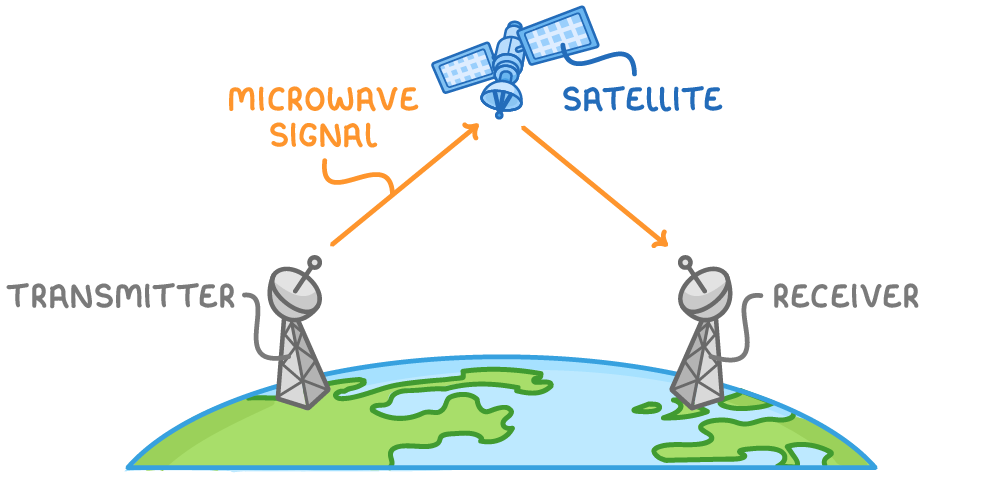
Communication to and from satellites uses microwaves (and high-frequency radio waves) because they pass straight through the Earth's atmosphere without being reflected or absorbed.
How satellite communication works
- A signal is transmitted from Earth up into space.
- A dish on the satellite receives the signal.
- The satellite amplifies and transmits the signal back down to a different location on Earth.
- The signal is picked up by a ground satellite dish.
Geostationary and polar satellites
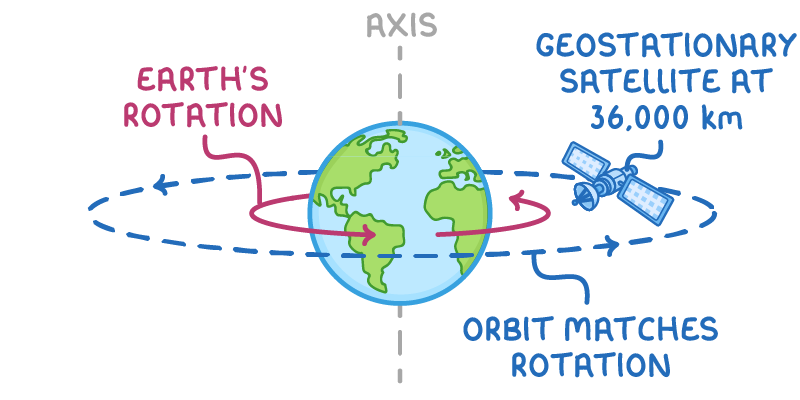
- A geostationary satellite orbits above the Earth's equator at an altitude of about 36,000 km with an orbital period of 24 hours.
- Because its period matches the Earth's rotation, it stays above the same point on the surface.
- This makes geostationary satellites ideal for communications, as ground receiver dishes can point at a fixed spot in the sky.
Low polar orbits
- A satellite in a polar orbit travels over the North and South Poles at a much lower altitude, with an orbital period of around 2 hours.
- As the Earth rotates beneath the satellite, it covers a different strip of the Earth on each orbit, eventually imaging the entire surface.
- This makes polar orbits ideal for weather monitoring, mapping, and Earth observation.
Orbital altitude and orbital period
- The orbital period (the time taken for one full orbit) depends on the satellite's altitude.
- A satellite at a higher altitude experiences a weaker gravitational pull, travels at a lower orbital speed, and has a longer orbital period.
- A geostationary satellite orbits at about 36,000 km and has a period of 24 hours.
- A low Earth orbit satellite orbits a few hundred kilometres up and completes an orbit in roughly 90 to 120 minutes.
TermDefinition
SatelliteAn object that orbits a larger object in space.
Artificial satelliteA satellite that humans have built and put into orbit.
Orbital periodThe time taken for an object to complete one full orbit.
Geostationary satelliteA satellite that orbits above the equator with a period of 24 hours, so it stays above the same point on the Earth's surface.
Polar orbitA low-altitude orbit that passes over the Earth's North and South Poles.