2.3 - Space Travel - Propulsion & Re-Entry
Ion drives
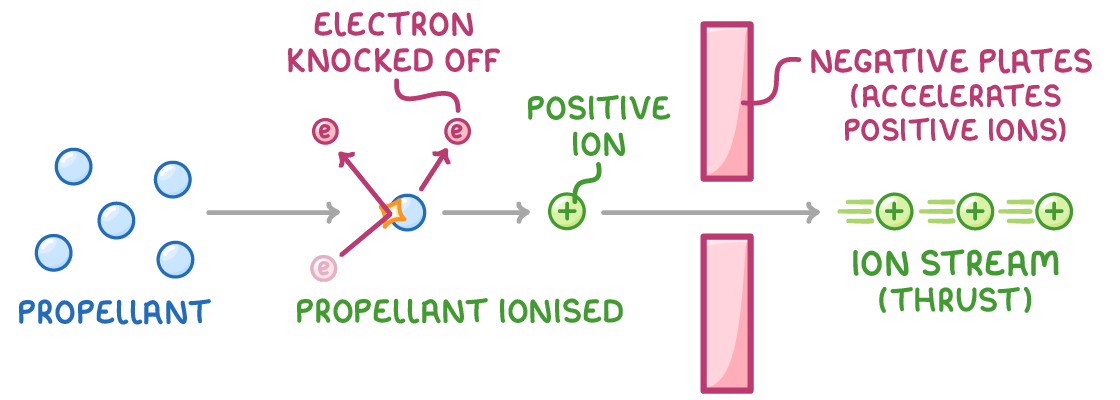
An ion drive is a highly efficient engine that uses far less fuel than a conventional chemical thruster.
How it works
- It ionises a propellant by adding or removing electrons to produce ions.
- It then accelerates those ions to produce thrust.
Small force, big change in speed
- The thrust is tiny, producing only a small unbalanced force.
- Because it can fire continuously for months or years, that small force produces a large change in speed.
- Needing far less fuel makes the spacecraft lighter and cheaper to launch.
Gravitational catapults (slingshots)
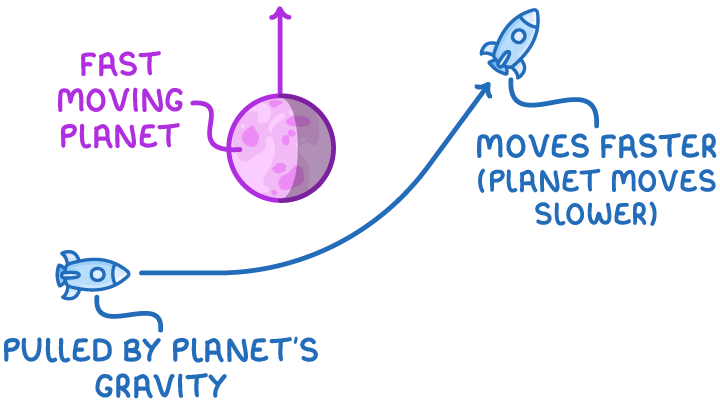
A gravitational catapult (or slingshot) uses the gravity of a moving planet, moon or asteroid to change a spacecraft's speed or direction without using fuel.
How it works
- As the spacecraft enters the body's gravitational field, it's pulled towards the body and accelerates.
- It leaves the field moving faster than it arrived, because some of the body's kinetic energy is transferred to the spacecraft.
- The body is so massive that its own loss of speed is negligible.
Precise manoeuvres with no friction
- Spacecraft often have to make precise manoeuvres, such as entering Earth's atmosphere at an exact angle or docking with a space station.
- This is difficult because space is a zero-friction environment - there's nothing to slow the spacecraft down or hold it in place.
- Small thrusters fire tiny, carefully timed bursts of fuel to nudge the spacecraft into the correct position and orientation.
Re-entry heating and heat shields
- During re-entry, traveling at high speed through the atmosphere produces a very large frictional force on the spacecraft's surface.
- This friction does work on the spacecraft, transferring kinetic energy to heat and reaching temperatures of around 1,600 °C.
Ablation heat shields
- An ablation heat shield is a protective layer designed to burn away on re-entry, carrying heat away from the spacecraft.
- Heat is absorbed in two ways:
- As the shield material rises in temperature
- As some of the material turns into a gas
TermDefinition
Ion driveA highly efficient spacecraft engine that turns a propellant into ions (charged particles) and accelerates them to produce thrust.
Gravitational catapultA manoeuvre that uses the gravity of a moving body to change a spacecraft's speed or direction without using fuel.
Ablation heat shieldA protective layer designed to burn away and carry heat away from a spacecraft during re-entry.