5.5 - Changes of State
Heating or cooling changes temperature or state
- Heating transfers energy to the particles in a substance; cooling transfers energy away.
- Heating or cooling leads to a temperature change or a change of state.
Heating and cooling
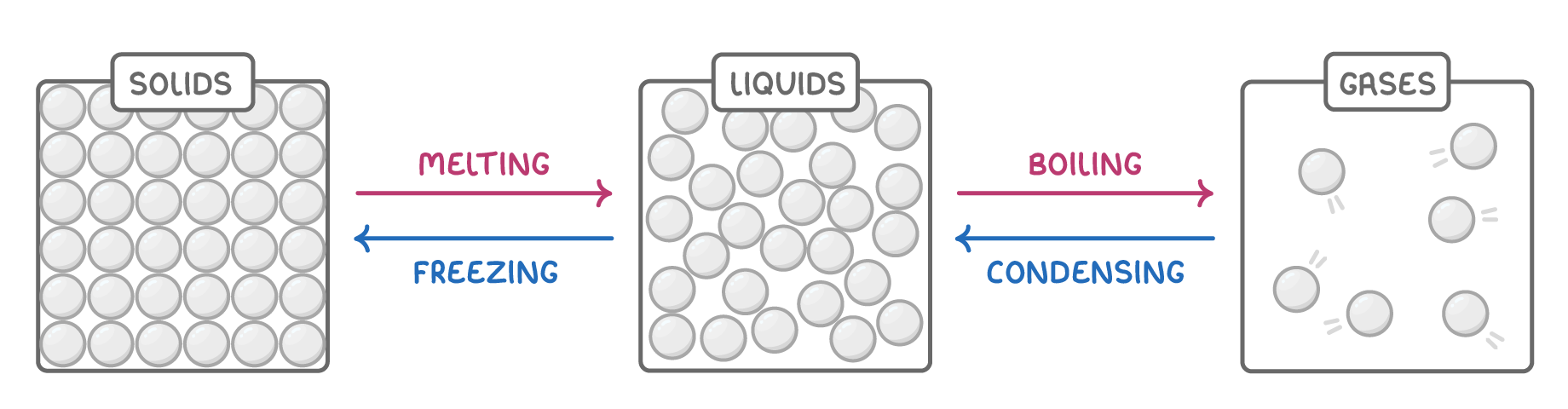
- Temperature change - Heating makes particles move or vibrate faster, raising the temperature. Cooling slows particles down, lowering the temperature.
- Change of state - If heated enough, the energy breaks the bonds between particles rather than raising their temperature. When cooled enough, bonds form between particles.
Temperature stays constant during a change of state
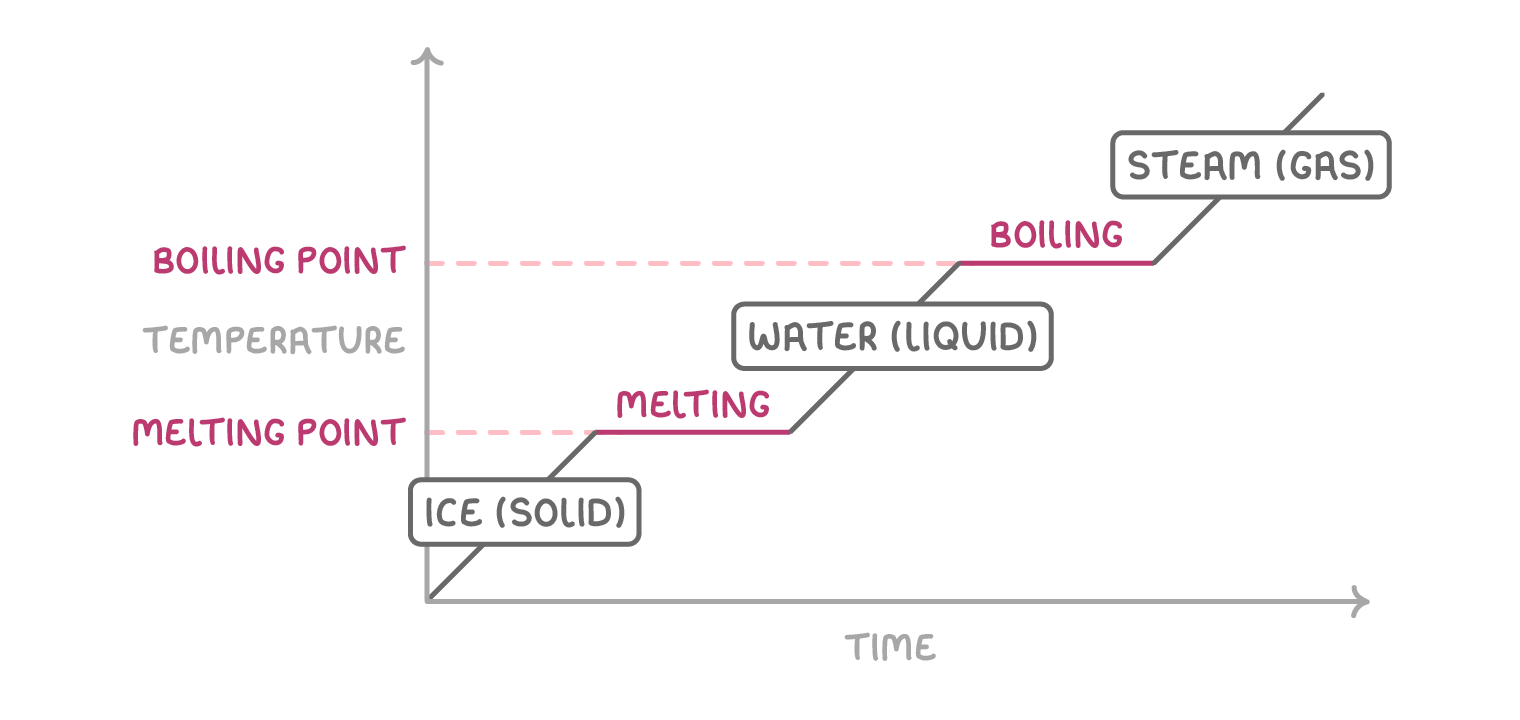
- While a substance is changing state, its temperature does not change.
- During melting or boiling, energy is absorbed to break bonds rather than raise the temperature.
- During condensing or freezing, bonds form and release energy, so the temperature does not fall until the change of state is complete.
- Melting point is the temperature at which a substance melts; boiling point is the temperature at which it boils.
- For pure water at normal atmospheric pressure: melting point 0 °C, boiling point 100 °C.
Practical - Temperature-time graph for melting ice
Method
- Fill a beaker with crushed ice and place a thermometer in it. Record the starting temperature.
- Heat the beaker steadily with a Bunsen burner.
- Record the temperature and state of the contents (e.g. solid, partly melted, liquid) every 20 seconds until the water boils.
- Plot a graph of temperature against time.
What the graph shows
- The graph rises as the ice warms, has a flat section while it melts, rises again as the liquid warms, then flattens while the water boils.
- Each flat section is a change of state at constant temperature: the energy supplied breaks bonds between particles rather than raising the temperature.
- The flat sections occur at the melting point (0 °C for water) and the boiling point (100 °C for water).
TermDefinition
Melting pointThe temperature at which a substance melts.
Boiling pointThe temperature at which a liquid changes into a gas throughout the liquid, not only at its surface.