5.6 - Evaporation
Evaporation
- Evaporation is when particles escape from the surface of a liquid and become gas particles.
- Unlike boiling, evaporation:
- Happens only at the surface, with no bubbles forming.
- Can happen at temperatures below the boiling point of the substance.
How particles escape
- Particles in a liquid move at different speeds, so some have more energy in their kinetic energy stores than others.
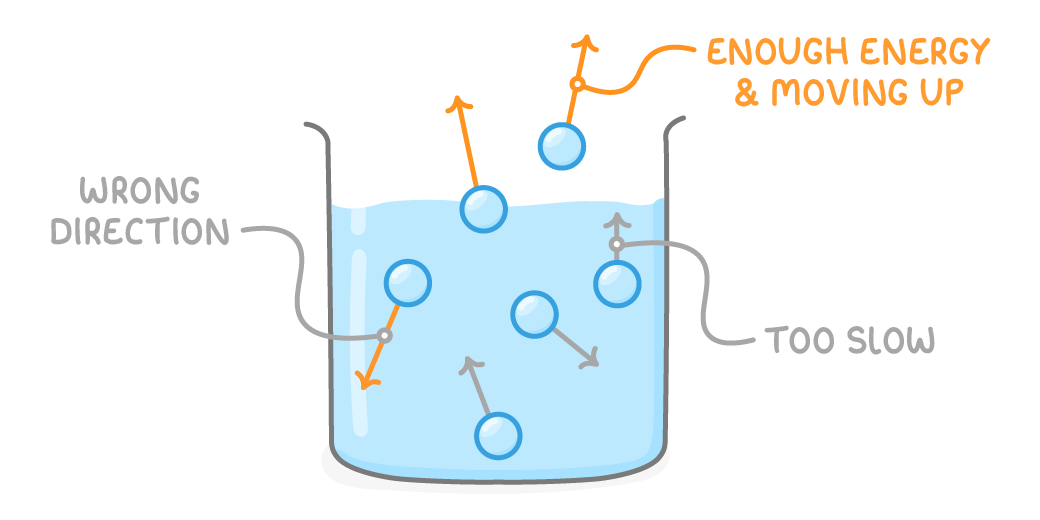
- A particle near the surface can escape if:
- It is moving in the right direction (towards the surface).
- It has enough energy in its kinetic energy store to overcome the attractive forces holding it in the liquid.
Evaporation cools the liquid left behind
- The particles that escape from the surface are the ones with the most energy in their kinetic energy stores.
- When these high-energy particles leave, the average energy in the kinetic energy stores of the remaining particles falls.
- A lower average kinetic energy means a lower temperature, so the remaining liquid cools down.
TermDefinition
EvaporationThe process where particles escape from the surface of a liquid and become a gas.