9.10 - Speed of Sound in Air
The experiment
Aim
To measure the speed of sound in air, either by timing a sound over a measured distance or by measuring the wavelength of a note of known frequency.
Background
- Sound is a longitudinal wave carried by vibrating particles, so it needs a material to travel through. In air it travels at about 340 m/s.
- Light travels nearly a million times faster, so you see a distant bang almost straight away and hear it noticeably later.
- The speed of a wave is distance ÷ time, . It's also frequency × wavelength, .
- Sound moves too fast to follow, but you can time it over a long distance, or set its frequency and measure its wavelength.
- So in this practical you time a sound over a measured distance, or measure the wavelength of a note of known frequency, and work out the speed of sound.
Variables
- Independent variable - None in the timing methods, where you only take measurements. With two microphones, the frequency.
- Dependent variable - The time in the timing methods, and the wavelength with two microphones.
- Control variables - The microphones kept in line with the speaker, and the air temperature, because sound travels a little faster in warmer air.
Method - Timing a sound over a long distance
- Measure the distance - Measure a straight distance of at least 100 m outdoors, with a tape measure or a trundle wheel.
- Time the bang - A partner at the far end bangs two wooden blocks together. Start the stopwatch when you see the blocks meet, and stop it when you hear the bang.
- Repeat - Time at least five bangs, and find the mean time.
Method - Timing echoes off a wall
- Stand back from a wall - Stand about 50 m from a large flat wall with no other buildings nearby, and measure the distance.
- Clap in time with the echo - Clap, and adjust your rhythm until each clap falls exactly on the echo of the one before.
- Time 20 claps - Once the rhythm is steady, start the stopwatch on one clap and stop it on the twentieth clap after that.
Method - Two microphones and an oscilloscope
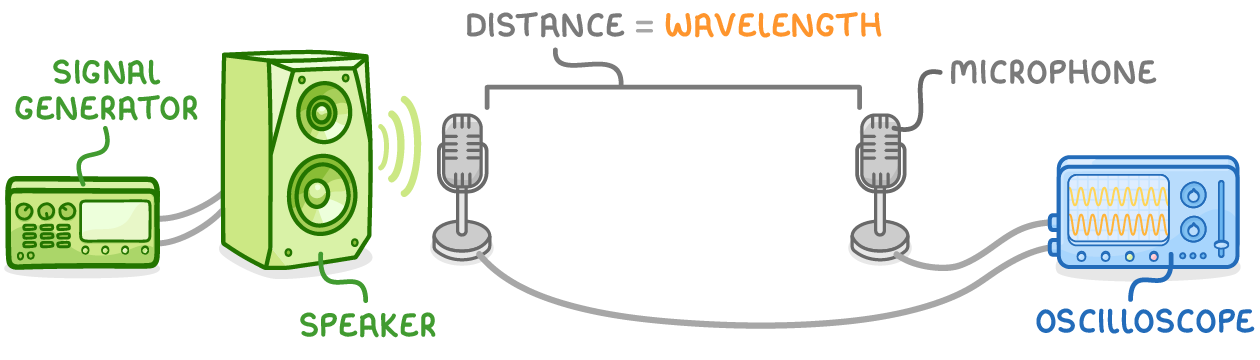
- Set the frequency - Connect a signal generator to a speaker, set it to about 1,000 Hz, and write the frequency down.
- Connect the microphones - Connect two microphones to an oscilloscope, so each draws its own trace.
- Start them side by side - Put both microphones right next to the speaker.
- Move one microphone - Slide it slowly straight away from the speaker, until the two traces come back into step for the first time.
- Find the speed - Measure the distance between the microphones, which is one wavelength, and use .
Safety
- Traffic - Do the outdoor timing away from roads, and keep everyone in sight of each other.
- Loud sounds - Keep the speaker volume moderate, because a loud tone close to your ears can damage your hearing.
Worked example - Comparing two timing methods
A student measured the speed of sound in two ways. First she stood 100 m from a partner who banged two wooden blocks together, and timed the gap between seeing the blocks meet and hearing the bang. Her mean time was 0.30 s. Then she stood 50.0 m from a large flat wall, clapped in time with the echoes, and timed 20 claps as 5.9 s. Her reaction time makes each stopwatch reading uncertain by about 0.2 s.
Work out the speed of sound from each method, and explain why the echo method is better.
Step 1 - Work out the speed from the direct timing
Step 2 - Find the percentage uncertainty in the direct time
The time is so short that reaction time makes this reading very uncertain.
Step 3 - Find the total distance for the echo method
Between one clap and the next, the sound travels to the wall and back, which is 2 × 50.0 = 100 m. Over 20 claps it travels this distance.
Step 4 - Work out the speed from the echo method
Step 5 - Find the percentage uncertainty in the echo time
The same reaction-time error is spread over 20 journeys of the sound, so it's a much smaller percentage of the time. That makes the echo method much more reliable.
Common exam questions
Question 1
A signal generator is set to 2,000 Hz. The microphones are 0.17 m apart when the two traces come back into step. Calculate the speed of sound.
The microphones are one wavelength apart, so λ = 0.17 m. Then v = fλ = 2,000 × 0.17 = 340 m/s.
Question 2
Why are both microphones placed right next to the speaker before either one is moved?
So the two traces start exactly in step. Then when they come back into step, you know the microphone has moved one whole wavelength, not some unknown fraction of one.
Question 3
A student keeps sliding the microphone until the traces come into step for the fourth time. How do they find the wavelength?
The microphone has moved four whole wavelengths, so the wavelength is the distance between the microphones divided by four.
Question 4
A student does the two-microphone experiment in a small room with bare walls, and the traces are messy. Explain why.
Sound reflects off hard walls, so echoes reach the microphones as well as the direct sound. A room with carpet and curtains, or doing it outdoors, gives cleaner traces.
Question 5
A student's timing method gives a speed of 390 m/s, well above the accepted value. Suggest why.
They probably stopped the stopwatch slightly early, expecting the bang, so the measured time was too short. Dividing the distance by a time that's too small gives a speed that's too large.