14.7 - Analogue & Digital Signals
Analogue and digital signals
Analogue signals
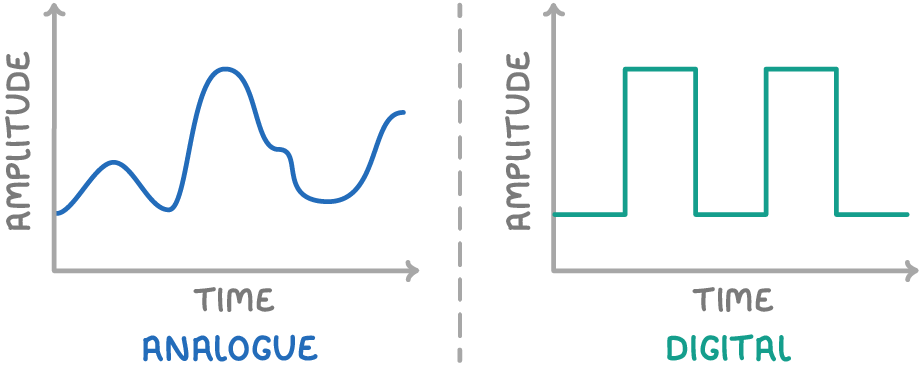
- An analogue signal can take any value within a continuous range.
- Its value varies smoothly and continuously, producing a smooth curve on a trace.
Digital signals
- A digital signal can only take certain fixed values.
- It jumps between these allowed values in discrete steps, often switching between just two states (on and off).
Sound as an analogue or digital signal
- The amplitude and frequency of a sound wave vary continuously, so sound can be carried directly as an analogue signal (e.g. AM and FM radio).
- Sound can also be converted into a digital signal through a process called digitising (e.g. DAB radio).
How digitising works
- Sampling - The value of the analogue signal is measured at regular time intervals.
- Each measured value is rounded to the nearest allowed digital value.
- The result is a digital approximation of the original analogue wave.
Benefits of digital signals
- Faster data transmission - Digital signals can carry more information per second than analogue signals.
- Easier processing - Digital signals can be processed directly by computers and digital circuits.
- Better signal regeneration - Digital signals can be cleaned up and restored much more accurately than analogue signals, so they can be sent over a greater range without losing quality.
Regeneration and noise
- As any signal travels, it weakens and picks up noise (unwanted electrical interference).
- Amplifying an analogue signal amplifies the noise along with the signal, permanently distorting it.
- A digital signal only uses fixed, discrete values (such as 1s and 0s). A regenerator can easily determine whether a noisy pulse was meant to be a high or low value and reconstruct the original, noise-free signal.
TermDefinition
Analogue signalA signal that can take any value within a continuous range.
Digital signalA signal that can only take certain fixed values.
DigitisingThe process of converting an analogue signal into a digital signal by sampling and rounding its values.
NoiseUnwanted electrical interference that a signal picks up as it travels.