15.1 - Sound Waves & Hearing
Sound is a longitudinal wave that needs a medium
- A sound wave is produced by a vibrating object, which passes vibrations into the particles of the surrounding material.
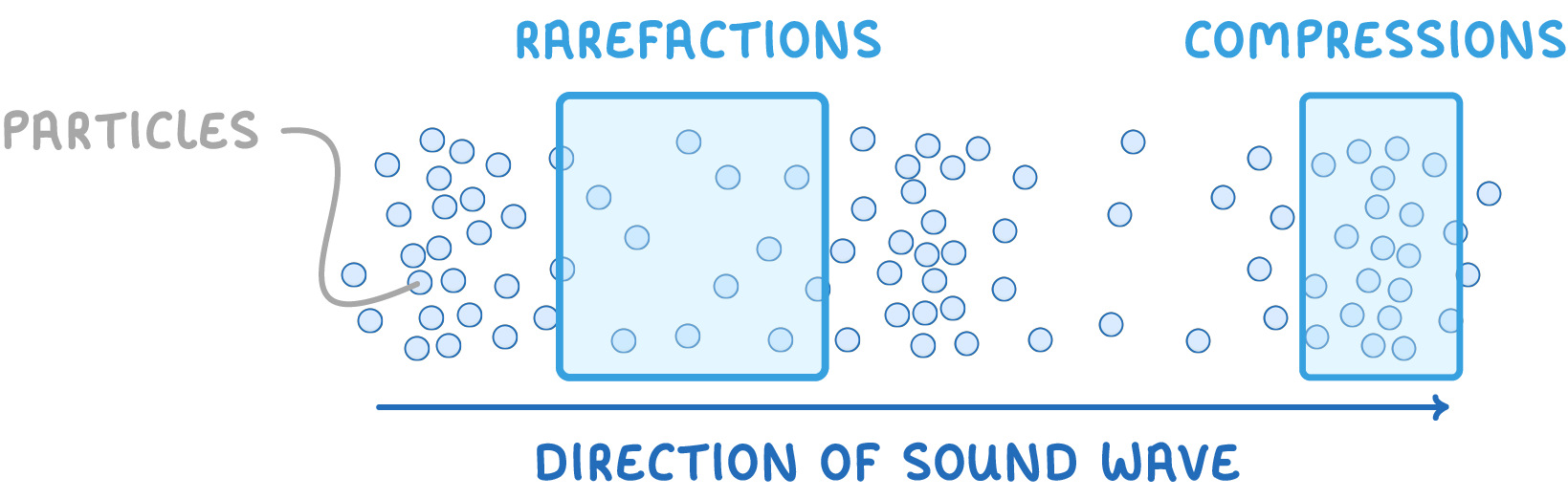
- Sound is a longitudinal wave: the particles vibrate back and forth along the same direction the wave travels.
- As they vibrate, particles bunch into regions of high pressure called compressions, and spread apart into regions of low pressure called rarefactions.
- The wave is this travelling pattern of compressions and rarefactions. The particles vibrate about fixed positions - it's the wave, not the material, that travels.
Sound needs a medium
- Because it is carried by vibrating particles, sound needs a medium - a solid, a liquid, or a gas.
- Sound cannot travel through a vacuum (such as space) because there are no particles to pass the vibrations on.
The speed of sound in different materials and measuring it
- Sound travels at different speeds in different materials: in general, it travels fastest in solids, slower in liquids, and slowest in gases.
- The denser the medium, the more closely packed its particles are, so vibrations pass from particle to particle more quickly.
- In air, sound travels at roughly 330 to 350 m/s, depending mainly on air temperature.
Measuring the speed of sound in air
Two common lab methods are used.
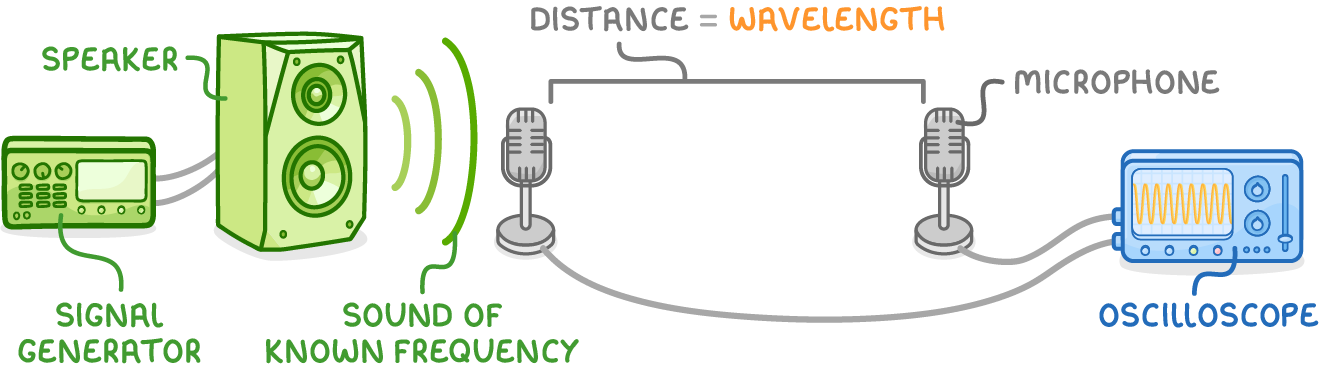
Method 1 - Two microphones and a known wavelength
A signal generator and speaker produce sound of a known frequency. Two microphones connected to an oscilloscope each display a trace. Starting with both by the speaker, one microphone is moved away until the traces align again at exactly one wavelength apart. The speed is calculated using .
Method 2 - Distance and time directly
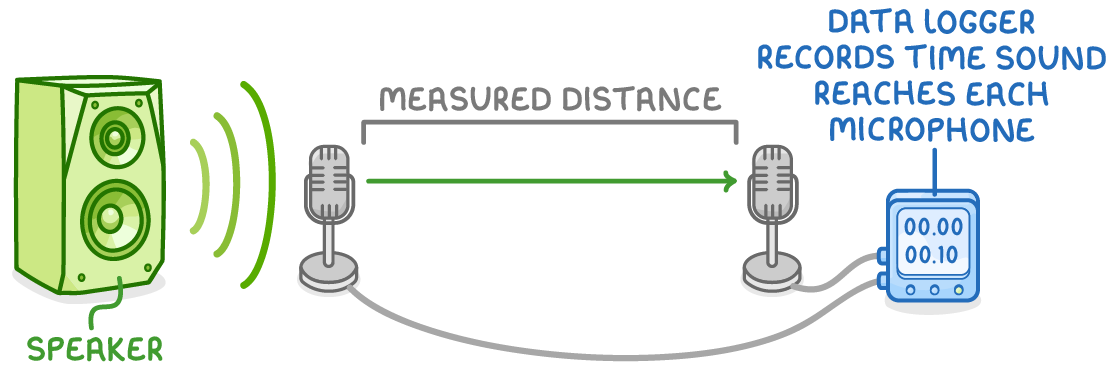
Two microphones are placed a measured distance apart in a line with a sound source. A data logger records the time the sound reaches each microphone to find the travel time. Speed is calculated using .
A data logger is used because sound travels too fast over short distances to be timed accurately with a stopwatch.
The range of human hearing
- Humans can detect sound waves with frequencies between about 20 Hz and 20,000 Hz (20 kHz).
- Sounds below 20 Hz or above 20,000 Hz fall outside this range and cannot normally be heard.
- As a person ages, the upper frequency limit falls.
Reflection of sound and echoes
-
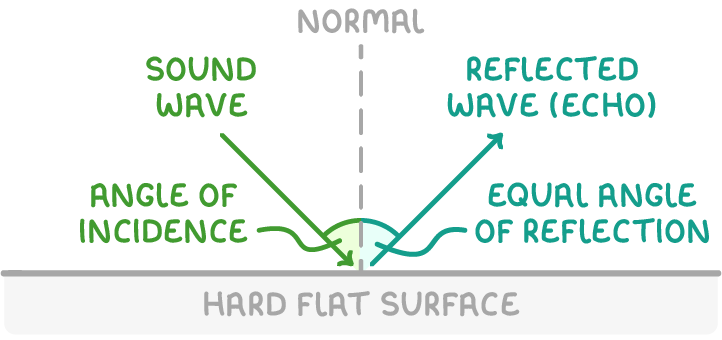
Sound waves reflect off hard, flat surfaces. A reflected sound wave is called an echo.
-
Sound obeys the law of reflection: the angle of incidence equals the angle of reflection, measured from the normal.
-
Soft surfaces (such as carpets and curtains) absorb sound rather than reflect it.
-
An echo is heard after the original sound because the reflected wave has to travel further to reach the ear.
Loudness and pitch as wave properties of sound
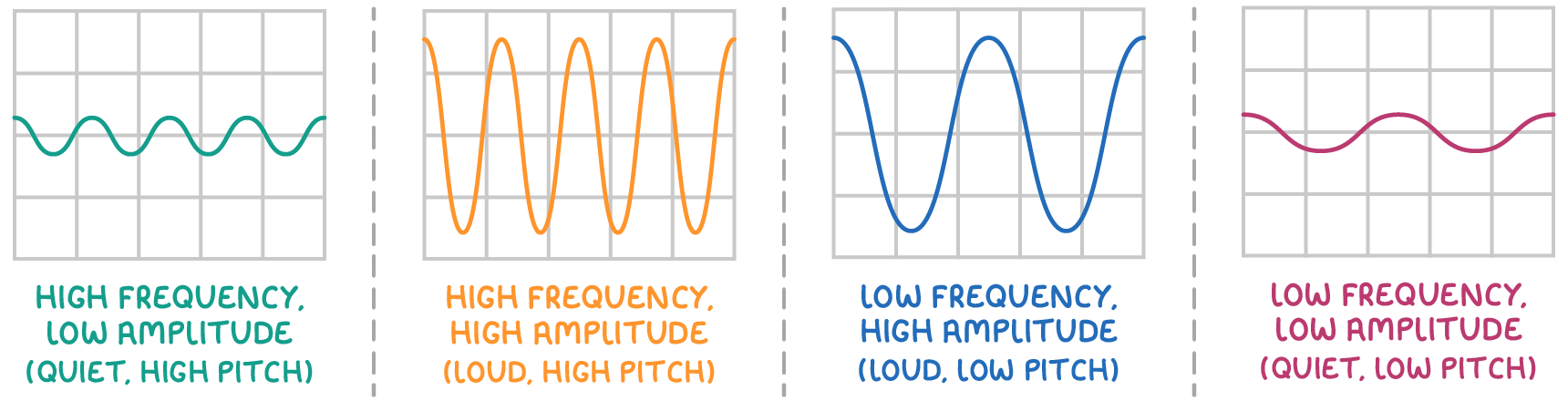
- Loudness depends on amplitude - A larger amplitude carries more energy, producing a louder sound.
- Pitch depends on frequency - A higher frequency produces a higher-pitched sound; a lower frequency produces a lower-pitched sound.
Displaying sound on an oscilloscope
A microphone converts sound waves into electrical signals, and an oscilloscope displays the signal as a trace on a screen.
- A louder sound produces a trace with a larger amplitude.
- A higher-pitched sound produces a trace with more complete cycles across the screen.