13.4 - Refractive Index & Snell's Law
Refractive index
- Light travels fastest in a vacuum. When it enters a transparent material such as glass or water, it slows down.
- The refractive index of a material, , measures how much it slows light down.
- It's the ratio of the speed of light in a vacuum, , to the speed of light in the material, .
Formula for refractive index
Where:
- = Refractive index (no units)
- = Speed of light in a vacuum, in metres per second (m/s)
- = Speed of light in the material, in metres per second (m/s)
Because light travels fastest in a vacuum, is always 1 or greater. The more a material slows light down, the higher its refractive index.
Typical values
- Glass - Around 1.5
- Water - Around 1.33
- Air - 1.00 (to 2 d.p.)
Snell's law
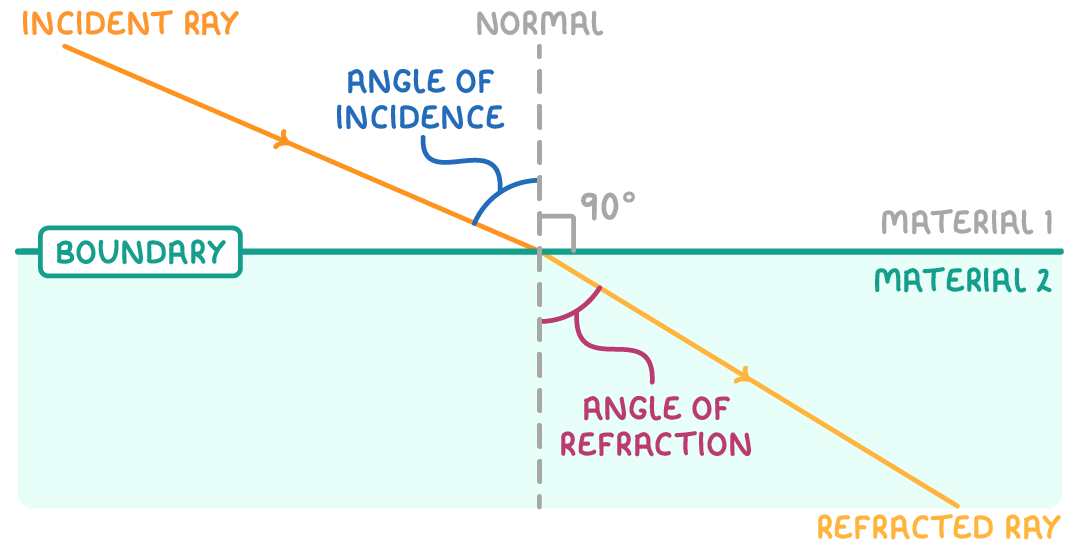
- When a ray of light crosses the boundary into a material, the angle of incidence , the angle of refraction and the refractive index are linked by Snell's law.
- Both angles are measured from the normal - the line drawn at right angles to the surface at the point where the ray hits it.
Formula for Snell's law
Where:
- = Refractive index (no units)
- = Angle of incidence, in degrees
- = Angle of refraction, in degrees
If a ray travels along the normal, it does not refract - it carries straight on without changing direction.
Worked example - Finding the angle of refraction
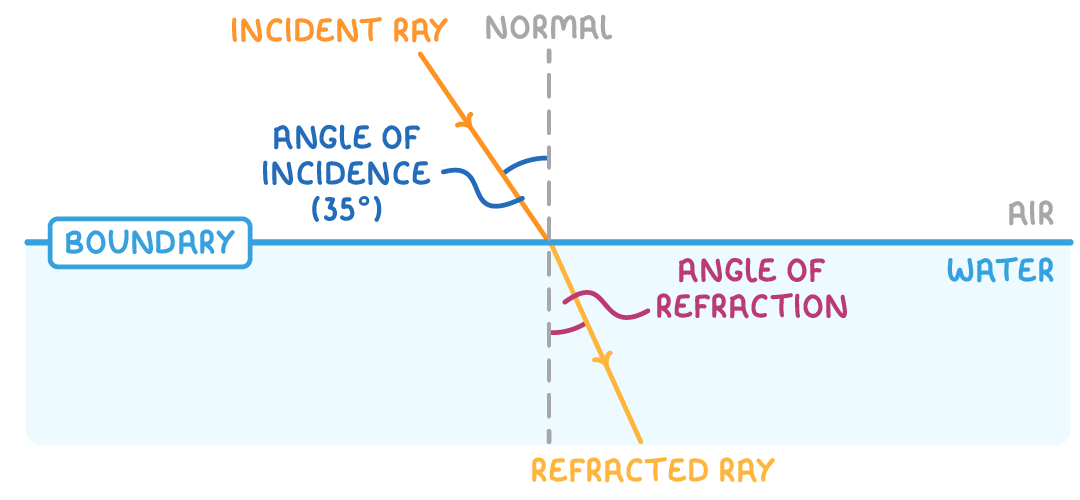
A ray of light passes from air into water. The angle of incidence is 35° and the refractive index of water is 1.33. Find the angle of refraction, to the nearest degree.
Step 1 - Formula
Step 2 - Rearrange the formula
Make the subject:
Step 3 - Substitution and calculation
Take the inverse sine to find :
TermDefinition
Refractive indexThe ratio of the speed of light in a vacuum to the speed of light in a material.
NormalA line drawn at right angles to a surface or boundary at the point where a ray or wave meets it. A force or pressure that acts at right angles to a surface is also said to act normal to it.