13.5 - Total Internal Reflection
Internal reflection
- At a boundary between two materials, a wave often does both things at once - some is reflected back while the rest is transmitted into the new material.
- When a ray of light tries to leave a material, some of it can be reflected back inside. This is called internal reflection.
- The reflected part obeys the law of reflection: the angle of incidence equals the angle of reflection, both measured from the normal.
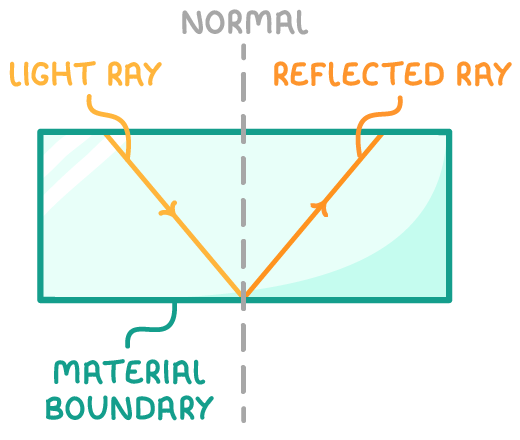
An everyday example
A fish tank - Light from a fish that reaches the water surface from below is partly reflected back into the water, so you can see a faint reflection of the fish in the surface. The rest of the light passes out into the air.
Total internal reflection depends on the critical angle
- Under the right conditions, light meeting a boundary is reflected entirely back into the material it came from. This is total internal reflection.
- Total internal reflection can only happen when:
- Light travels from a denser material (such as glass or water) towards a less dense material (such as air).
- The angle of incidence is greater than the critical angle.
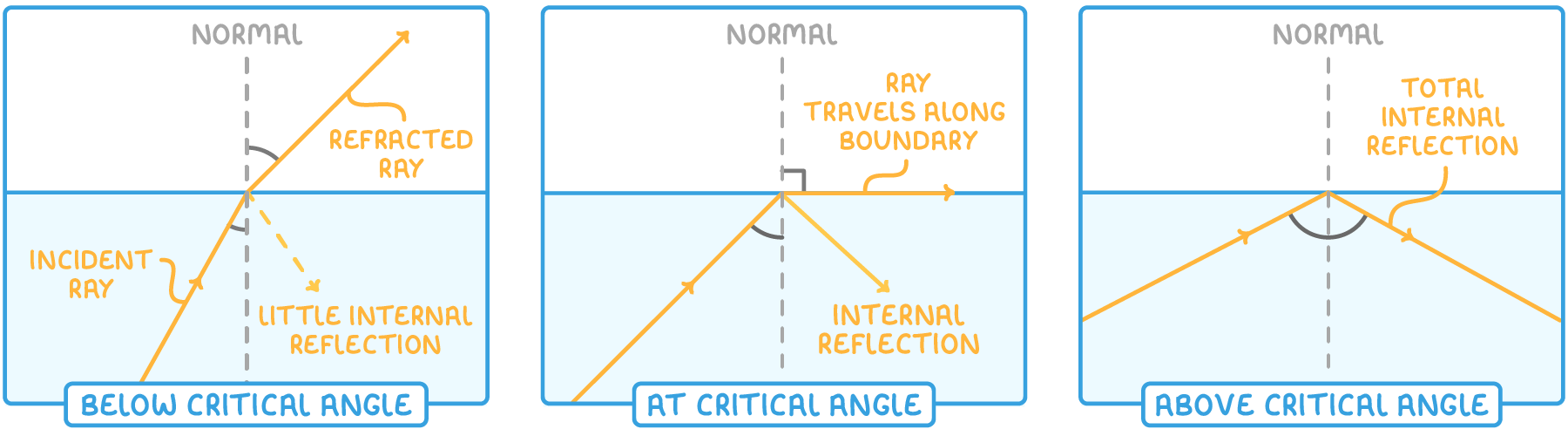
- The critical angle () is the angle of incidence in the denser material that produces an angle of refraction of 90 degrees in the less dense material. For glass to air, this is about 42 degrees.
What happens at each angle of incidence
- Below the critical angle - Most light refracts out into the less dense material, and a small amount is internally reflected.
- At the critical angle - The refracted ray travels along the boundary, and there's strong internal reflection.
- Above the critical angle - No light escapes; it's all reflected back into the material. This is total internal reflection.
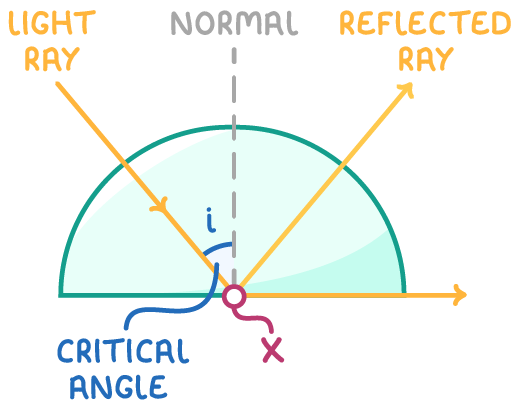
Finding the critical angle with a semicircular block
- The critical angle of glass can be measured with a semicircular glass or Perspex block, a ray box and a protractor.
- The ray is aimed at the curved edge, pointing directly at the centre of the flat side. Because it enters along a radius, it meets the curved surface at 90 degrees and doesn't bend on entering.
- It only refracts or reflects when it reaches the flat edge.
Method
- Place the block on white paper and draw around its outline. Mark the centre of the flat edge and label it X.
- Direct a ray through the curved edge towards X, starting with a small angle of incidence so a refracted ray leaves the flat edge.
- Slowly increase the angle of incidence at X until the refracted ray just emerges along the flat edge.
- Mark points along the incident ray, remove the block, join the points to X, and draw the normal at X.
- Measure the angle between the incident ray and the normal - this is the critical angle. Repeat and calculate a mean.
Formula for the critical angle
Where:
- = Critical angle, in degrees
- = Refractive index of the material (no units)
The critical angle of a material-to-air boundary is linked to the refractive index of the material.
The higher the refractive index, the smaller the critical angle. For example, water has a critical angle of about 49 degrees, while glass (which has a higher refractive index) has a critical angle of about 42 degrees.
Worked example - Critical angle of glass
A type of glass has a refractive index of 1.52. Calculate the critical angle for a glass-to-air boundary. Give the answer to the nearest degree.
Step 1 - Formula
Step 2 - Substitution and calculation
Optical fibres use total internal reflection
- Optical fibres carry light signals using total internal reflection.
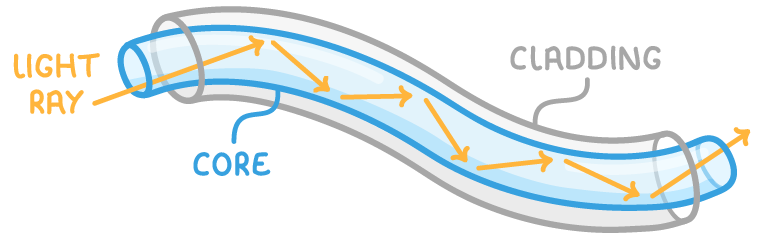
- A fibre has a dense central core surrounded by cladding of a lower refractive index.
How light stays in the core
- Light enters the core at a shallow angle.
- Each time it meets the core-cladding boundary, it strikes at an angle greater than the critical angle, so it totally internally reflects and bounces along inside the core.
- If a fibre is bent too sharply, light can meet the boundary below the critical angle and escape by refraction into the cladding.
Use in telecommunications
- Used in broadband internet and telephone cables, where data is encoded as pulses of light.
- An optical fibre carries far more information than a copper cable of the same diameter and produces higher quality signals.
Cut diamonds use total internal reflection to sparkle
- Diamonds have a very high refractive index, giving them a small critical angle (about 24 degrees).
- A diamond is cut with angled facets so that light entering through the top strikes internal faces at angles greater than the critical angle.
- This light undergoes multiple total internal reflections and exits back through the top facets into the viewer's eye, creating a bright sparkle.
TermDefinition
Internal reflectionThe reflection of part of a ray of light back inside a material as the ray tries to leave it.
Total internal reflectionThe complete reflection of light back into a material when it meets a boundary with a material in which light travels faster (for example from glass into air), at an angle of incidence greater than the critical angle.
Critical angleThe angle of incidence in a denser material that produces an angle of refraction of exactly 90 degrees.