23.2 - The Solar System
The Sun, our star
- The Sun is a medium-sized star, made up mostly of hydrogen and helium.
- It radiates energy across the electromagnetic spectrum, mostly as infrared, visible light, and ultraviolet.
- The Sun contains most of the mass of the Solar System, so its gravitational pull dominates, keeping the planets and other bodies in orbit around it.
Inner rocky planets and outer gas planets
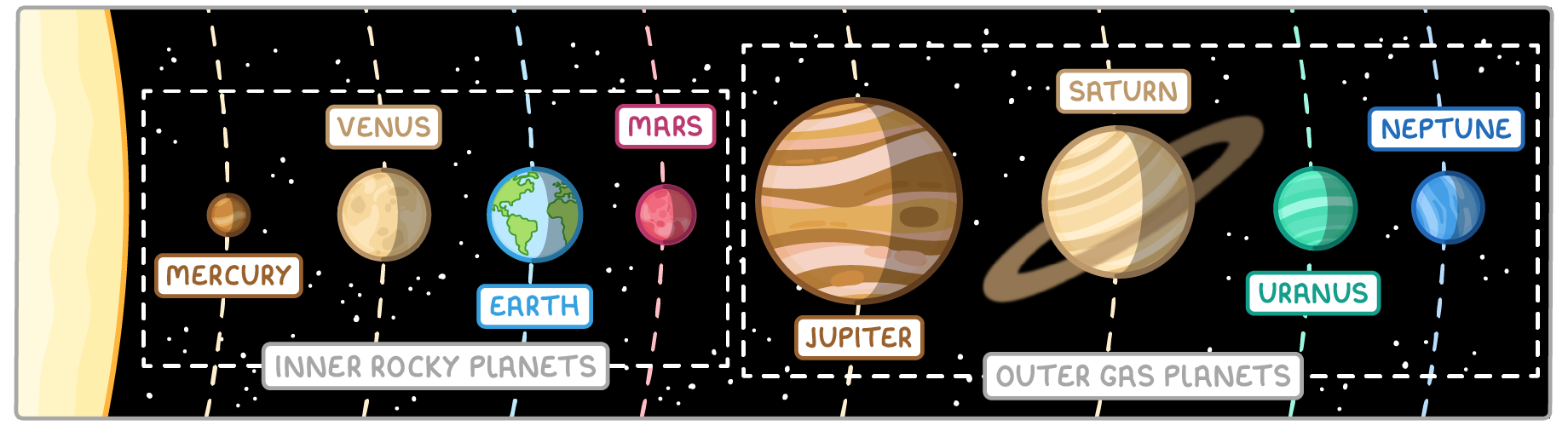
The eight planets fall into two families:
- Inner planets - The four nearest the Sun (Mercury, Venus, Earth, and Mars) are small and rocky.
- Outer planets - The four furthest out (Jupiter, Saturn, Uranus, and Neptune) are large and gaseous.
Light-travel time across the Solar System
- Distances in the Solar System are so large that it's useful to measure them by how long light takes to cross them.
- Light travels at a speed of about 3 × 10⁸ m/s.
Formula for light-travel time
Where:
- = Time, in seconds (s)
- = Distance, in metres (m)
- = Speed of light, about 3 × 10⁸ m/s
Worked example - Light from the Sun to the Earth
The Earth is about 1.5 × 10¹¹ m from the Sun. How long does light take to travel from the Sun to the Earth?
Step 1 - Formula
Step 2 - Substitution and calculation
Step 3 - Interpretation
Light from the Sun reaches the Earth in about 500 seconds, which is roughly 8 minutes.
TermDefinition
Inner planetsThe four small, rocky planets nearest the Sun.
Outer planetsThe four large, gaseous planets furthest from the Sun.