23.3 - Orbits
Gravity provides the force that creates orbits
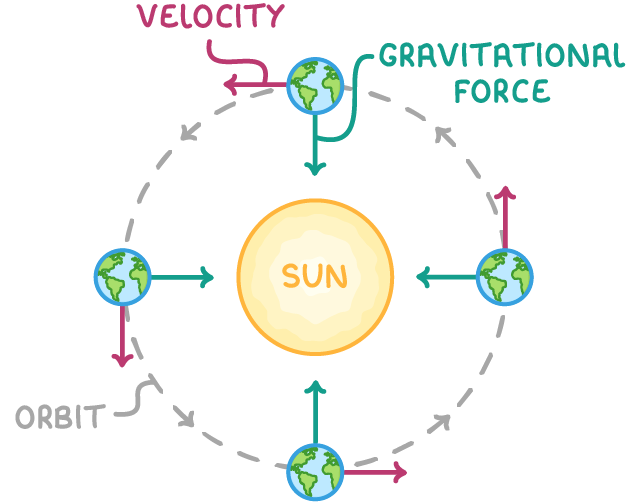
- Planets orbit the Sun, and moons and artificial satellites orbit planets, in almost circular orbits.
- An object moving in a circle is constantly changing direction, so even at a constant speed its velocity is constantly changing.
- A changing velocity means the object is accelerating, which requires a resultant force.
- This force acts towards the centre of the circle.
Gravity provides the inward force
- For an orbiting object, this inward force is provided by gravity:
- The Sun's gravitational pull keeps planets and comets in orbit.
- A planet's gravitational pull keeps moons and artificial satellites in orbit.
- Because the object is already moving, the gravitational pull doesn't pull it straight in - it constantly bends its path into a circle.
Orbital speed and the size of the orbit
- For a circular orbit, the gravitational force acts at right angles to the object's motion.
- This changes the object's direction without changing its speed.
Orbital speed depends on the radius
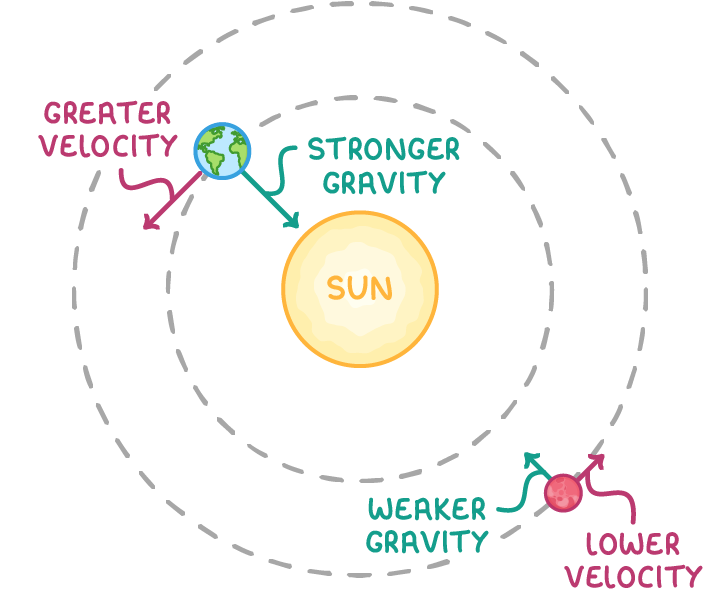
- Gravitational pull is stronger the closer an object is to the body it orbits.
- The stronger the pull, the faster the object must travel to maintain a stable orbit.
- If the speed of an orbiting object changes, its radius must change too:
- A faster object orbits with a smaller radius.
- A slower object orbits with a larger radius.
- This is why planets closer to the Sun travel faster and have shorter orbital periods than planets further out.
Orbits can be circular or elliptical
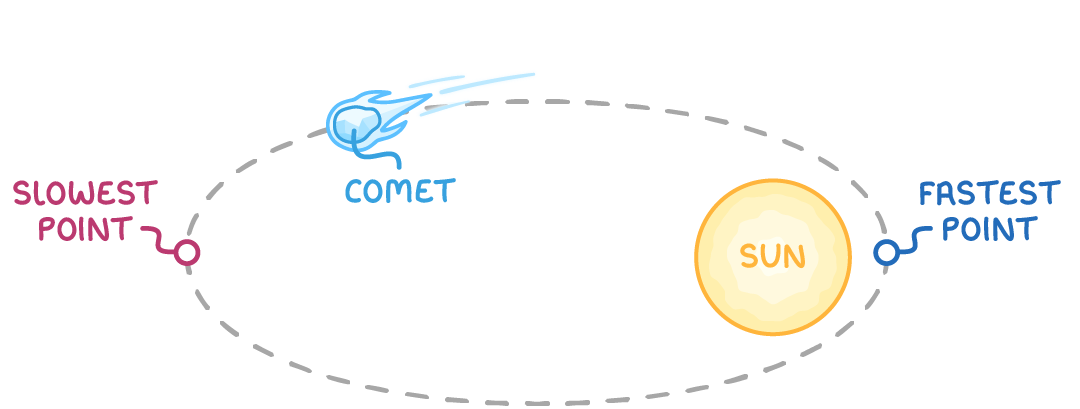
- Most planets and moons have slightly elliptical (stretched circular) orbits.
- Comets have highly elliptical orbits, with the Sun near one end of the ellipse.
- A comet's orbital period is much longer than a planet's because it travels far into the outer solar system.
- A comet travels much faster near the Sun than far away, because the gravitational pull is stronger the closer it gets.
Why an object speeds up near the Sun
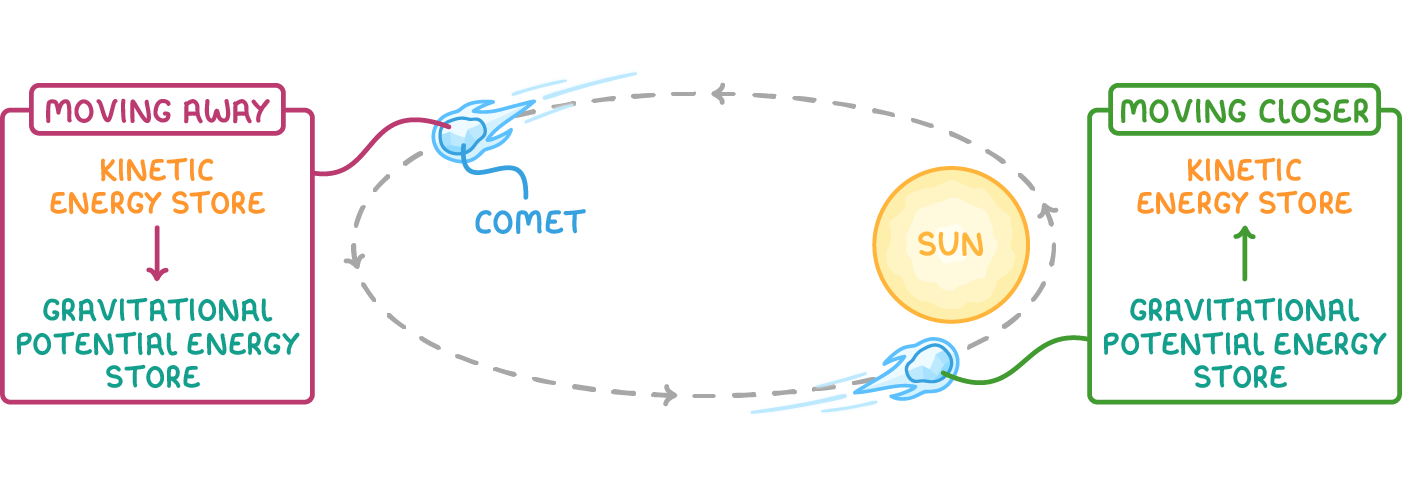
- The change in speed of an object in an elliptical orbit is explained by the conservation of energy.
- As the object moves closer to the Sun:
- Its gravitational potential energy store decreases.
- Energy is transferred to its kinetic energy store, so it speeds up.
- As the object moves away from the Sun:
- Energy transfers from its kinetic store back to its gravitational potential store, so it slows down.
Calculating orbital speed
- In one complete circular orbit, an object travels a distance equal to the circumference ().
- Dividing this distance by the time for one orbit gives the orbital speed.
Formula for orbital speed
Where:
- = Orbital speed, in metres per second (m/s)
- = Orbital radius, in metres (m), the distance from the centre of the orbited body to the orbiting object
- = Orbital period, in seconds (s), the time for one complete orbit
Worked example - Orbital speed of a satellite
A satellite orbits at an altitude of 800 km above the Earth's surface. The radius of the Earth is 6,400 km, and the satellite takes 100 minutes to complete one orbit. Calculate its orbital speed.
Step 1 - Find the orbital radius in metres
Add the altitude to the Earth's radius:
Step 2 - Convert the orbital period to seconds
Step 3 - Substitute into the orbital-speed equation
TermDefinition
Orbital periodThe time taken for an object to complete one full orbit.