24.4 - The Big Bang
The Big Bang theory
- The Big Bang theory is the accepted explanation of how the Universe began.
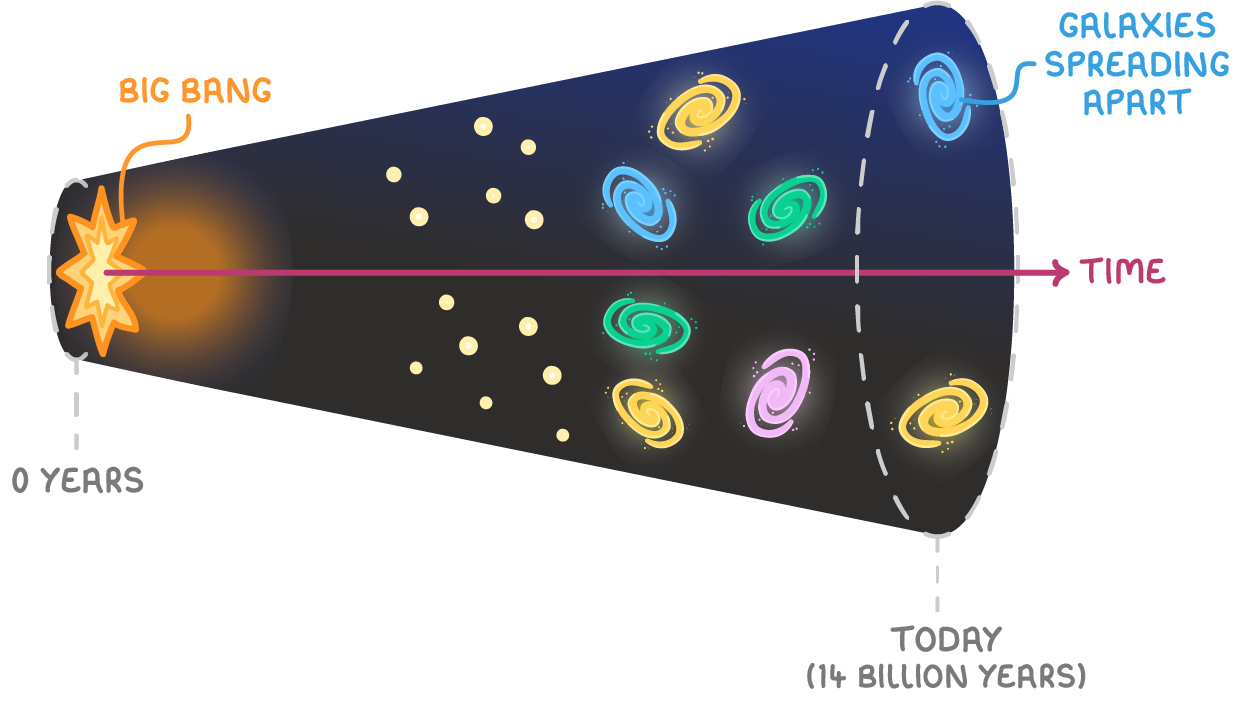
- All the matter and energy in the Universe was once concentrated into a single, tiny region that was extremely hot and dense.
- It then began to expand rapidly - the Big Bang - and space has been expanding ever since.
The age of the Universe
- The theory gives the Universe a finite age.
- Working back from the expansion rate gives an age of roughly 14 billion years (about 13.8 billion years).
Microwave radiation from every direction
- Detectors pointed anywhere in the sky pick up a faint glow of microwave radiation.
- It arrives from every direction at a specific frequency.
- This is the cosmic microwave background radiation (CMBR or CMB).
- It doesn't come from any single object - it fills all of space.
CMBR is stretched-out radiation from the early Universe
- CMBR is leftover radiation released shortly after the Universe began.
- When first emitted, it was high-energy, short-wavelength radiation.
- As space expanded, the radiation was stretched along with it to longer wavelengths, reaching the microwave region today.
- Because the Big Bang model predicted this leftover radiation, the CMBR is key evidence supporting the hot Big Bang model.
TermDefinition
Big Bang theoryThe theory that all the matter in the Universe was once packed into a very small, extremely hot and dense region, and that the Universe has been expanding from it ever since.
Cosmic microwave backgroundFaint electromagnetic radiation filling all of space, left over from the very early Universe.