24.5 - The Hubble Constant
One light-year
- A light-year is the distance that light travels in one year.
- One light-year is approximately 9.5 × 10¹⁵ m.
Finding recession speed from red shift
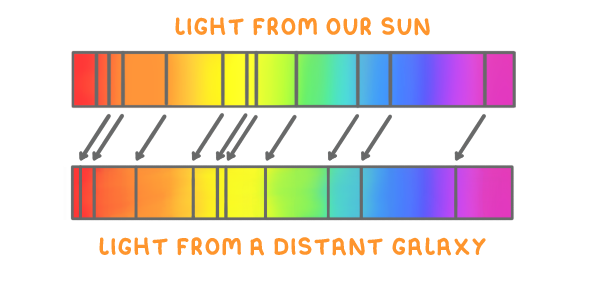
- Light from a distant galaxy is red-shifted: spectral lines appear shifted to longer wavelengths because the galaxy is moving away from Earth.
- A larger shift in wavelength means a faster recession speed .
Measuring a galaxy's distance from a supernova
- A galaxy's distance is found using a supernova within it.
- One specific type of supernova always reaches the same known brightness.
- By comparing how bright the supernova appears from Earth with its known true brightness, astronomers calculate the distance to the galaxy.
The Hubble constant
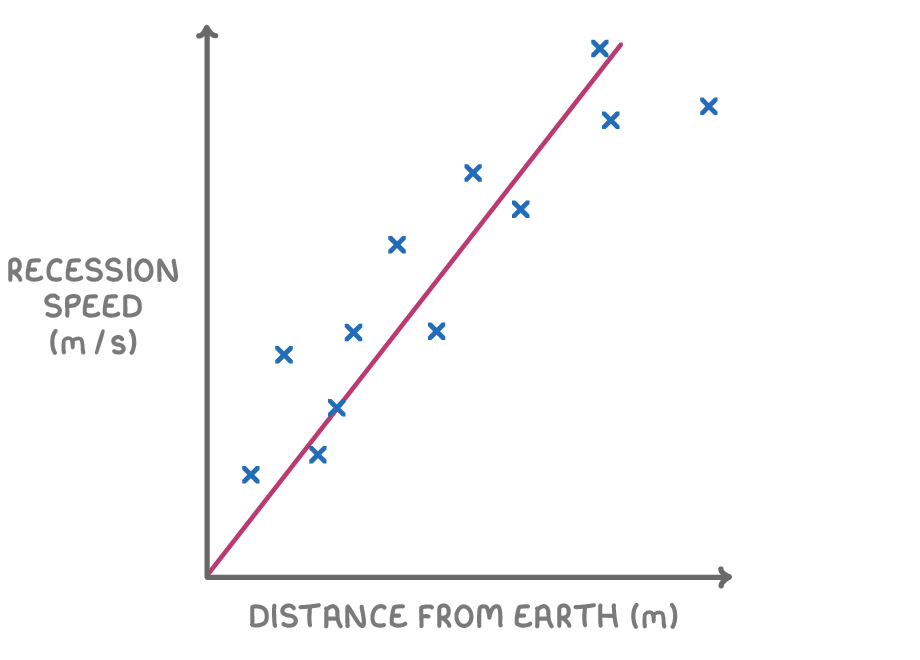
- A galaxy's recession speed is directly proportional to its distance from Earth: the further away a galaxy is, the faster it moves away.
- The Hubble constant, , is the ratio of a galaxy's recession speed to its distance from Earth.
Formula for the Hubble constant
Where:
- = Hubble constant, per second
- = Recession speed, in metres per second (m/s)
- = Distance to the galaxy, in metres (m)
The current accepted estimate of is about 2.2 × 10⁻¹⁸ per second. Plotting the recession speed of many galaxies against their distance from Earth gives a straight line through the origin, as shown below.
Worked example - Calculating the Hubble constant
A galaxy is moving away from Earth at 1.5 × 10⁷ m/s and is at a distance of 6.8 × 1024 m. Find the Hubble constant.
Step 1 - Formula
Step 2 - Substitution and calculation
Estimating the age of the Universe
- The Big Bang theory states that all matter in the Universe was once concentrated at a single point.
- Assuming each galaxy has moved outwards at a constant speed since the Big Bang:
Using the current value of gives an age of roughly 14 billion years (about 4.5 × 10¹⁷ s).
Worked example - Estimating the age of the Universe
The Hubble constant is 2.2 × 10⁻¹⁸ per second. Estimate the age of the Universe in seconds.
Step 1 - Formula
Step 2 - Substitution and calculation
Step 3 - Convert to years
This is about 1.4 × 10¹⁰ years, or roughly 14 billion years.
TermDefinition
Light-yearThe distance that light travels through space in one year.
Hubble constantThe ratio of a galaxy's recession speed (the speed at which it is moving away from us) to its distance from Earth.
Big Bang theoryThe theory that all the matter in the Universe was once packed into a very small, extremely hot and dense region, and that the Universe has been expanding from it ever since.