17.10 - Potential Dividers
A potential divider shares a voltage between two resistors
- A potential divider is a circuit that splits a supply voltage between two resistors in series.
- It allows a circuit to take a smaller voltage from a larger supply.
- The supply's potential difference is shared between the two resistors in the ratio of their resistances: the larger a resistor's share of the total resistance, the larger its share of the voltage.
Because the same current passes through both resistors in series, a larger resistance has a larger potential difference across it.
Worked through with numbers
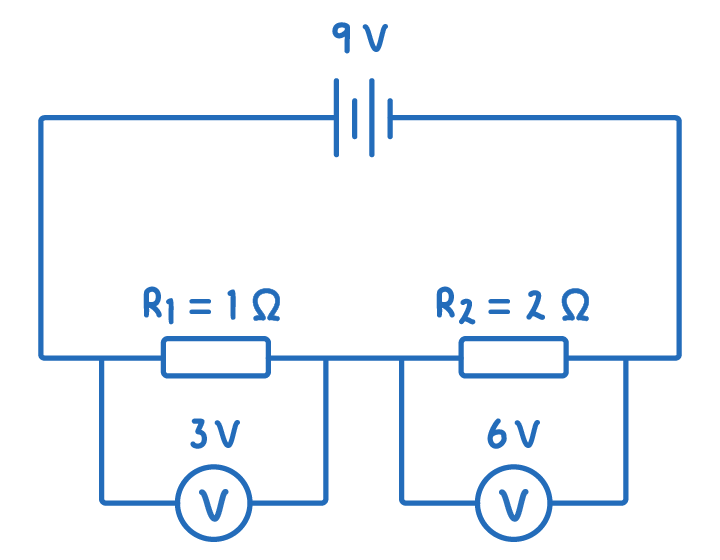
A 9 V supply is connected across a 2 Ω resistor and a 1 Ω resistor in series, as shown in the circuit below.
- Total resistance = 2 + 1 = 3 Ω.
- The 2 Ω resistor takes 2/3 of the supply: 2/3 of 9 V = 6 V.
- The 1 Ω resistor takes 1/3 of the supply: 1/3 of 9 V = 3 V.
- The two shares add up to the 9 V supply.
The potential-divider ratio equation
For two resistors in a potential divider, the ratio of the resistances equals the ratio of the potential differences across them.
Ratio equation
Where:
- = The two resistances, in ohms (Ω)
- = The potential differences across and , in volts (V)
The two potential differences always add up to the supply: .
Worked example - Finding a variable resistor setting
A 10 V supply is connected across a fixed 5 Ω resistor and a variable resistor in series. The variable resistor must be set so that the potential difference across the fixed resistor is 8 V. What resistance is needed?
Step 1 - Find the potential difference across the variable resistor
The two potential differences add up to the supply:
Step 2 - Apply the ratio equation
Let = 5 Ω (the fixed resistor, with = 8 V) and = the variable resistor (with = 2 V).
Step 3 - Rearrange and substitute to find R2
The variable resistor must be set to 1.25 Ω.
Varying the output with a variable resistor
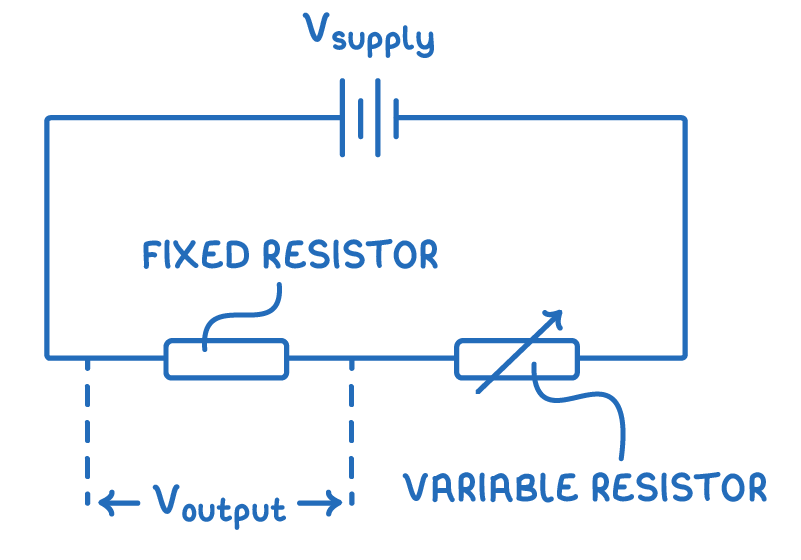
Replacing one fixed resistor with a variable resistor lets the output voltage be adjusted while the circuit runs.
- With the variable resistor set to zero, almost the whole supply voltage appears across the fixed resistor, so the output is close to the full supply.
- As the variable resistance increases, it takes a larger share of the supply, and the output across the fixed resistor falls.
The variable potential divider (potentiometer)
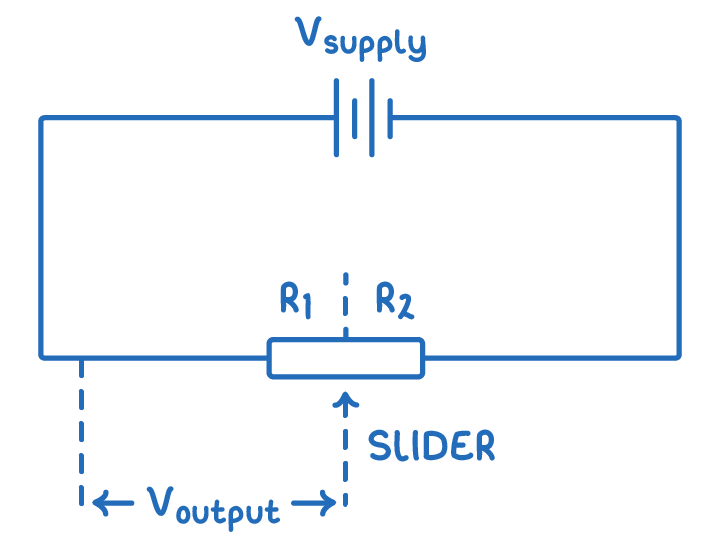
- A variable potential divider, or potentiometer, does the same job as two resistors using a single component.
- A track of resistance has a slider that taps off a point along it, dividing the track into two parts that act as two resistors in series.
Moving the slider changes the relative resistance of the two parts, varying the output smoothly from zero up to the full supply voltage.