18.1 - Components
How resistance depends on length and area
- The resistance of a wire depends on the material it's made from, its length, and its cross-sectional area.
- The longer the wire, the greater its resistance.
- The greater the cross-sectional area, the smaller its resistance.
- A long, thin wire therefore has a higher resistance than a short, thick wire of the same material.
Resistance vs length and cross-sectional area
Resistance is proportional to length
Resistance is directly proportional to length (doubling the length doubles the resistance).
Resistance is inversely proportional to area
Resistance is inversely proportional to cross-sectional area (doubling the area halves the resistance).
Light-dependent resistors (LDRs)
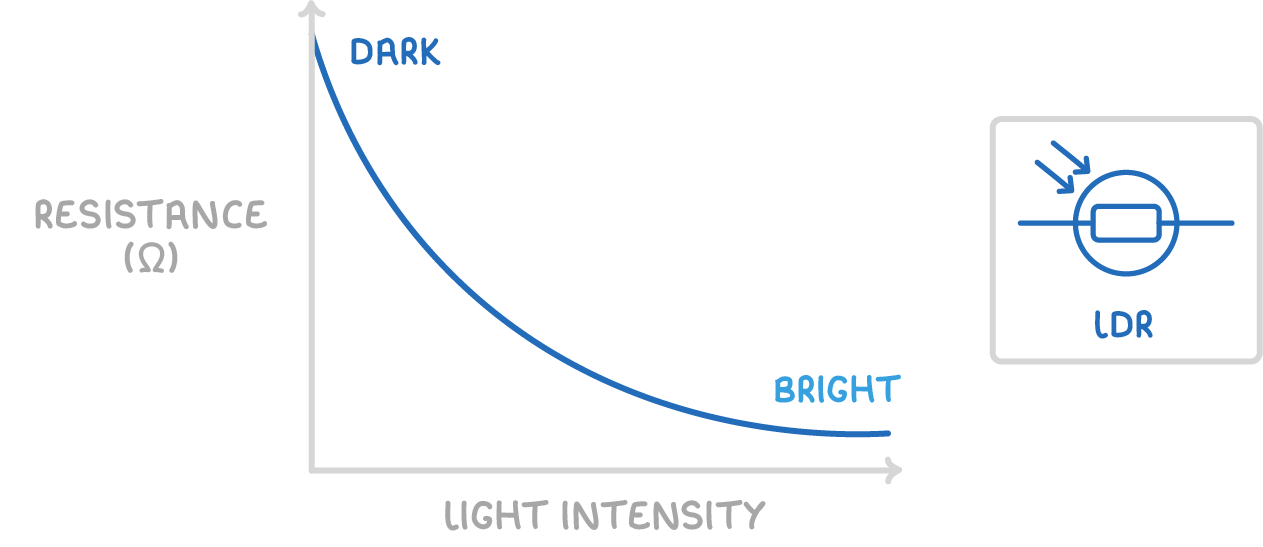
- A light-dependent resistor (LDR) is a resistor whose resistance depends on the intensity of light falling on it.
- In darkness, its resistance is highest.
- As the light gets brighter, its resistance falls.
- Common applications: automatic night lights, outdoor lighting, and burglar detectors.
Thermistors
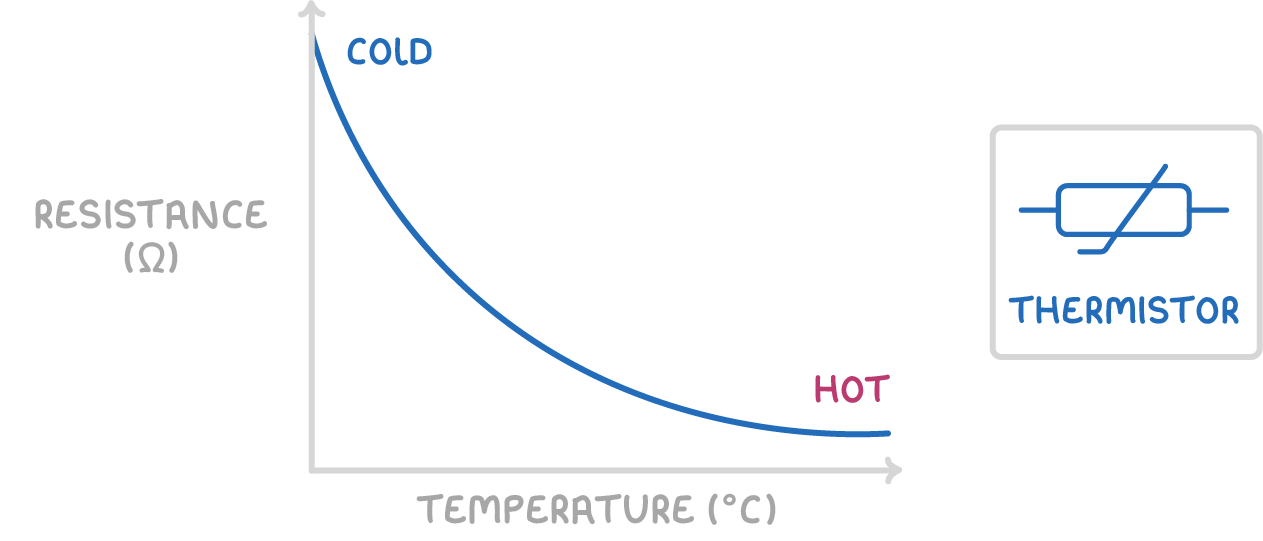
- A thermistor is a resistor whose resistance depends on temperature.
- In cold conditions, its resistance is high.
- As the temperature rises, its resistance falls.
- Because resistance falls as temperature rises, it's called a negative temperature coefficient (NTC) thermistor.
- Common applications: car engine temperature sensors, thermostats, irons, and fire alarms.
Diodes
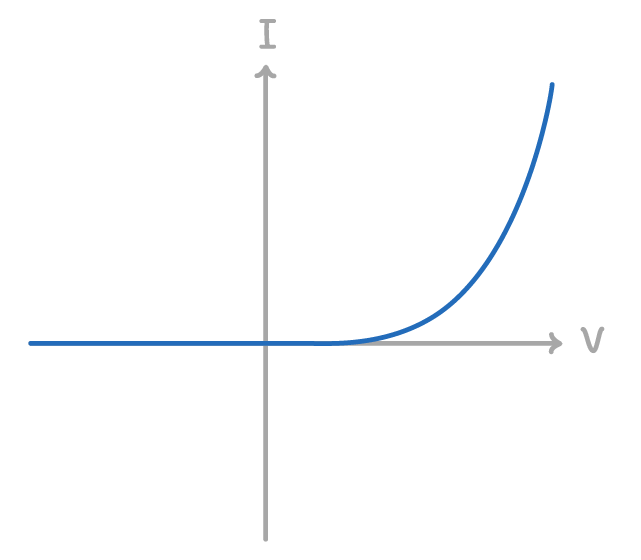
- A diode is a component, usually made from a semiconductor such as silicon, that lets current flow freely in one direction only.
- In the reverse direction it has a very high resistance, so almost no current flows.
Forward and reverse bias
- Forward bias - The direction in which current can flow.
- Reverse bias - The direction in which the diode has high resistance and does not conduct.
- A diode doesn't conduct until the forward voltage reaches a specific threshold value.
Uses
- Used in electronic circuits, such as radio receivers.
- Used to turn alternating current (ac) into direct current (dc).
Light-emitting diodes (LEDs)
- A light-emitting diode (LED) is a diode that emits light when a current flows through it in the forward direction.
- Like any diode, it only lets current flow one way, so it only lights up when connected the right way round.
- LEDs indicate the presence of a current in a circuit, so they're often used in appliances to show they're switched on.
Advantages and uses
- Uses: energy-saving lighting, traffic lights, screens, and remote controls.
- Unlike filament bulbs, LEDs have no filament to burn out.
- They use a much smaller current than traditional filament lamps.
TermDefinition
Light-dependent resistor (LDR)A resistor whose resistance decreases as the intensity of light falling on it increases.
ThermistorA resistor whose resistance decreases as its temperature increases.
DiodeA component that lets current flow through it in one direction only.
Forward biasThe direction of potential difference in which a diode allows current to flow.
Reverse biasThe direction of potential difference in which a diode has a very high resistance and does not conduct.
Light-emitting diode (LED)A diode that emits light when current flows through it in the forward direction.