18.2 - Series Circuits
What a series circuit is
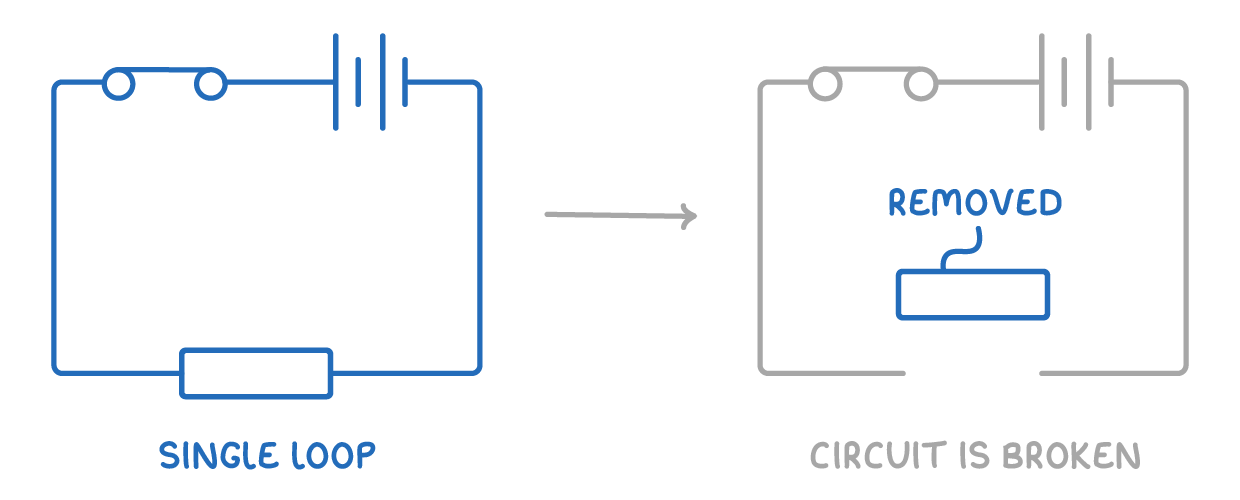
- In a series circuit, the components are connected end to end in a single loop between the positive and negative ends of the power supply.
- If one component is removed or breaks, the circuit is broken and all the components stop working.
Connecting meters
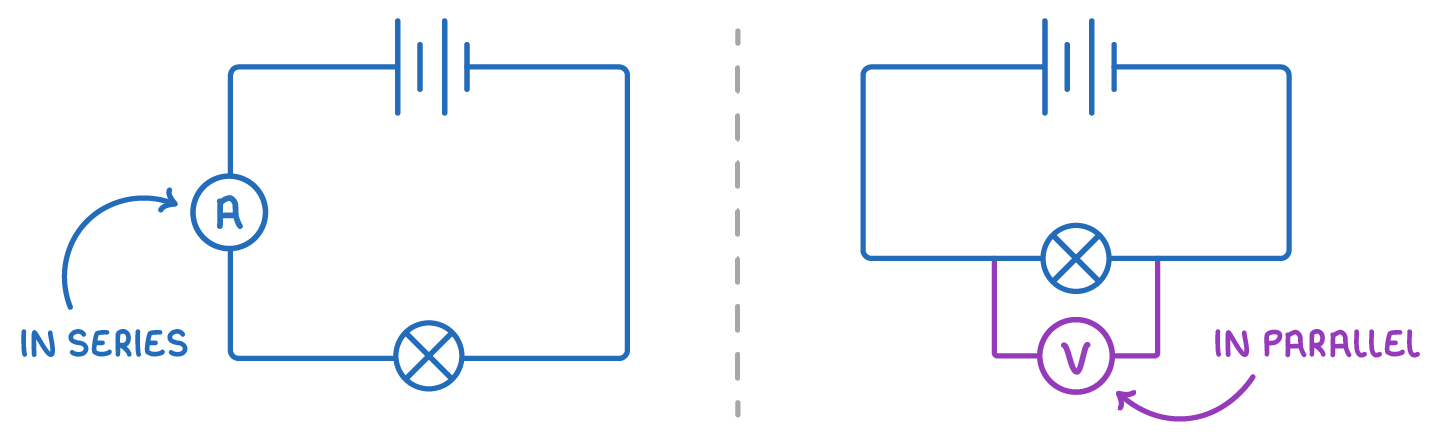
- An ammeter is connected in series, so the current it measures flows through it.
- A voltmeter is connected in parallel across a component.
The series rules - E.m.f., current and resistance
Current is the same everywhere
The same current flows through every part of a series circuit:
The size of the current depends on the total e.m.f. and total resistance ().
Resistance adds up
The total resistance is the sum of the individual resistances:
The source e.m.f. is shared
The e.m.f. of the supply is shared between the components, so the potential differences round the circuit add up to the source e.m.f.:
Worked example - Current in a series circuit
A 24 V supply is connected in series with two resistors of 3 Ω and 5 Ω. Calculate the current in the circuit.
Step 1 - Find the total resistance
The resistors are in series, so add them:
Step 2 - Rearrange to make the subject
Step 3 - Substitute the values
Use the supply voltage and the total resistance:
The current is 3 A, and because this is a series circuit, the same 3 A flows through both resistors.
Source e.m.f.s add up in series
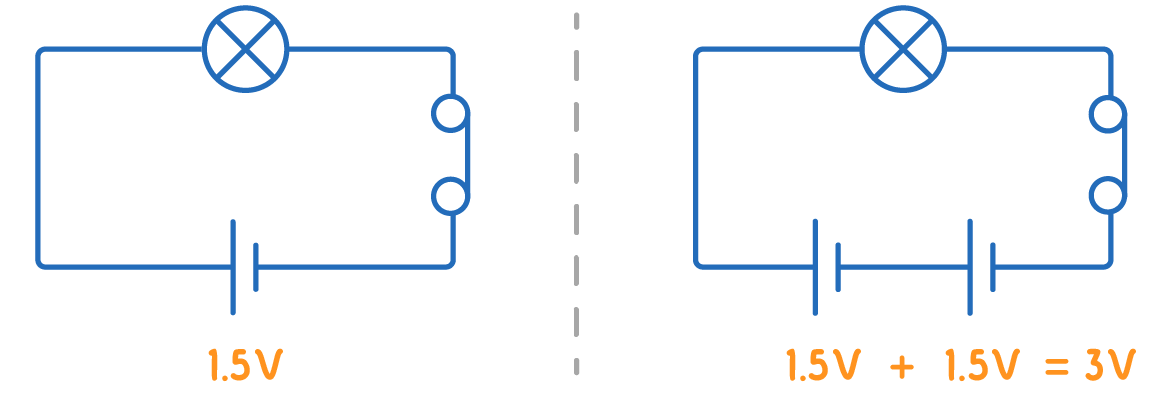
- When energy sources, such as cells, are connected in series the same way round, their e.m.f.s add together.
- For example, two cells each with an e.m.f. of 1.5 V connected in series supply a total e.m.f. of 3 V.
TermDefinition
Series circuitA circuit where the components are connected end to end in a single loop. Components connected like this are said to be in series.