10.1 - Internal Energy & Changes of State
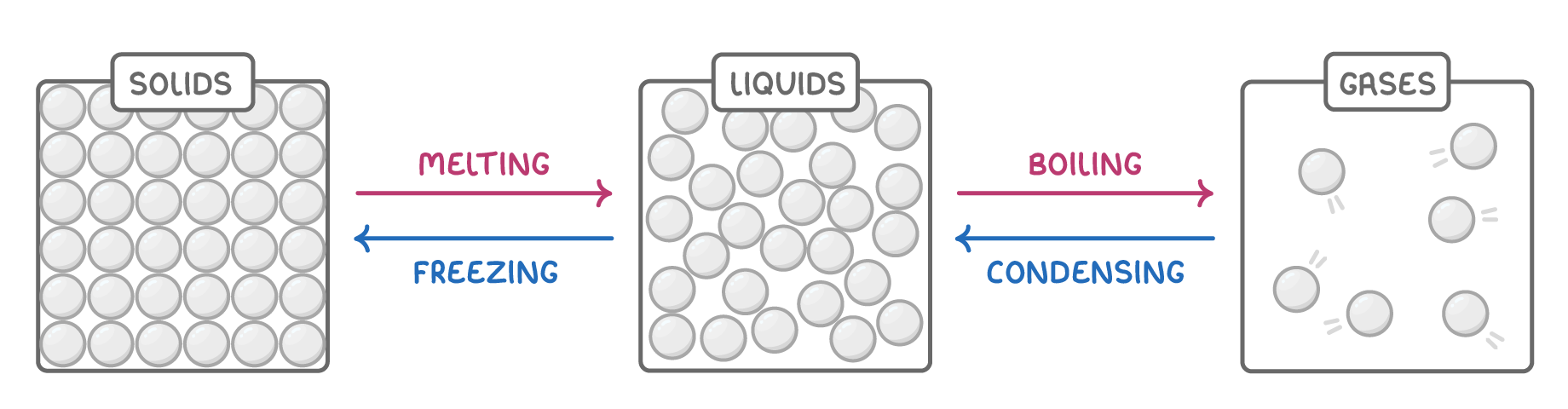
Heating or cooling changes temperature or state
- Heating transfers energy to the particles in a substance; cooling transfers energy away.
- Heating or cooling leads to a temperature change or a change of state.
Heating and cooling
- Temperature change - Heating makes particles move or vibrate faster, raising the temperature. Cooling slows particles down, lowering the temperature.
- Change of state - If heated enough, the energy breaks the bonds between particles rather than raising their temperature. When cooled enough, bonds form between particles.
Temperature stays constant during a change of state
- While a substance is changing state, its temperature does not change.
- During melting or boiling, energy is absorbed to break bonds rather than raise the temperature.
- During condensing or freezing, bonds form and release energy, so the temperature does not fall until the change of state is complete.
- Melting point is the temperature at which a substance melts; boiling point is the temperature at which it boils.
- For pure water at normal atmospheric pressure: melting point 0 °C, boiling point 100 °C.
Internal energy
- The particles that make up a substance are constantly moving or vibrating, so they have energy in their kinetic energy stores.
- The total energy of all the particles in a substance is the energy in its internal energy store.
Temperature and internal energy
- Heating a substance transfers energy to its particles, making them move faster.
- This increases the average energy in their kinetic stores, which raises the temperature and increases the substance's internal energy.
TermDefinition
Melting pointThe temperature at which a substance melts.
Boiling pointThe temperature at which a liquid changes into a gas throughout the liquid, not only at its surface.
Internal energyThe total kinetic energy and potential energy of all the particles in a substance or system.