10.2 - Evaporation
Evaporation
- Evaporation is when particles escape from the surface of a liquid and become gas particles.
- Unlike boiling, evaporation:
- Happens only at the surface, with no bubbles forming.
- Can happen at temperatures below the boiling point of the substance.
How particles escape
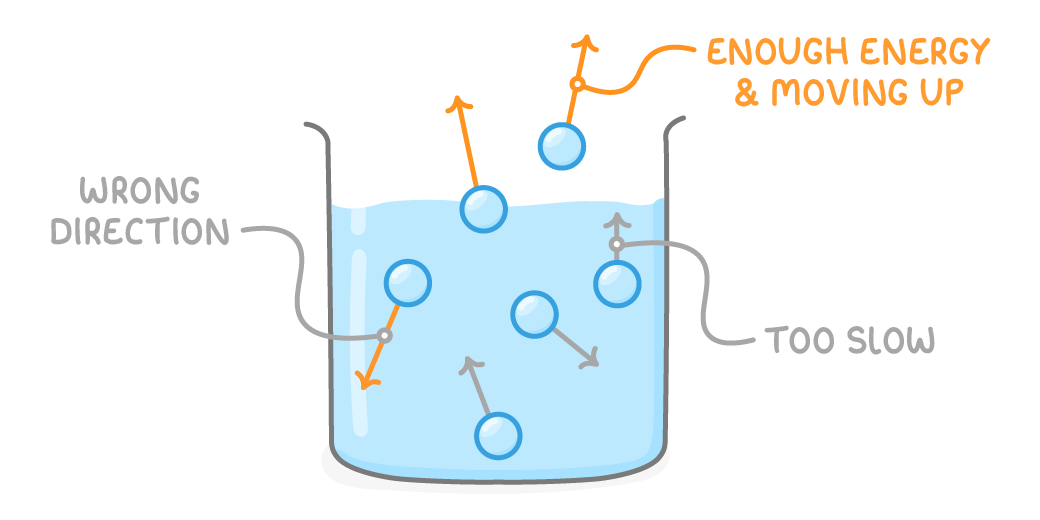
- Particles in a liquid move at different speeds, so some have more energy in their kinetic energy stores than others.
- A particle near the surface can escape if:
- It is moving in the right direction (towards the surface).
- It has enough energy in its kinetic energy store to overcome the attractive forces holding it in the liquid.
Evaporation cools the liquid left behind
- The particles that escape from the surface are the ones with the most energy in their kinetic energy stores.
- When these high-energy particles leave, the average energy in the kinetic energy stores of the remaining particles falls.
- A lower average kinetic energy means a lower temperature, so the remaining liquid cools down.
The differences between boiling and evaporation
| Boiling | Evaporation | |
|---|---|---|
| Where it happens | Throughout the whole liquid - bubbles of gas form inside the liquid, rise to the surface and escape. | Only at the surface of the liquid - no bubbles form. |
| Temperature | At one fixed temperature, the boiling point of the substance. | At any temperature below the boiling point. |
Factors that affect the rate of evaporation
Increasing any of the following increases the rate of evaporation.
Temperature
- The higher the temperature, the higher the average energy in the kinetic energy stores of the particles.
- A larger fraction of particles have enough energy to escape from the surface, so the liquid evaporates faster.
Surface area
- A larger surface area means more particles are near the surface at any moment.
- More particles are in a position to escape, so the liquid evaporates faster.
Air movement over the surface
- Moving air carries away escaped particles before they can drop back into the liquid.
- With fewer particles returning, the liquid evaporates faster.
Cooling an object in contact with an evaporating liquid
- As an evaporating liquid cools, energy is transferred to it from a warmer object in contact with it by heating.
- This transfer of energy cools the object down.
- For example, as sweat evaporates from skin, energy is transferred away from the body, cooling it down.
TermDefinition
EvaporationThe process where particles escape from the surface of a liquid and become a gas.