10.3 - Specific Heat Capacity
Different substances have different specific heat capacities
- Heating a substance increases its internal energy - the total energy in the kinetic energy stores and potential energy stores of its particles.
- Temperature measures the average kinetic energy of the particles.
- Different materials need different amounts of energy to change their temperature by the same amount - e.g. 4,200 J to warm 1 kg of water by 1 °C, but only 139 J for 1 kg of mercury.
Specific heat capacity
The specific heat capacity of a substance is the amount of energy needed to raise the temperature of 1 kg of that substance by 1 °C.
- It's also the energy released by 1 kg of a substance for every 1 °C it cools.
- It's a property of the material, so any sample of a given material has the same specific heat capacity.
- Water has a particularly high specific heat capacity (4,200 J/kg°C), making it useful for storing and carrying thermal energy.
The specific heat capacity equation
Where:
- = Change in thermal energy, in joules (J)
- = Mass, in kilograms (kg)
- = Specific heat capacity, in joules per kilogram per degree Celsius (J/kg°C)
- = Change in temperature, in degrees Celsius (°C)
The symbol means 'change in'.
Worked example - Specific heat capacity equation
A 1.5 kg block of aluminium is heated from 22 °C to 62 °C. The specific heat capacity of aluminium is 900 J/kg°C. How much energy is transferred to the block's thermal energy store?
Step 1 - Find the change in temperature
Step 2 - Substitute into the equation
Step 3 - Calculate
So 54,000 J is transferred to the block's thermal energy store.
Investigating specific heat capacity - Joulemeter method
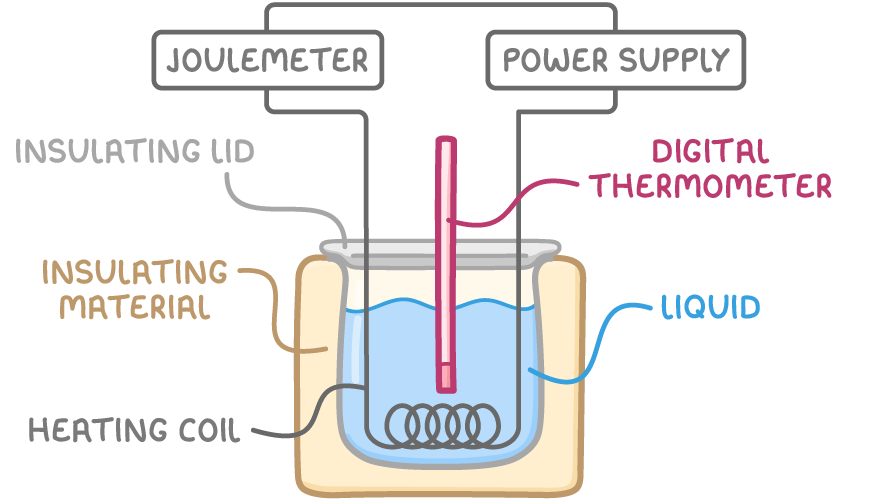
The specific heat capacity of a liquid or a solid can be found by heating a known mass with an immersion heater and measuring the energy supplied with a joulemeter.
Method (liquid)
- Measure the mass of the empty insulating container on a balance. Add the liquid and measure again - the difference is the mass of the liquid, .
- Set up the immersion heater, thermometer, and joulemeter in the liquid, with a lid on the container.
- Record the starting temperature, then switch on the heater.
- When the temperature has risen by about 10 °C, switch off the heater. Record the highest temperature reached and the energy reading on the joulemeter, .
- Calculate using the specific heat capacity equation. Repeat the experiment and calculate a mean.
Method (solid)
- Use a block of the material with two holes drilled for the immersion heater and thermometer, wrapped in an insulating layer.
- Add a little oil or water to the thermometer hole to improve thermal contact.
- After switching off the heater, wait until the temperature stops rising before recording the final temperature, allowing heat to spread through the block.
Sources of error
Some energy is lost to the surroundings rather than heating the substance:
Energy supplied = energy gained by substance + energy lost to surroundings
- Because the joulemeter measures all the energy supplied, the value calculated for is higher than the true value.
- Using a well-insulated container with a lid reduces this error.
TermDefinition
Internal energyThe total kinetic energy and potential energy of all the particles in a substance or system.
TemperatureA measure of the average kinetic energy of the particles in a substance.
Specific heat capacityThe amount of energy needed to raise the temperature of 1 kg of a substance by 1 °C.