10.4 - Thermal Expansion
Thermal expansion
- When most substances are heated, they expand. This is called thermal expansion.
- It happens in solids, liquids and gases, as long as the surrounding pressure stays the same.
Why it happens
- Heating gives the particles more energy, so they move about more and push further apart, causing the substance to expand.
- Cooling reverses this: the particles lose energy, move less, settle closer together, and the substance contracts.
Why solids, liquids and gases expand by different amounts
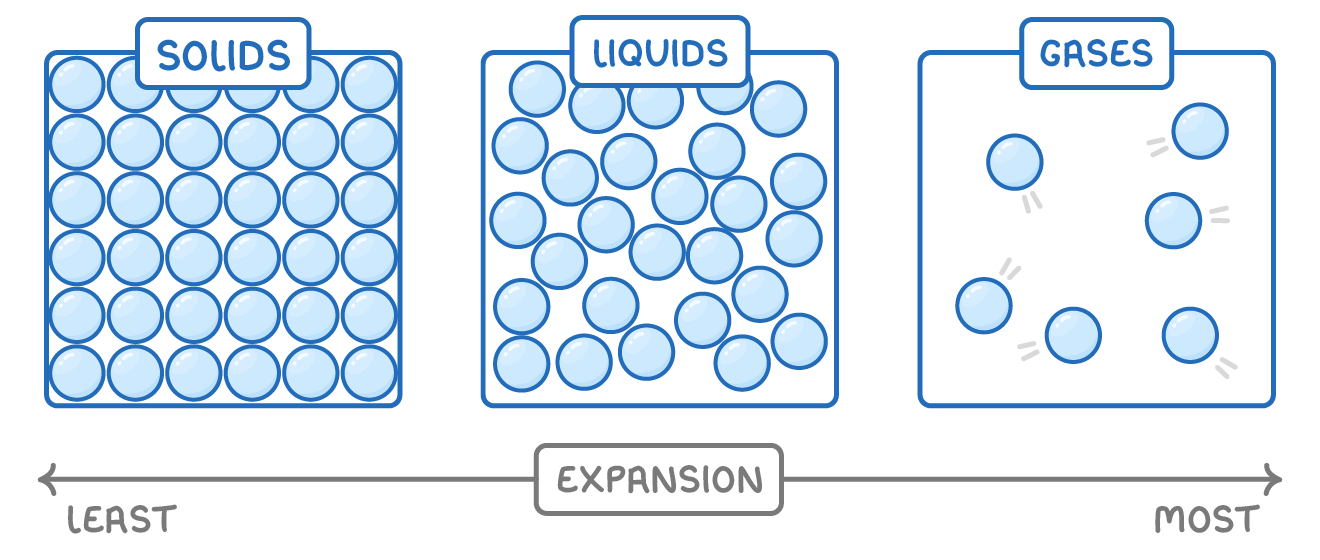
- How much a substance expands depends on the forces of attraction between its particles.
- The stronger the forces, the less the particles can move apart, so the less the substance expands.
Comparing the three states
- Solids - Have the strongest forces between particles, so they expand the least.
- Liquids - Have weaker forces than solids, so they expand more than solids.
- Gases - Have almost no forces between particles, so they expand the most.
Uses and drawbacks of thermal expansion
Rivets
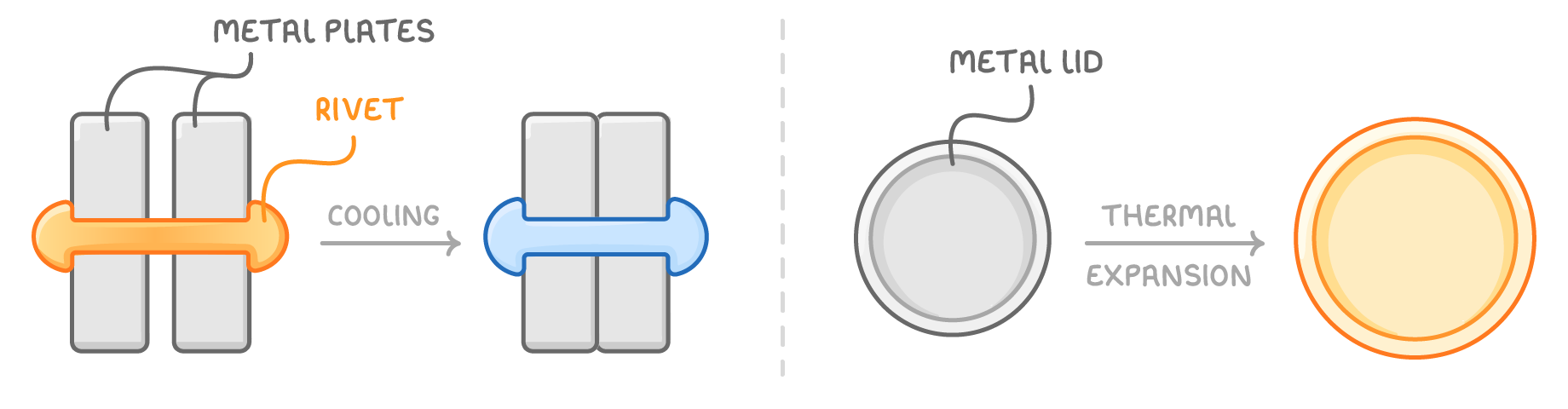
- A rivet fastens metal plates together using contraction on cooling.
- A hot metal rod is put through holes in the plates, and its ends are hammered flat.
- As the rivet cools, it contracts and pulls the plates tightly together.
Loosening a jar lid
- When a solid ring is heated, it expands and the opening in its centre gets bigger.
- Running a stuck metal jar lid under hot water causes the lid to heat up and expand, making it easier to turn.
Expansion joints
- If a structure is fixed in place when it expands, large forces build up that can damage it.
- Expansion joints leave small gaps so the material can expand into them without buckling or cracking.
Sagging power lines
- Power lines are hung with a slight sag rather than pulled tight.
- In cold weather they contract; if they were strung tight, they could snap or pull on pylons.
- In hot weather they undergo thermal expansion and sag further.
TermDefinition
Thermal expansionThe expansion of a substance when it is heated, caused by its particles moving further apart.