11.1 - Conduction, Convection, Radiation
Conduction transfers energy through vibrating particles
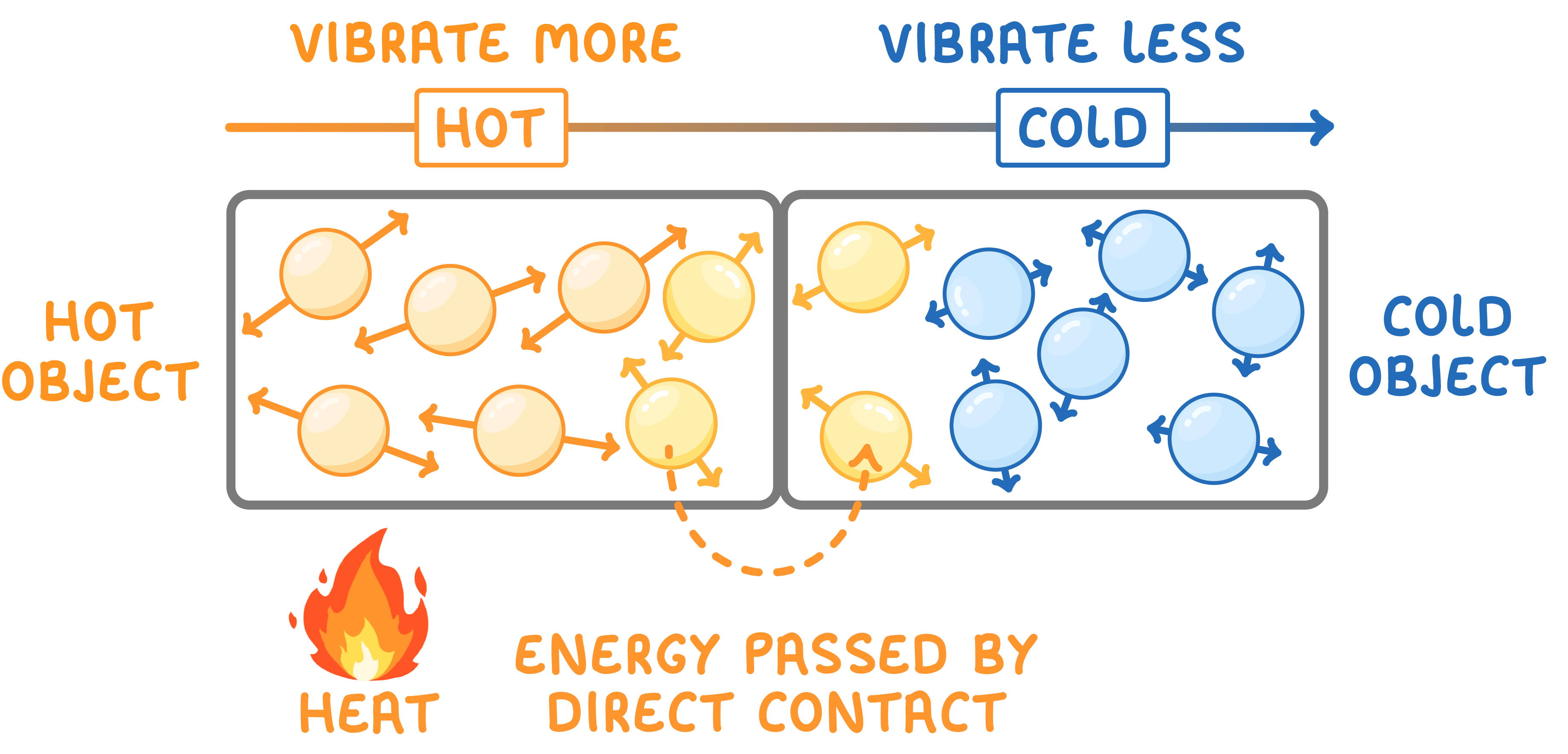
- Conduction is the way energy spreads through a material when its particles pass energy from one to the next.
- It's the main way energy is transferred by heating through solids.
How it works
- Heating one part of an object transfers energy to the kinetic energy stores of its particles, so the particles in the heated part vibrate faster.
- As they vibrate, they collide with their neighbours and pass some energy on. Those particles then vibrate faster too.
- The process carries on through the object until energy has spread to the other side, raising its temperature.
Good and bad conductors
- Thermal conductivity describes how quickly a material transfers energy this way.
- A material with high thermal conductivity transfers energy quickly and is a good thermal conductor (such as metals).
- A material with low thermal conductivity transfers energy slowly and is called a thermal insulator (such as gases, most liquids, plastic, and wood).
How conduction works at the particle level
In a solid
- The particles of a solid are held tightly together in a fixed arrangement (a lattice).
- When one particle gains energy and vibrates more, it can't move away, so it collides with the particles next to it and passes kinetic energy on.
- These lattice vibrations carry energy from the hot region towards the cooler region, particle by particle.
Why gases and most liquids conduct poorly
- In a gas, the particles are much further apart, so collisions happen far less often.
- In a liquid, the particles are only slightly further apart than in a solid, but they are not held in a fixed lattice, so vibrations are not passed on as effectively.
- Energy is passed on much more slowly, which is why these materials are poor conductors.
Why metals are the best conductors
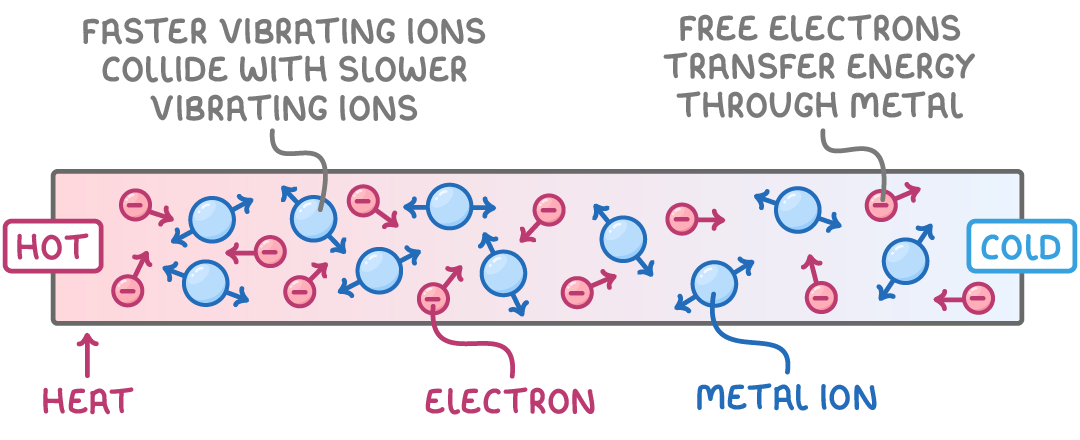
- Metals contain free (delocalised) electrons that can move throughout the structure.
- At the hot end, the free electrons gain kinetic energy and move faster.
- They travel through the metal and collide with metal ions and other electrons, transferring energy as they go.
- Because the electrons move freely and quickly, they carry energy across the metal far faster than vibrations passed between neighbouring particles.
Convection transfers energy by moving particles
- Convection is the way energy is carried through a liquid or a gas by the movement of the particles themselves.
- It can't happen in solids, because the particles are fixed in place and can only vibrate.
Why heated regions rise
- When a region of a liquid or gas is heated, its particles gain energy and move faster, spreading further apart.
- This makes the heated region expand and become less dense than the cooler material around it.
- The warmer, less dense region rises, and the cooler, denser material sinks to take its place.
How a convection current forms
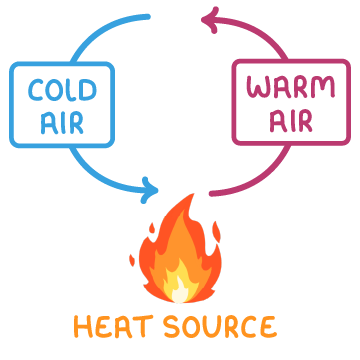
With a constant heat source, this sets up a circulation called a convection current:
- Material above the heat source warms, becomes less dense and rises.
- Cooler, denser material flows in below to replace it.
- The risen material cools, becomes denser again and sinks.
- The cycle repeats, circulating energy through the whole liquid or gas.
Radiation transfers energy by infrared waves
- Conduction and convection both need particles to carry energy - radiation does not.
- Thermal radiation is energy transferred by infrared electromagnetic waves.
- Because these waves need no particles to travel through, radiation is the only method that works through a vacuum (such as energy reaching Earth from the Sun).
Emitting and absorbing
Every object is constantly emitting and absorbing infrared radiation:
- The hotter an object is, the more radiation it emits.
- An object hotter than its surroundings emits more than it absorbs, so it cools down.
- An object cooler than its surroundings absorbs more than it emits, so it warms up.
- At a steady temperature, it emits and absorbs at the same rate.
Surfaces matter
- Matt black surfaces are the best absorbers and emitters of radiation.
- Light, shiny surfaces are poor absorbers and emitters, but are the best reflectors of radiation.
- The rate of radiation also increases with higher surface temperature and greater surface area (such as cooling fins on a device).
Demonstrating conduction, convection and radiation
Comparing conduction in different solids
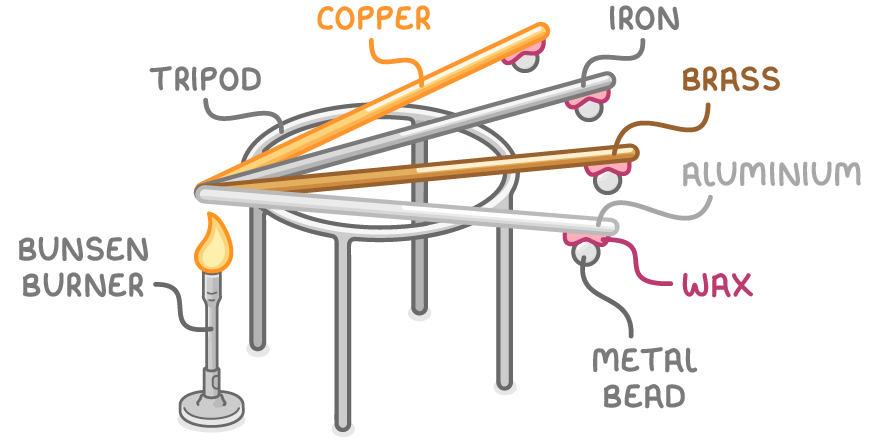
- Take rods of different materials (such as copper, iron, brass and aluminium) of equal length and diameter, with one end of each heated equally over a Bunsen burner.
- Fix a small marker (a drawing pin or bead) near the far end of each rod with wax or petroleum jelly.
- As energy travels along each rod by conduction, the wax melts and the marker falls.
- The marker on the best conductor falls first, ranking the materials by conductivity.
Tracing a convection current in a liquid
- Place a crystal of potassium manganate(VII) at the bottom of one side of a beaker of water.
- Heat the water gently directly beneath the crystal.
- As the crystal dissolves, the coloured water is carried up and around by the convection current, tracing out its path.
Showing a convection current in a gas
- In a sealed box with two chimneys and a candle below one of them, hold a smoking straw over each chimney:
- Over the chimney above the candle, smoke is carried straight up.
- Over the other chimney, smoke is drawn down into the box.
- Air heated by the candle expands, becomes less dense, and rises; cooler air is drawn down the other chimney to replace it, and the smoke traces the convection current.
Comparing absorption and emission by different surfaces
- Place two identical surfaces, one matt black and one shiny, at equal distances from a heat source: the matt black surface heats up faster, showing it's the better absorber.
- When both surfaces are heated to the same temperature, the matt black surface cools faster and emits more detectable heat, showing it's the better emitter.
- The shiny surface is the better reflector.
Everyday uses of conduction, convection and radiation
Devices that rely on one method
- A metal cooking pan - Uses conduction: metal is a good conductor, so energy applied to the base spreads quickly through it to cook food evenly.
- A toaster - Uses radiation: glowing heating elements emit infrared radiation that is absorbed by the bread.
- A radiator - Uses convection: it heats the air beside it, which rises while cooler air sinks, circulating warm air around the room.
Devices that combine methods
- A fire - Warms a room by radiation (the heat felt directly from it) and convection (hot air above it rises and sets up a current).
- A car radiator - Uses all three: conduction carries energy from the engine into the coolant and metal pipes, convection circulates the fluid, and metal fins increase the surface area to lose energy to the air by radiation and convection.
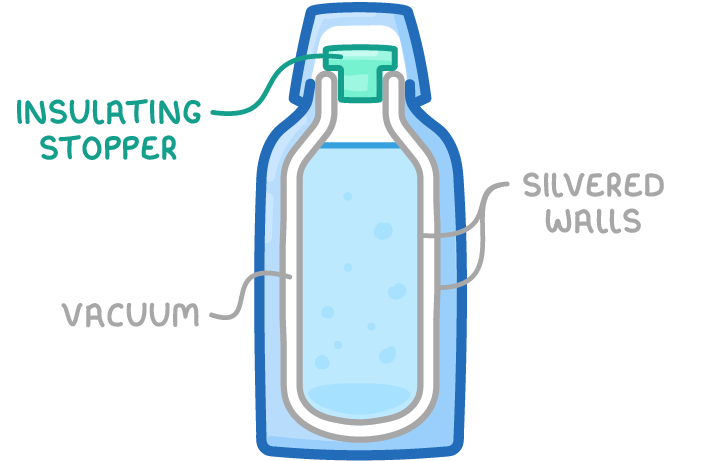
Minimising energy transfer - The vacuum flask
A vacuum flask keeps liquids hot or cold by reducing all three transfer methods:
- The vacuum between its double walls stops conduction and convection, since there are no particles to carry energy.
- The silvered walls reflect radiation back into the liquid and emit very little radiation outwards.
- The insulating stopper reduces energy transfer by conduction and convection through the top.
TermDefinition
ConductionThe transfer of energy through a material as its particles vibrate and collide with their neighbours.
Thermal conductivityA measure of how quickly a material transfers energy by conduction.
Free (delocalised) electronAn electron in a metal that is not bound to a specific atom and can move freely through the structure.
ConvectionThe transfer of energy through a liquid or gas by the movement of the particles themselves.
Convection currentA circulating flow in a fluid caused by hotter, less dense material rising and cooler, denser material sinking.
Thermal radiationThe transfer of energy by infrared electromagnetic waves.