23.4 - Solar System Formation
The accretion model of Solar System formation
- The accretion model explains how the Solar System formed from a giant cloud of gas and dust.
- Gravity is the driving force throughout: it pulls the cloud together, heats the centre enough to form the Sun, and assembles the planets.
How the Solar System formed
- The Solar System began as a large, rotating cloud of interstellar gas and dust containing heavy elements from earlier supernovae.
- Gravity pulled the material closer together.
- As the matter collapsed inwards, the cloud became denser, especially near the centre.
- The denser regions had a stronger gravitational pull, attracting more matter and becoming denser still.
- Compression raised the temperature and pressure in the densest regions.
- The centre became hot and dense enough to form a star: the Sun.
- The remaining gas and dust settled into an accretion disc orbiting the new Sun.
- The disc was hottest near the Sun and cooler further out. High temperatures vaporised lighter materials close in, leaving heavier substances near the Sun and lighter substances further out.
- Within the disc, material clumped together under gravity to form the planets.
- Heavier rocky substances formed the rocky planets near the Sun; lighter substances formed the gas planets further out.
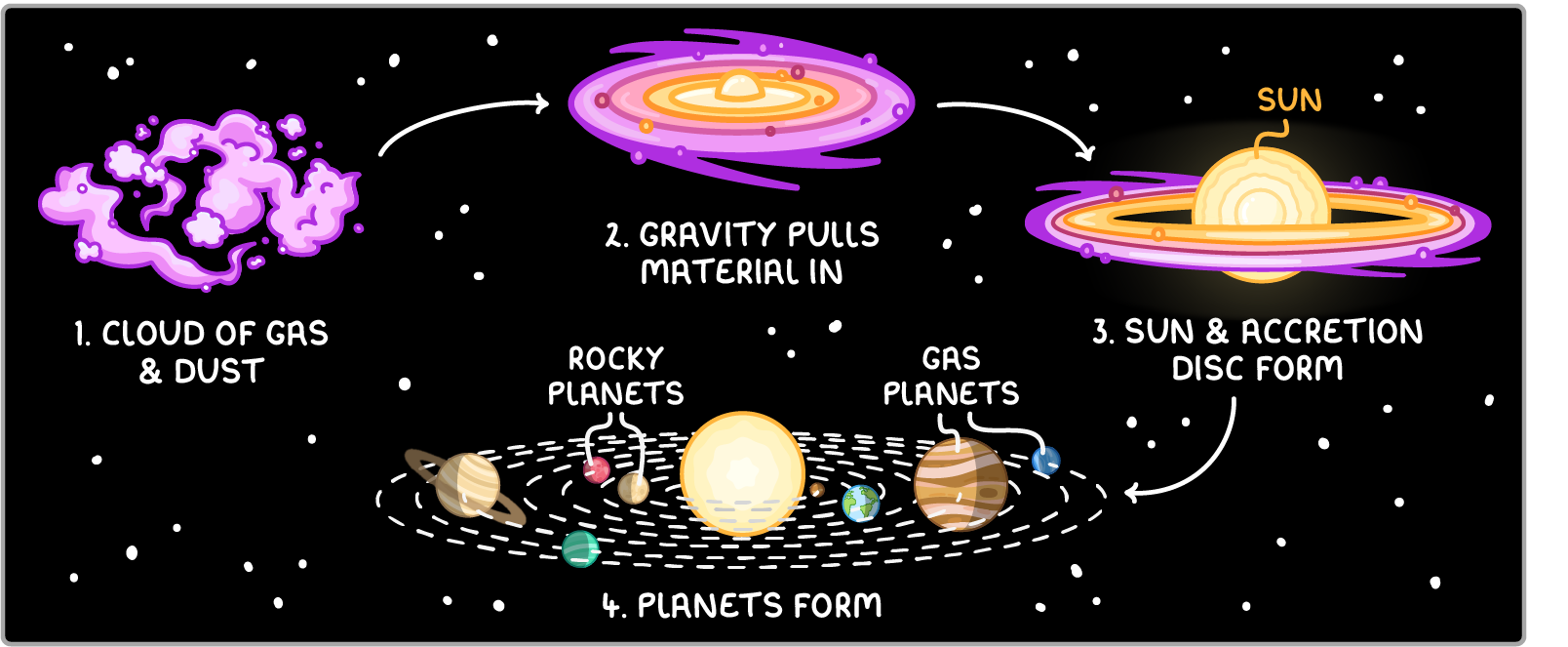
The ten steps above grouped into the four stages of the accretion model.
Gravitational field strength of a planet
- Every planet has a gravitational field around it that pulls objects towards its centre.
- Two factors determine its strength:
- Mass - A more massive planet has a stronger gravitational field at its surface.
- Distance - The field weakens as distance from the planet increases.
- Surface gravity does not depend on size alone; for planets of similar size, the one with the greater mass has the stronger surface field.
The Sun's field and orbital speed with distance
- The Sun's gravitational field holds the planets in orbit.
- The field weakens with distance, so planets further from the Sun experience a weaker gravitational pull and travel at lower orbital speeds.
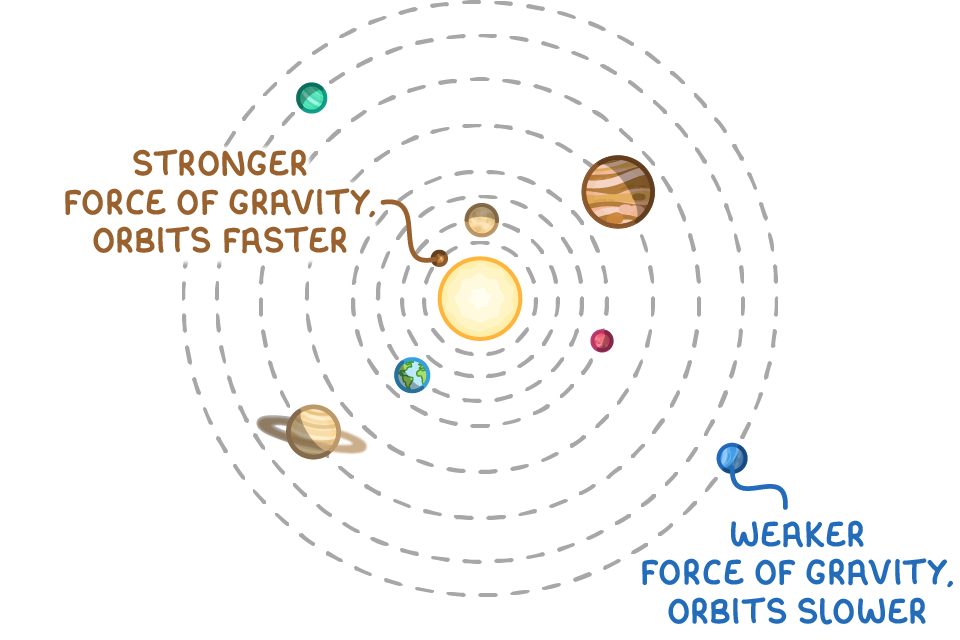
Interpreting trends in planetary data
- Planetary data shows patterns linked to a planet's average orbital radius (distance from the Sun).
- As average orbital radius increases:
- Orbital period increases - A more distant planet travels a longer path at a lower orbital speed, so it takes longer to complete an orbit.
- Density decreases - The inner planets are dense and rocky, while the outer gas planets have much lower densities.
- Surface temperature decreases - A more distant planet receives less concentrated radiation from the Sun.
Surface gravity
- Surface gravity does not follow a trend with distance from the Sun.
- The gravitational field strength at a planet's surface depends on the planet's own mass and radius, so it shows no pattern with orbital radius.
TermDefinition
Accretion modelThe model explaining how the Solar System formed from a giant cloud of gas and dust.
Accretion discA rotating disc of gas and dust orbiting a newly formed star.
Average orbital radiusA planet's average distance from the Sun.