13.3 - Investigating Refraction
Investigating refraction with a transparent block
- Apparatus - A ray box (or laser), a rectangular block of glass or other transparent material, and a protractor.
- Keep the room dim so the thin ray shows up clearly.
Method
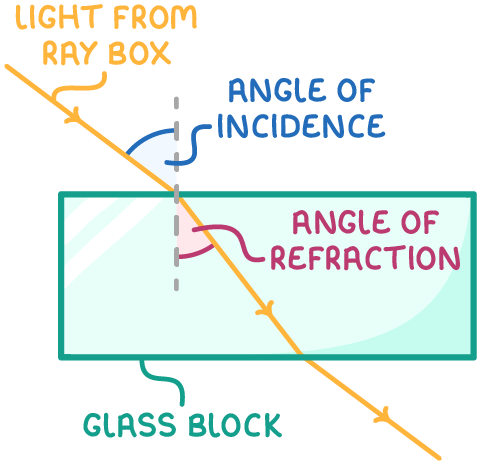
- Place the block on paper and trace around it. Shine a thin ray at the middle of one side, aimed at an angle to the surface.
- Mark the incident ray and where the ray emerges from the far side. Remove the block and join the entry and exit points with a straight line to show the refracted ray through the block.
- Draw the normal (a line at 90° to the surface) where the ray entered. Use the protractor to measure the angle of incidence (between incident ray and normal) and the angle of refraction (between refracted ray and normal).
- Repeat for a range of angles of incidence, recording the angle of refraction each time. Repeat each angle and calculate a mean to improve reliability.
- Plot a graph of angle of incidence against angle of refraction - it shows the two angles are related but not directly proportional.
- Repeat with blocks of different materials, keeping the angle of incidence the same each time.
Findings
- Entering the denser block, light slows down and bends towards the normal, so the angle of refraction is smaller than the angle of incidence.
- Leaving the block back into air, it speeds up and bends away from the normal.
- The block's two sides are parallel, so the emerging ray is parallel to the ray that entered.
- The angle of refraction differs for different materials, because light changes speed by different amounts in materials of different optical density.
TermDefinition
NormalA line drawn at right angles to a surface or boundary at the point where a ray or wave meets it. A force or pressure that acts at right angles to a surface is also said to act normal to it.
Angle of incidenceThe angle between the incident ray and the normal.
Angle of refractionThe angle between the refracted ray and the normal.
Optical densityA measure of how much a material slows down light passing through it.