23.1 - Days, Months & Seasons
The Earth's rotation causes day and night
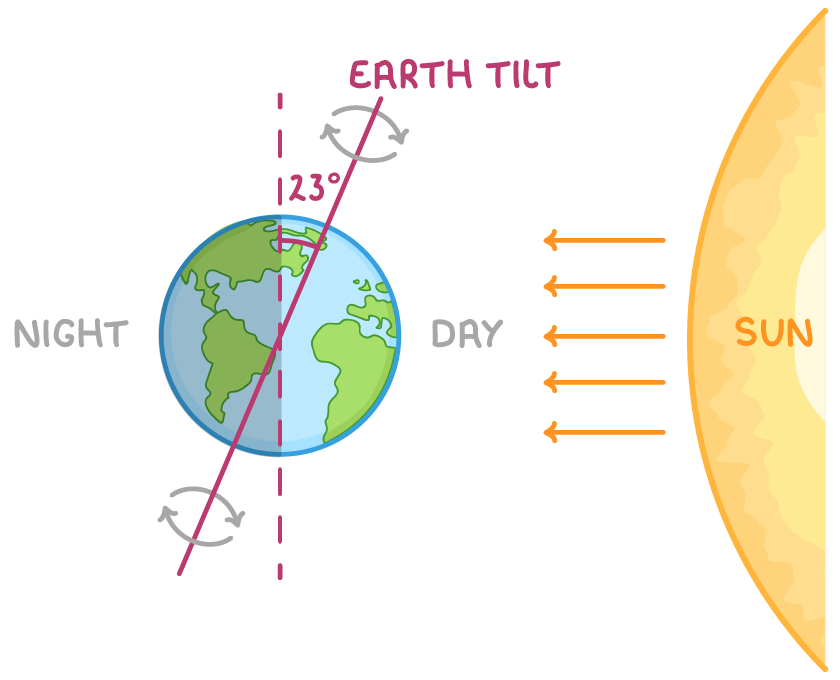
- The Earth spins on its axis - the imaginary line running through the North and South Poles.
- One complete turn about this axis takes approximately 24 hours, which defines a day.
- The Sun appears to move across the sky because the Earth's surface is turning beneath it; the Sun isn't actually moving.
Day and night
- As the Earth rotates, the side facing the Sun has daytime.
- The side facing away into shadow has night-time.
The Earth's orbit and the year
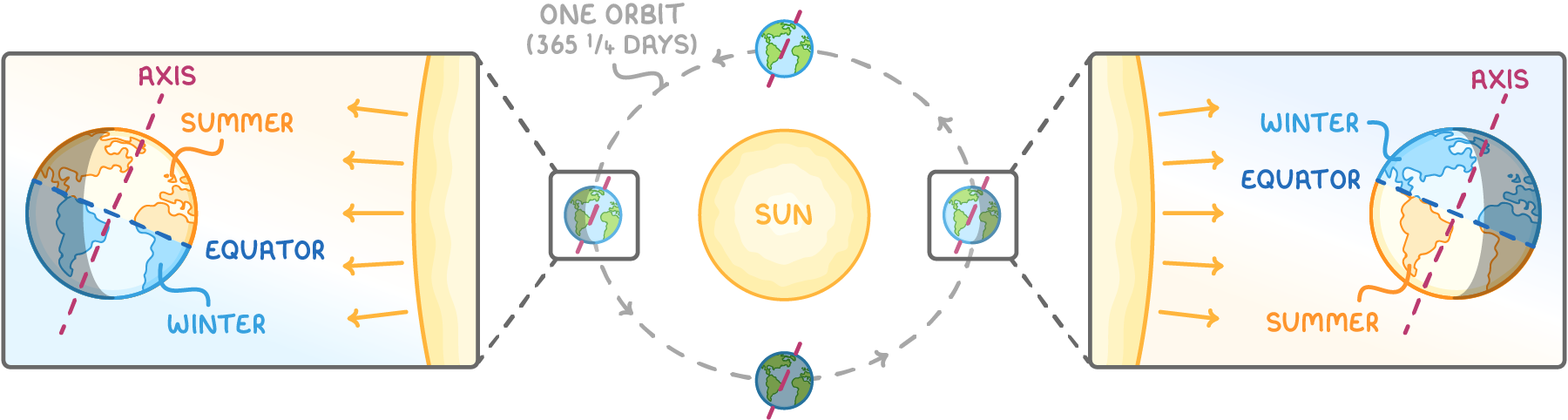
- The Earth travels in an orbit around the Sun.
- One complete orbit takes approximately 365¼ days, which defines a year.
Leap years
To account for the extra quarter-day each year, an extra day is added to the calendar every four years on the 29th of February - a leap year.
The seasons are caused by the axis tilt
- The Earth takes about 365¼ days to make one orbit of the Sun, and its axis isn't upright relative to that orbit - it's tilted.
- The seasons are caused by this tilt, not by the Earth moving closer to or further from the Sun.
Opposite seasons in the two hemispheres
- The axis stays tilted in the same direction as the Earth orbits, so the two hemispheres take turns leaning towards the Sun.
- When the northern hemisphere is tilted towards the Sun, it's summer in the north and winter in the south.
- Half an orbit later, the situation is reversed: the southern hemisphere tilts towards the Sun and has summer, while the north has winter.
Why summer and winter feel different
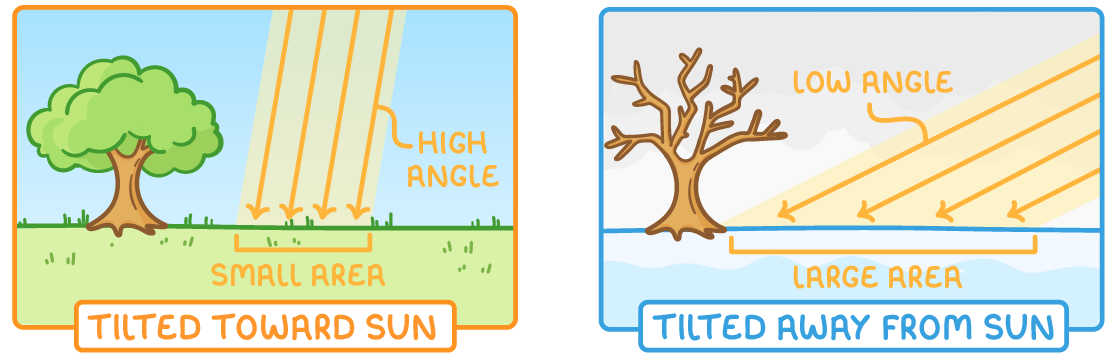
The tilt changes the heating of a hemisphere through day length and the angle of the Sun's rays.
Summer - Hemisphere tilted towards the Sun
- Days are longer than nights, so there are more hours of sunshine to warm the ground.
- The Sun is high in the sky, so its rays strike steeply and are concentrated onto a smaller area of land, causing stronger heating.
Winter - Hemisphere tilted away from the Sun
- Days are shorter than nights, so there are fewer hours of sunshine to warm the ground.
- The Sun is low in the sky, so its rays strike at a shallow angle and spread out over a larger area of land, causing weaker heating.
The Moon's orbit and phases
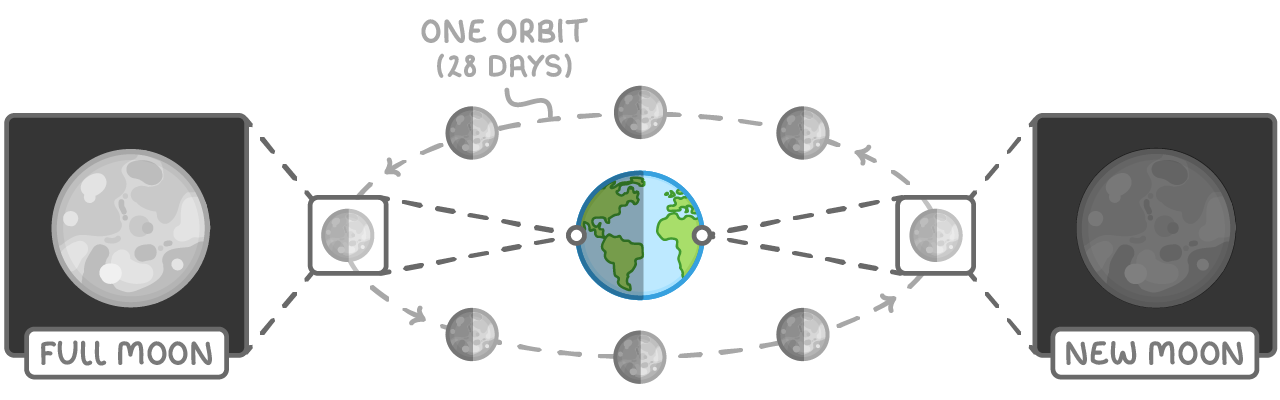
- The Moon orbits the Earth. One complete orbit takes approximately 28 days (one month).
- The Moon produces no light of its own - it's visible only because it reflects light from the Sun.
- At any moment, only the half of the Moon facing the Sun is lit; the other half is in shadow.
The phases of the Moon
- As the Moon orbits, we view its lit half from different angles, so the amount of lit surface visible from Earth changes. These shapes are the phases of the Moon.
- A full moon occurs when the entire lit half faces the Earth.
- A new moon occurs when the dark half faces the Earth.
TermDefinition
AxisThe imaginary line running through the North and South Poles that the Earth spins on.
DayThe time it takes for the Earth to complete one full rotation on its axis, which is approximately 24 hours.
YearThe time it takes the Earth to complete one full orbit of the Sun, which is about 365.25 days.
Phases of the MoonThe different shapes of the lit portion of the Moon visible from Earth as it completes its orbit.
Full moonThe phase of the Moon when its entire lit half faces the Earth.
New moonThe phase of the Moon when its dark half faces the Earth.