9.6 - Reflection & Refraction of Light
The experiment
Aim
To find the refractive index of two different transparent materials by measuring how much each of them bends a ray of light, and to find the critical angle at which light stops leaving a material altogether.
Background
- The normal is a line at 90° to a surface, at the point where a ray hits it.
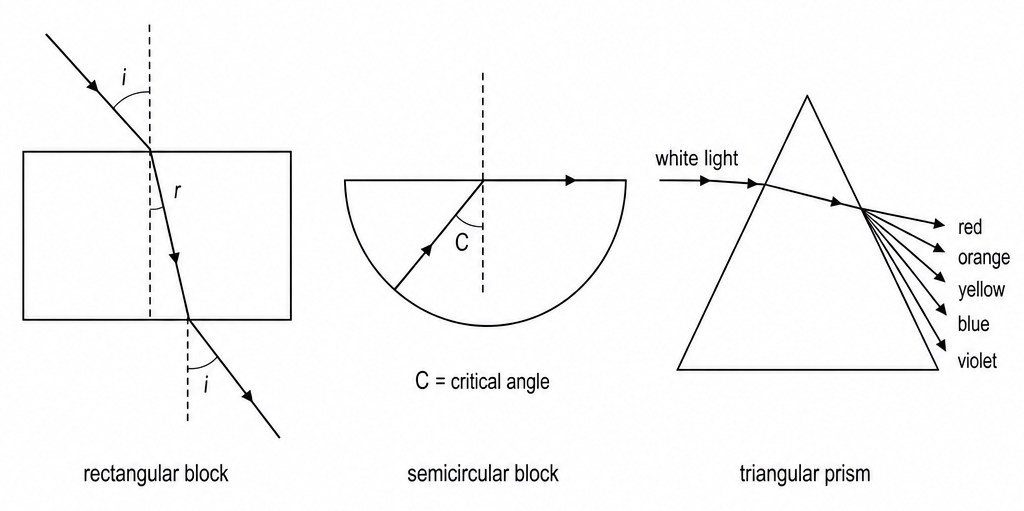
- Light slows down as it passes from air into glass, so it bends towards the normal. This is refraction. On the way out, it speeds up and bends away from the normal.
- How strongly a material bends light is its refractive index, . Snell's law links it to the angle of incidence, , and the angle of refraction, .
- A ray going from glass into air can't get out if it meets the surface at more than the critical angle, . All the light is reflected back inside, which is total internal reflection.
- You can't measure how much a material slows light, but you can measure how much it bends a ray.
- So in this practical you measure the angles to find the refractive indices of glass and Perspex, then find the critical angle and split white light with a prism.
Variables
- Independent variable - The angle of incidence, and separately, the material the ray passes into.
- Dependent variable - The angle of refraction.
- Control variables - The ray box and slit, and the position of the block on the paper.
Method - Refractive index with a rectangular block
- Set up - In reduced light, fit a narrow slit to the ray box. Draw the line for the block and the normal before putting the block down, so the normal is truly at 90°.
- Mark the rays - Stand the block on the line, and shine the ray where the normal meets it at about 20°. Mark two crosses on the ray going in and two on the ray coming out.
- Draw the path inside the block - Lift the block off, join the crosses, and join the point where the ray went in to the point where it came out. Measure both angles from the normal.
- Change the angle - Repeat for angles of incidence up to about 70°.
- Repeat with Perspex - Use a Perspex block in place of the glass one.
Method - Critical angle with a semi-circular block
- Set up - Draw round the block, and draw the normal at the middle of its straight edge.
- Increase the angle - Shine the ray through the curved side at that point, and slowly increase the angle. The ray leaving the straight edge bends further from the normal and gets dimmer.
- Find the critical angle - When the ray leaving runs along the straight edge, measure the angle of the ray going in from the normal.
Method - A triangular prism
- Split white light - Shine a narrow ray of white light through a triangular prism onto a white screen. The light spreads into colours, with violet bent most and red least.
Safety
- Hot ray box - Hold it by its base.
- Dim room - Clear bags and stools out of the way first.
- Bright light - Don't look straight into the ray.
- Prism corners - They chip easily and can be sharp.
Worked example - Refractive index and critical angle
A student shone a ray into a rectangular glass block at six angles of incidence, and measured the angle of refraction each time.
| Angle of incidence, i (°) | 20 | 30 | 40 | 50 | 60 | 70 |
|---|---|---|---|---|---|---|
| Angle of refraction, r (°) | 13 | 19 | 25 | 31 | 35 | 39 |
The same experiment with a Perspex block gave a graph with a gradient of 1.49. Measuring the critical angle of the glass directly, with a semi-circular block, gave 41°.
Find the refractive index and the critical angle of the glass, and compare the glass with Perspex.
Step 1 - Find the refractive index from one pair
Take i = 40° and r = 25°, and use Snell's law.
Step 2 - Find the refractive index from a graph
Work out sin i and sin r for every pair.
| sin i | 0.342 | 0.500 | 0.643 | 0.766 | 0.866 | 0.940 |
|---|---|---|---|---|---|---|
| sin r | 0.225 | 0.326 | 0.423 | 0.515 | 0.574 | 0.629 |
Plot sin i on the y-axis against sin r on the x-axis, and draw a line of best fit through the origin. It passes through (0.600, 0.900), so its gradient is 0.900 ÷ 0.600 = 1.50. This uses all six readings, so a random error in any one pair has less effect.
Step 3 - Compare glass with Perspex
Perspex's gradient of 1.49 is very close to the glass's 1.50, so the two materials bend light by almost the same amount.
Step 4 - Work out the critical angle
Use n = 1.50 from the graph.
Step 5 - Check against the direct measurement
The semi-circular block gave 41°, within 1° of the calculated 42°. So the two agree, within the uncertainty of the measurement.
Common exam questions
Question 1
Light passes from air into water, which has a refractive index of 1.33, at an angle of incidence of 30°. Calculate the angle of refraction.
Rearranging Snell's law, sin r = sin i ÷ n = sin 30° ÷ 1.33 = 0.500 ÷ 1.33 = 0.376. So r = 22°.
Question 2
Why is sin i plotted against sin r, rather than i against r?
Snell's law says sin i = n × sin r, so a graph of the sines is a straight line through the origin with the refractive index as its gradient. A graph of the angles is a curve.
Question 3
Why is the ray aimed at the middle of the straight edge, through the curved side of a semi-circular block?
It travels along a radius, so it meets the curved surface at 90° and passes in without bending. The angle you set is then the angle inside the block.
Question 4
Explain why a triangular prism splits white light into colours.
Each colour in white light travels at a slightly different speed in glass, so each is refracted by a slightly different amount and leaves along a different path.